


Taipei Mayor Ko Wen-je (柯文哲), if he runs for president in 2020, might have a similar magnitude of influence as People First Party Chairman James Soong (宋楚瑜), who nearly won the 2000 presidential election as an independent candidate, Taiwanese Public Opinion Foundation chairman You Ying-lung (游盈隆) said yesterday.
In a radio interview, You commented on Ko’s rising popularity and his potential candidacy.
“Ko might well be the next James Soong judging from the structure of his support base,” You said.

Photo: CNA
Soong, who entered the 2000 race as an independent after losing the Chinese Nationalist Party’s (KMT) presidential nomination to then-vice president Lien Chan (連戰), was then expelled from the KMT and the party accused him of embezzling millions of US dollars from it in what became known as the Chung Hsing Bills Finance scandal.
Soong lost the election to the Democratic Progressive Party’s (DPP) candidate, Chen Shui-bian (陳水扁), by 312,805 votes, but beat Lien by more than 1.7 million votes.
Ko enjoys a degree of popularity similar to Soong’s ahead of the 2000 race and is the nation’s favorite politician, surpassing Premier William Lai (賴清德), You said.
A foundation opinion poll released on Sunday found that Ko scored 66.75 on the “feeling thermometer,” which is gauged between zero and 100, compared with Lai’s 63.44.
However, it remains to be seen if Ko can match Soong’s political influence, You said.
Soong, as a former Taiwan Province governor, had the support of the provincial government and he had built up local political networks loyal to him through decades of effort, You said.
“A fast-rising star like Ko Wen-je might not have the same degree of local support James Soong had,” You said.
Increasing tension between Ko and the DPP is evidence that it finds his popularity threatening, You said.
DPP lawmakers have signed a petition urging the party to nominate its own candidate for next year’s Taipei mayoral election, which it did not do in the 2014 election, and DPP Legislator Cheng Pao-ching (鄭寶清) on Monday accused Ko of trying to curry favor with Beijing and turning voters against the DPP.
“It is the ‘Godzilla’ phenomenon. [Ko has become] a powerful monster that frightens all and provokes attack,” You said.
For people outside the political sphere, Ko’s straightforward manner makes him appear unpretentious and his criticism of the DPP administration’s unpopular policies, such as the Forward-looking Infrastructure Development Program and pension reforms, have aligned him with the public, You said.
The recent Cabinet reshuffle has shown disappointed supporters that President Tsai Ing-wen (蔡英文) can make wise decisions at critical moments, You said, pointing to Sunday’s poll that found her approval rating boosted by 16.6 percentage points to 46.4 percent.
Tsai approved of the unpopular workweek policy, but the new Cabinet must now amend it because employers and employees do not like it, You said.
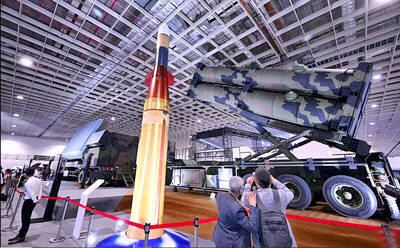
Taiwan is to commence mass production of the Tien Kung (天弓, “Sky Bow”) III, IV and V missiles by the second quarter of this year if the legislature approves the government’s NT$1.25 trillion (US$39.78 billion) special defense budget, an official said yesterday. Commenting on condition of anonymity, a defense official with knowledge of the matter said that the advanced systems are expected to provide crucial capabilities against ballistic and cruise missiles for the proposed “T-Dome,” an advanced, multi-layered air defense network. The Tien Kung III is an air defense missile with a maximum interception altitude of 35km. The Tien Kung IV and V
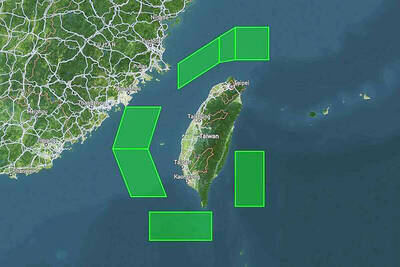
The disruption of 941 flights in and out of Taiwan due to China’s large-scale military exercises was no accident, but rather the result of a “quasi-blockade” used to simulate creating the air and sea routes needed for an amphibious landing, a military expert said. The disruptions occurred on Tuesday and lasted about 10 hours as China conducted live-fire drills in the Taiwan Strait. The Civil Aviation Administration (CAA) said the exercises affected 857 international flights and 84 domestic flights, affecting more than 100,000 travelers. Su Tzu-yun (蘇紫雲), a research fellow at the government-sponsored Institute for National Defense and Security Research, said the air
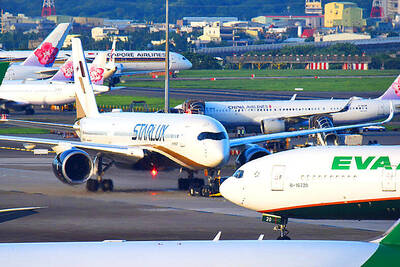
Trips for more than 100,000 international and domestic air travelers could be disrupted as China launches a military exercise around Taiwan today, Taiwan’s Civil Aviation Administration (CAA) said yesterday. The exercise could affect nearly 900 flights scheduled to enter the Taipei Flight Information Region (FIR) during the exercise window, it added. A notice issued by the Chinese Civil Aviation Administration showed there would be seven temporary zones around the Taiwan Strait which would be used for live-fire exercises, lasting from 8am to 6pm today. All aircraft are prohibited from entering during exercise, it says. Taipei FIR has 14 international air routes and
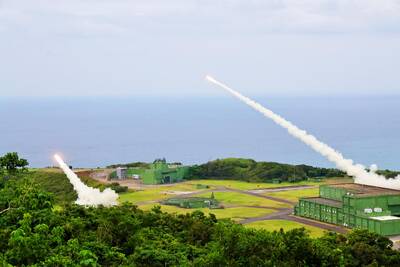
Taiwan lacks effective and cost-efficient armaments to intercept rockets, making the planned “T-Dome” interception system necessary, two experts said on Tuesday. The concerns were raised after China’s military fired two waves of rockets during live-fire drills around Taiwan on Tuesday, part of two-day exercises code-named “Justice Mission 2025.” The first wave involved 17 rockets launched at 9am from Pingtan in China’s Fujian Province, according to Lieutenant General Hsieh Jih-sheng (謝日升) of the Office of the Deputy Chief of the General Staff for Intelligence at the Ministry of National Defense. Those rockets landed 70 nautical miles (129.6km) northeast of Keelung without flying over Taiwan,


 RSS
RSS