


Indonesia is to mark the 72nd anniversary of its independence from Dutch colonial rule on Thursday, and a group of Taiwanese has been recognized for contributing to the cause.
Li Po-ching (李柏青), whose Japanese name was Eiji Miyahara, was born in 1922 in Tainan, when Taiwan was under Japanese colonial rule.
More than 70 years ago, he volunteered for the Japanese Army and was posted to Indonesia during the Second World War.
At the end of the war, approximately 900 remnants of the Japanese Imperial Army, including Li, joined local Indonesian guerrilla fighters, providing weapons, supplies and training to expel the Dutch colonial government.
Over half of them were killed or went missing for the cause.
The Indonesian War of Independence took place between 1945 and 1949 between Indonesia and the Netherlands, which was then the occupying colonial administration.
After independence, Li and approximately 300 of his comrades decided not to return to Japan, but to stay in Indonesia.
In 2005, Li was invited to attend a ceremony to mark the 60th anniversary of Indonesian independence and was awarded a hero’s medal by then-President Susilo Bambang Yudhoyono for his dedication and service in the war, making him the first foreigner to receive such an honor.
He died on Oct. 16, 2013, at the age of 93 and received a hero’s burial at the Kalibata Heroes’ Cemetery in Jakarta.
While Li was alive, he founded the Yayasan Warga Persahabatan foundation to promote friendship between Indonesia and Japan.
Poppy, a worker at the foundation, spoke highly of Li, referring to him as kind, not a man of many words, and someone who never forgot his roots.
Poppy said that even though Li conversed with everyone in Indonesian, he taught his children to be fluent in Chinese.
Li’s foundation has had many visitors from Taiwan and has also received Japanese Prime Minister Shinzo Abe three times when he came to pay his respects.
In an earlier interview with Li, he said he was concerned that he might be imprisoned when he made a trip to Taiwan in 1974, when the nation was still under martial law, as he had also fought in the Japanese army against the Chinese Nationalist revolutionary army in Myanmar.
Li left Taiwan in a hurry after a brief meeting with his parents.
Li’s grandson, Jevan Purnawan said that his grandfather often told him stories of the war and was proud of fighting in the Indonesian War of Independence.
Another Taiwanese contribution that was recognized was that of Chen Chih-hsiung (陳智雄), who was referred to as a “national guest” by the first president of Indonesia, Sukarno.
He was also dispatched to the Dutch East Indies by the Japanese foreign ministry during the Second World War.
Chen stayed in Indonesia after the war and sided with Sukarno by helping to arm Indonesian fighters, for which he was imprisoned by the Dutch colonial administration for approximately a year.
After Indonesian independence, Sukarno granted him honorary citizenship.
Chen went back to Taiwan, but was imprisoned in 1962 by the Taiwan Garrison Command and executed in 1963 for his involvement in promoting Taiwan independence.
His daughter, Vonny Chen (陳雅芳), who grew up in Indonesia, said she only learnt about the stories of her father’s fight for democracy when she came to Taiwan in March 2013 to attend a commemorative event held for her father.

REASONS FOR TRAVEL: An assistant professor said that proposed amendments to penalize drivers if they used drugs overseas would not deter people from traveling People who operate a motor vehicle under the influence of marijuana would have their driver’s license revoked, even if they used the substance while overseas, the Ministry of Transportation and Communications said yesterday, citing proposed amendments to the Road Traffic Management and Penalty Act (道路交通管理處罰條例). The amendments would also authorize the government to revoke the licenses of people determined to have used Category 1 or Category 2 narcotics, even if they were not operating a vehicle while under the influence of drugs, as well as ban them from taking the license test for three years, the ministry said. People aged 18 or

GLOBALGIVING: ‘ Caving to external pressure is not acceptable for an organization that has cultivated justice reform and human rights for 30 years,’ one NGO said A slew of non-government organizations (NGOs) have withdrawn from the GlobalGiving fundraising platform after it announced it would use “Chinese Taipei” instead of “Taiwan” from next month. The Taiwan Good Rice Association wrote on Facebook on Friday that it was informed on April 28 via a teleconference call of the change, which was made because the platform wanted to operate in China. Taiwan Good Rice is to terminate all cooperative relationships with GlobalGiving in response to the platform’s “unilateral and non-negotiable” decision to remove references to Taiwan, the NGO said. “Taiwan is in the official name of Taiwan Good Rice Association and the

HEAVY WEATHER: Typhoon Jangmi is due to crash straight into the Ryukyus as airlines look to shift flights to larger aircraft or cancel flights to Okinawa entirely Taiwan’s international air carriers announced flight adjustments over the weekend as Typhoon Jangmi is forecast to hit the Ryukyu Islands today and tomorrow. The Central Weather Administration (CWA) upgraded Jangmi from a tropical storm to a typhoon at 8am yesterday, with the eye located 580km south of Naha city. It was moving north at 19kph. Today, China Airlines’ CI-120, CI-121, CI-122 and CI-123 flights between Taoyuan and Naha, Okinawa, have been canceled as well as CI-132 and CI-133 between Kaohsiung and Naha. EVA Air’s BR-112, BR-113, BR-186 and BR-185 flights between Taoyuan and Naha are also canceled. Low-cost carrier Tigerair Taiwan canceled IT-230,
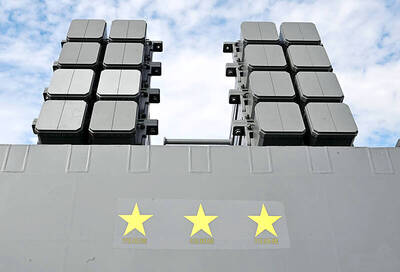
UPGRADE: The Kang Ding-class frigate is replacing its Chaparall missiles with Tien Chien II and Hua Yang VLS, which would provide it with long-range, 360° air defense Taiwan plans to produce 1,200 to 1,376 Hai Chien II missiles (海劍二, Sea Sword II) — also known as TC-2N — to serve as the standard air defense system of the navy’s surface combatant fleet, a source said yesterday. Last week, the Hai Chien II, the naval version of the Tien Kung II missile (天劍二, Sky Sword II), completed a live-fire test in waters off the National Chungshan Institute of Science and Technology’s Jiupeng facility (九鵬) in Pingtung County’s Manjhou Township (滿州). The MIM72 Chaparral and other dated air defense missiles that currently arm Taiwanese ships have inadequate range to combat Chinese


 RSS
RSS