


Hong Kong-based Next Digital Ltd (壹傳媒), the group that owns Taiwan’s Chinese-language Next Magazine (壹週刊) and Apple Daily (蘋果日報) newspapers, yesterday temporarily suspended trading in Hong Kong after the company was reportedly finalizing the sale of Next Magazine and other publications in the group.
According to the Hong Kong edition of the Apple Daily, Next Digital chief executive officer Cheung Ka-sing (張嘉聲) announced in a meeting with employees at 11am yesterday that the group had accepted W Brothers Investment Ltd’s offer of HK$500 million (US$6.4 million) to purchase both the Hong Kong and Taiwan editions of Next Magazine, as well as three others in the group.
The entire transaction is scheduled to be completed by September, Cheung added.
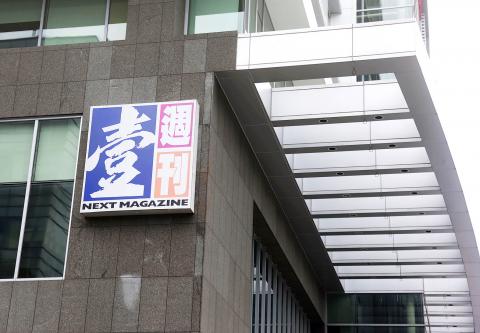
Photo: CNA
The Apple Daily in Taiwan and Hong Kong are not included in the deal, Cheung said.
The investment firm is owned by Hong Kong businessman Kenny Wee (黃浩), Cheung said, adding that the deal secured firm support from the group’s largest shareholder and chairman, Jimmy Lai (黎智英).
The group also issued a written statement to its employees explaining the sale.
“In the past few years, we have seen the transition of news media from print to digital. This is an irresistible trend… The decision to sell Next Magazine is a crucial part of the group’s plan for transformation, and the transaction shows that the transformation is basically complete,” the group said in a statement.
The group also said that it has reached an agreement with the buyer, who has promised to continue investing in Next Magazine and allow reporters who wish to continue working for the magazine to develop their talents.
“The buyer’s proposal is in sync with the group’s strategies for development,” Lin said.
As of March 31, Next Digital reported an operating loss of HK$393 million this year due to shrinking advertising revenue in Taiwan and Hong Kong, employee layoffs and restructuring of the group’s publications.
Operation of the Taiwan edition of Next Magazine was under scrutiny last year as its former managing editor, Pei Wei (裴偉), who contributed greatly to the rise of the magazine in Taiwan, chose to leave.
He and several former Next Magazine reporters later launched Mirror Media, which has become Next Magazine’s main competitor.
Management at the Apple Daily also reportedly considered changing its operations and encouraged reporters to take generous severance packages to become freelancers and continue writing for Apple Daily.
In Taiwan, Next Digital would have to secure approval from the Investment Commission of the Ministry of Economic Affairs, as the deal would involve a withdrawal of one foreign investor and an entry of a new foreign investor in the same company.
Taiwan does not allow Chinese individuals to invest in or purchase media outlets, the commission said, adding that the transaction would be disallowed if the funding comes from Chinese investors.
However, the commission said that it would have to wait until the application for transfer of ownership to understand the shareholder structure, which would be jointly reviewed by the Ministry of Culture and National Security Bureau.

FUKUOKA SITUATION: Japanese media reported that the pathogen is expected to be identified by the summer, while the CDC downplayed the idea that it was hMPV A “mysterious cold-like illness” reported in Japan’s Fukuoka Prefecture does not seem to be a new disease, but Japanese authorities have been asked about the situation, the Centers for Disease Control (CDC) said yesterday. The Fukuoka Prefectural Medical Association on Wednesday told a news conference that a “mystery cold” that has become a hot topic on social media is “highly likely to be caused by some kind of viral infection,” Japan’s KBC News reported. “Many people are experiencing symptoms starting with a sore throat, followed by a runny nose, phlegm and a severe cough,” KBC News reported, citing association officials. Health authorities are

Nvidia Corp CEO Jensen Huang (黃仁勳) arrived in Taiwan yesterday ahead of upcoming AI and technology events, saying he plans to meet with clients and Taiwan Semiconductor Manufacturing Co Chairman C.C. Wei (魏哲家) during his visit. After landing at Taipei Songshan Airport, Huang posed for photos with fans and handed out Yakult drinks to reporters and supporters waiting at the scene, saying he has “a lot to do” during the trip. Asked about reports that Nvidia’s planned headquarters site in Taipei’s Beitou Shilin Technology Park could break ground on May 27, Huang said that if the company holds an event, he would

The Ministry of Finance this afternoon announced the winning numbers for the March-April uniform invoice lottery. The winning number for the NT$10 million (US$318,060) special prize is 19531471, and the winning number for the NT$2 million grand prize is 85941329. Three numbers were drawn for the NT$200,000 first prize: 07225810, 20231230 and 83518781. Those with receipts matching the last seven digits of any of the first-prize numbers will win the NT$40,000 second prize, while those matching the last six digits will win the NT$10,000 third prize. Those whose receipts match the last five digits of the first-prize numbers can claim the NT$4,000 fourth prize,
Taiwan Travelogue (臺灣漫遊錄), which earlier this week became the first Taiwanese novel to win the International Booker Prize, is to be adapted into a television series through a Taiwan-Japan coproduction, producer Chang Chen-yu (張辰漁) said yesterday. Chang, a producer at World Softest Production Film Co, wrote on Facebook that the company had been searching for projects with international appeal that retain a strong Taiwanese identity after colleagues and Japanese partners strongly recommended the novel. After reading the book, Chang said he immediately decided to pursue the screen rights. “A great story has the power to transcend time and borders, and connect countless people,”


 RSS
RSS