


A statue of Japanese hydraulic engineer Nobuhei Torii, which stands beside an irrigation waterway in Pingtung County’s Chunrih Township (春日), was unveiled at a ceremony yesterday, with his grandson, Toru Torii, in attendance.
In the 1920s, Nobuhei Torii built the Er-feng Waterway, which irrigates about 3,000 hectares of farmland, in the county’s Laiyi Township (來義).
Chi Mei Corp founder Hsu Wen-long (許文龍) commissioned five statutes in Nobuhei Torii’s memory, one of which he gave to Chunrih Mayor Ko Chih-chiang (柯自強) about six months ago.
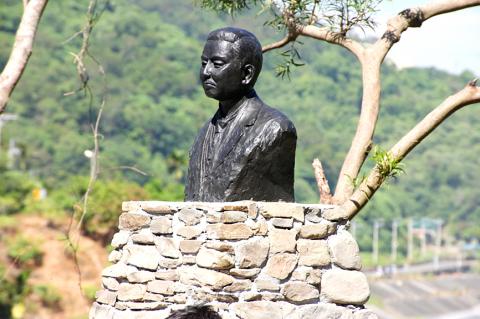
Photo: Chen Yen-ting, Taipei Times
The township’s plan to install the 290cm-tall statue was affected by the vandalism of Japanese engineer Yoichi Hatta’s statue in Tainan, Ko said, referring to an incident in April in which the statue of Hatta, who is called the “father of the Chianan irrigation system” for his contributions to irrigation in the Chianan Plain in the south by building the Wushantou Reservoir, was decapitated.
The Er-feng Waterway had been registered as a national cultural landscape, but the designer of another waterway beside the Lili Brook in Chunrih remains unknown, said Ting Che-shih (丁澈士), dean of College of Engineering at National Pingtung University of Science and Technology.
Nonetheless, Ting said he believes Nobuhei Torii was the designer of both waterways, given their similar designs and time of construction.
Military confidentiality might be the reason behind the designer’s anonymity, he added.
The township’s water source was highly prized during World War II, when a Japanese army command headquarters with about 20,000 soldiers was stationed there, he said.
At yesterday’s ceremony, nine mayors of the county’s aboriginal townships, including Chunrih, signed an agreement vowing to protect the water source.
The statue and agreement are meant to highlight the efforts of ancient people in building the waterways, Ko said, adding that an explanation placard for the statue would be installed soon.

South Korea is planning to revise its controversial electronic arrival card, a step Taiwanese officials said prompted them to hold off on planned retaliatory measures, a South Korean media report said yesterday. A Yonhap News Agency report said that the South Korean Ministry of Foreign Affairs is planning to remove the “previous departure place” and “next destination” fields from its e-arrival card system. The plan, reached after interagency consultations, is under review and aims to simplify entry procedures and align the electronic form with the paper version, a South Korean ministry official said. The fields — which appeared only on the electronic form

A bipartisan group of US senators has introduced a bill to enhance cooperation with Taiwan on drone development and to reduce reliance on supply chains linked to China. The proposed Blue Skies for Taiwan Act of 2026 was introduced by Republican US senators Ted Cruz and John Curtis, and Democratic US senators Jeff Merkley and Andy Kim. The legislation seeks to ease constraints on Taiwan-US cooperation in uncrewed aerial systems (UAS), including dependence on China-sourced components, limited access to capital and regulatory barriers under US export controls, a news release issued by Cruz on Wednesday said. The bill would establish a "Blue UAS

More than 6,000 Taiwanese students have participated in exchange programs in China over the past two years, despite the Mainland Affairs Council’s (MAC) “orange light” travel advisory, government records showed. The MAC’s publicly available registry showed that Taiwanese college and university students who went on exchange programs across the Strait numbered 3,592 and 2,966 people respectively. The National Immigration Agency data revealed that 2,296 and 2,551 Chinese students visited Taiwan for study in the same two years. A review of the Web sites of publicly-run universities and colleges showed that Taiwanese higher education institutions continued to recruit students for Chinese educational programs without
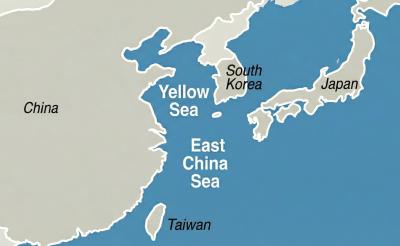
China has reserved offshore airspace in the Yellow Sea and East China Sea from March 27 to May 6, issuing alerts usually used to warn of military exercises, although no such exercises have been announced, the Wall Street Journal (WSJ) reported yesterday. Reserving such a large area for 40 days without explanation is an “unusual step,” as military exercises normally only last a few days, the paper said. These alerts, known as Notice to Air Missions (Notams), “are intended to inform pilots and aviation authorities of temporary airspace hazards or restrictions,” the article said. The airspace reserved in the alert is


 RSS
RSS