


Two Taiwanese were among the top-prize winners of a photography contest held by the National Museum of Natural Science in Taichung, with the first prize going to a photograph of a glass lizard protecting its eggs.
The museum accepted 400 entries from Taiwan, Hong Kong, Malaysia and China, and an exhibition of the top 62 finalists opened on Sunday at the museum.
First prize was awarded to Huang Fu-hseng (黃福盛) of Da Yeh University because glass lizards are rarely seen.
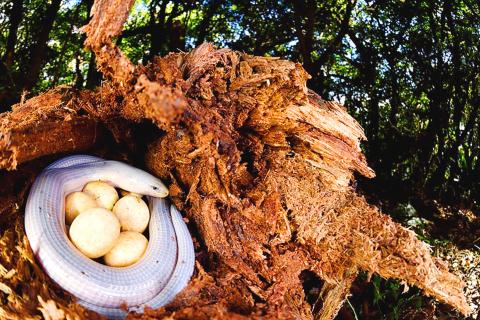
Photo: Screengrab by Tsai Shu-yuan, Taipei Times
Huang’s photograph also captured the female lizard before she molted, as the lizard’s skin is white, the museum said.
Most species of glass lizards do not have legs and are often mistaken for snakes.
The second-pace prize was also awarded to a Taiwanese for an image demonstrating the tension that holds water droplets together, made by spraying water onto a dandelion on black glass using an atomizer.
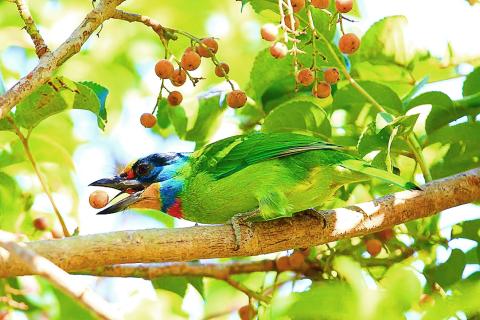
Photo: Screengrab by Tsai Shu-yuan, Taipei Times
The background created the visual effect of the droplets being in space, museum officials said.
The photography process was like living art as the water droplets continuously grew larger from the water from the atomizer, they said, adding that the droplets grew for 30 minutes before bursting.
Quanta Culture and Education Foundation sponsored the top two prizes. The company said it hopes to encourage young people to explore scientific photography.
Among the other top photos was one taken by a family that shows a Taiwan barbet gathering food, while one by 11-year-old Li Haoming (李浩銘) of China shows the profile of a spectacled caiman as a swarm of mosquitoes feed from the blood vessels near its eye sockets.
Curator Yang Ling (楊翎) said that although a photograph represents just an instant in time, there is a significant amount of planning, setup and experimentation involved before the image is captured.
The exhibit showcases photographs from a variety of subjects including space, molecular biology, astronomy, physics, chemistry and medicine, Yang said.
The exhibition will run until Jan. 7 next year.
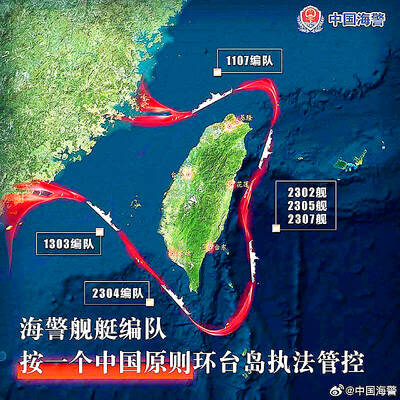
Taiwan would benefit from more integrated military strategies and deployments if the US and its allies treat the East China Sea, the Taiwan Strait and the South China Sea as a “single theater of operations,” a Taiwanese military expert said yesterday. Shen Ming-shih (沈明室), a researcher at the Institute for National Defense and Security Research, said he made the assessment after two Japanese military experts warned of emerging threats from China based on a drill conducted this month by the Chinese People’s Liberation Army’s (PLA) Eastern Theater Command. Japan Institute for National Fundamentals researcher Maki Nakagawa said the drill differed from the
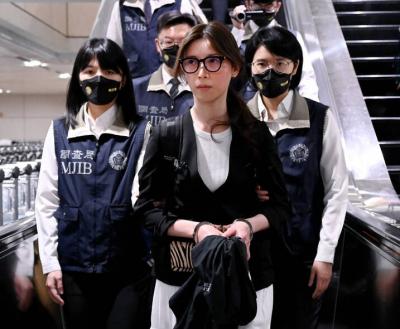
A fugitive in a suspected cosmetic surgery fraud case today returned to Taiwan from Canada, after being wanted for six years. Internet celebrity Su Chen-tuan (蘇陳端), known as Lady Nai Nai (貴婦奈奈), and her former boyfriend, plastic surgeon Paul Huang (黃博健), allegedly defrauded clients and friends of about NT$1 billion (US$30.66 million). Su was put on a wanted list in 2019 when she lived in Toronto, Canada, after failing to respond to subpoenas and arrest warrants from the Taipei District Prosecutors’ Office. Su arrived at Taiwan Taoyuan International Airport at 5am today on an EVA Air flight accompanied by a
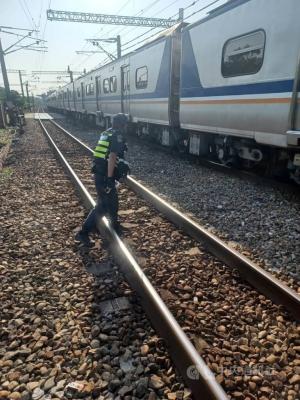
A 79-year-old woman died today after being struck by a train at a level crossing in Taoyuan, police said. The woman, identified by her surname Wang (王), crossed the tracks even though the barriers were down in Jhongli District’s (中壢) Neili (內壢) area, the Taoyuan Branch of the Railway Police Bureau said. Surveillance footage showed that the railway barriers were lowered when Wang entered the crossing, but why she ventured onto the track remains under investigation, the police said. Police said they received a report of an incident at 6:41am involving local train No. 2133 that was heading from Keelung to Chiayi City. Investigators
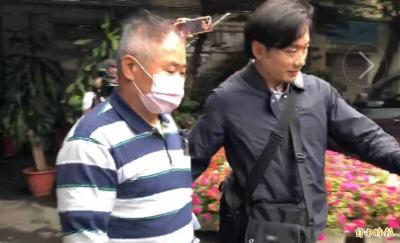
The Keelung District Prosecutors’ Office today requested that a court detain three individuals, including Keelung Department of Civil Affairs Director Chang Yuan-hsiang (張淵翔), in connection with an investigation into forged signatures used in recall campaigns. Chang is suspected of accessing a household registration system to assist with recall campaigns targeting Democratic Progressive Party (DPP) city councilors Cheng Wen-ting (鄭文婷) and Jiho Chang (張之豪), prosecutors said. Prosecutors yesterday directed investigators to search six locations, including the Chinese Nationalist Party’s (KMT) Keelung office and the residences of several recall campaign leaders. The recall campaign leaders, including Chi Wen-chuan (紀文荃), Yu Cheng-i (游正義) and Hsu Shao-yeh


 RSS
RSS