


Nearly 20 years after Hong Kong’s handover to China, very few Hong Kongers identify with China, Mainland Affairs Council Deputy Minister Chang Tien-chin (張天欽) said in Taipei yesterday.
Chang made the remark in his opening speech at a seminar titled “Hong Kong — 20 years after the handover and relations with Taiwan.”
The Friends of Hong Kong and Macau Association was commissioned by the council to host the seminar ahead of the 20th anniversary of the transfer of Hong Kong to China on Saturday next week.
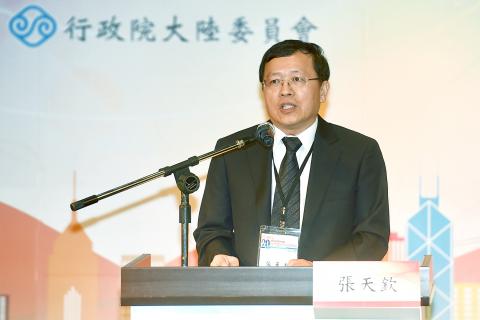
Photo: Chien Jung-fong, Taipei Times
Chang attributed the lack of identification with China due to Beijing’s suppression of the universal values shared by Taiwan and Hong Kong, namely democracy, liberal thought, human rights and the rule of law.
Chinese oppression in Hong Kong has caused its press freedom rating to drop and the “831 Decision” has sought to prevent its autonomy and increase Beijing’s hold on Hong Kong, he said.
The “831 Decision” was a decision made by the Standing Committee of the Chinese National People’s Congress on Aug. 31 2014, which set the limits for last year’s legislative council election and this year’s chief executive election in Hong Kong.
The Causeway Bay Books (銅鑼灣圖書) incidents further increased the doubts of the international community on whether the basic rights and safety of Hong Kongers would be guaranteed under Chinese rule, Chang said, referring to the incidents between October and December 2015 that saw five shareholders, co-owners or employees of Causeway Bay Books, including Lam Wing-kei (林榮基), go missing in Hong Kong.
Lam reappeared in July last year and publicly accused Beijing of kidnapping him as a way to intimidate the bookstore, which sells books banned in China.
Citing the latest Hong Kong University poll, Chang said that only 3.1 percent of Hong Kongers aged between 18 and 29 consider themselves to be Chinese in a general sense.
China should reflect on how it has failed to increase the identification with China of Hong Kongers in the 20 years since the territory was returned, Chang said.
Such a failure cannot simply be explained by stating that Hong Kong is “not allowed to resist central [government] authority under the name of greater autonomy,” Chang said.
Taiwan and Hong Kong share intimate ties on all levels and despite the slight impact after the change of government last year, Taiwan-Hong Kong interaction would help create a better future for both, Chang said.
He called on the Hong Kong Government to shun conservatism and adopt active and practical attitudes to help Taiwan-Hong Kong relations move toward a healthier and more positive state.
Chang also called on China to honor its promise made to Hong Kong during the handover in 1997 that the territory would retain a high degree of autonomy.
By listening and responding to Hong Kong’s call for a democratic system, China would live up to its promise to both Hong Kong and the international community, and only in this way can Hong Kong maintain stable development, Chang said.

UPGRADE: The Kang Ding-class frigate is replacing its Chaparall missiles with Tien Chien II and Hua Yang VLS, which would provide it with long-range, 360° air defense Taiwan plans to produce 1,200 to 1,376 Hai Chien II missiles (海劍二, Sea Sword II) — also known as TC-2N — to serve as the standard air defense system of the navy’s surface combatant fleet, a source said yesterday. Last week, the Hai Chien II, the naval version of the Tien Kung II missile (天劍二, Sky Sword II), completed a live-fire test in waters off the National Chungshan Institute of Science and Technology’s Jiupeng facility (九鵬) in Pingtung County’s Manjhou Township (滿州). The MIM72 Chaparral and other dated air defense missiles that currently arm Taiwanese ships have inadequate range to combat Chinese

REASONS FOR TRAVEL: An assistant professor said that proposed amendments to penalize drivers if they used drugs overseas would not deter people from traveling People who operate a motor vehicle under the influence of marijuana would have their driver’s license revoked, even if they used the substance while overseas, the Ministry of Transportation and Communications said yesterday, citing proposed amendments to the Road Traffic Management and Penalty Act (道路交通管理處罰條例). The amendments would also authorize the government to revoke the licenses of people determined to have used Category 1 or Category 2 narcotics, even if they were not operating a vehicle while under the influence of drugs, as well as ban them from taking the license test for three years, the ministry said. People aged 18 or
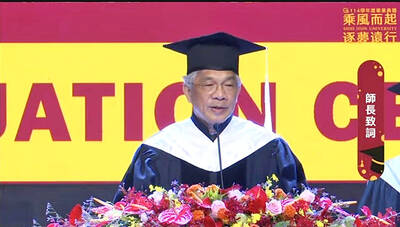
Shih Hsin University President Chen Ching-he (陳清河) yesterday issued a public apology for comments made in his commencement speech last week, stating that he has asked the school to suspend his duties and halt his wages for two months as a show of contrition. At the commencement ceremony on May 30, Chen said, “If you don’t manage your time well, or your own emotions, or your health, then I am telling every one of you — put a quick end to ‘you,’ because the world has no need for ‘you.’” The comments have sparked significant controversy online, and Chen through an open
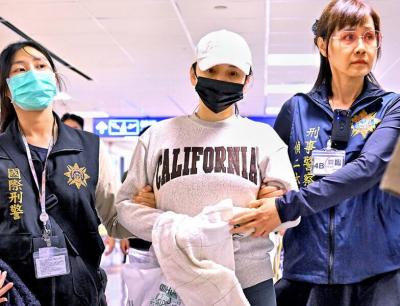
Johanne Liou (劉喬安), a Taiwanese woman who shot to unwanted fame during the Sunflower movement protests in 2014, returned to Taiwan last night after being deported from the US. She is to stand trial in Taiwan for charges involving embezzlement, fraud and drug crimes. The Criminal Investigation Bureau (CIB) said it took her into custody at Taiwan Taoyuan International Airport and would first question her before transferring her to the New Taipei District Prosecutors’ Office. She was arrested upon disembarking a flight from San Francisco that landed shortly before 7pm. Liou absconded to the US in 2019 after jumping bail


 RSS
RSS