


Religious groups and members of civic organizations advocating “traditional family values” yesterday rallied outside the Judicial Yuan in Taipei, a rally that became a protest after the Council of Grand Justices in the afternoon issued a constitutional interpretation in favor of the legalization of same-sex marriage.
The protesters included members of the Happiness of the Next Generation Alliance, the Association for Taiwan Social Stability, the Alliance of Religious Groups for the Love of Families Taiwan and other groups that have vehemently opposed marriage equality for lesbian, gay, bisexual, and transgender (LGBT) people.
At the initially boisterous rally, demonstrators accompanied their chants with drums and other musical instruments, while many people held up banners or placards with slogans such as “We do not welcome same-sex marriage in Taiwan,” “Defend the traditional family,” “The judicial process is unfair” and “Justice is dead and buried.”
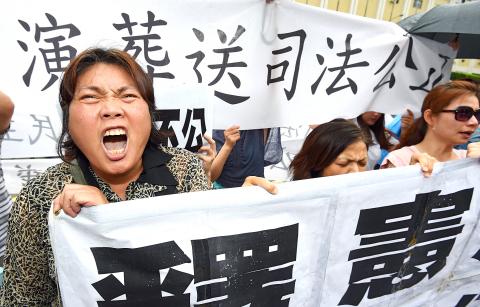
Photo: Liu Hsin-te, Taipei Times
After the grand justices’ interpretation was announced, many of the demonstrators reacted angrily or broke into tears.
They denounced the Council of Grand Justices and ripped up paper to symbolize their disbelief in the justices’ explanations for the ruling.
The chants turned to “Shame on the judiciary,” “We want a referendum,” “Down with the Judicial Yuan president” and “Down with President Tsai Ing-wen (蔡英文).”
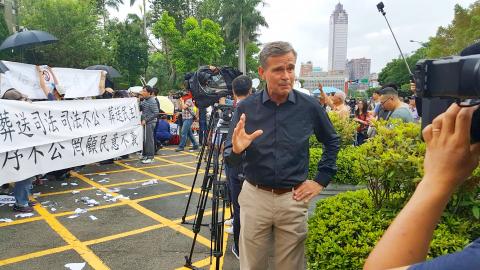
Photo: Wen Yu-te, Taipei Times
The interpretation represents “the elite of the nation’s judiciary system bullying the majority opinion of the public,” alliance convener Yu Hsin-yi (游信義) said, adding that it is wrong for the “lawmaking body to interfere with justice.”
“We are very disappointed with the ruling and plan to continue to fighting against it with all our might,” Yu told an improptu news conference at the rally site. “We plan to request that the Control Yuan conduct a probe into the grand justices.”
He said the grand justices had “rigged the process” by calling expert witnesses to testify, none of whom stood for traditional family values or the protection of the sacred institution of marriage.
Yu vowed to push for a national referendum so that the public could have their say on the issue, and also to redouble efforts with a signature campaign to recall legislators he said had failed to listen to their constituents on the issue.
Alliance lawyer Yeh Kuang-chou (葉光洲) said the constitutional interpretation puts Taiwan on the map as the first to allow same-sex marriage in Asia, “but we might lose many things in the future, and I am afraid to find out.”
“The grand justices should not become spokespeople for movements that advocate social causes. The ruling shows our justice system is biased toward certain groups,” Yeh said.

REPORT: Taipei has expressed an interest in obtaining loitering munitions matching the AeroVironment Switchblade 300 or the Anduril Altius-600, ‘Foreign Policy’ said Taiwan is seeking US-made kamikaze drones in an apparent concession to pressure from Washington to focus on asymmetric capabilities to defeat or deter a Chinese attack, Foreign Policy said in a report on Wednesday. Taipei has expressed an interest in obtaining AeroVironment Switchblade loitering munitions or other devices with similar capabilities, it said, citing four sources familiar with the matter commenting on condition of anonymity. The Switchblade 300 is a tube-launched drone designed for attacking ground troops, while its larger sibling, the Switchblade 600, could be used to destroy tanks and entrenched troops. Ukraine has utilized both systems extensively in its fight against

Police officers yesterday morning apprehended the prime suspect of a triple homicide case, after raiding the suspect’s hideout in Taichung. They transported the suspect to New Taipei City for questioning and recorded his statement last night. The suspect, identified as a 24-year-old man surnamed Chang (張), is believed to have used his hands to strangle his wife, surnamed Chen (陳), 29, along with his three-year-old son from a previous marriage and his wife’s mother, 69. The three dead bodies were wrapped in blankets when they were discovered inside their apartment in New Taipei City’s Sanchong District (三重) on Saturday. Chang was holding a

Hungarian Member of Parliament Tompos Marton said he considers Taiwan to be a better alternative to China as a strategic partner. Marton, who is the vice president of the opposition Momentum Party, made the remarks in an interview with the Central News Agency on Sunday. He draped a Republic of China flag across his shoulders to protest Chinese President Xi Jinping’s (習近平) visit to the capital city, Budapest, on Thursday last week, and openly voiced support for Taiwan on social media. He said in the interview that he wanted to remind the world that there were alternatives to China, and that “Taiwan has

A female physician at New Taipei City’s Shuang Ho Hospital was bullied and made to work for 32 consecutive hours by a senior colleague while pregnant before later having a miscarriage, an internal investigation found, the hospital said on Monday. The perpetrator has been removed from his post, the hospital said. The attending physician in the hospital’s Medical Imaging Department, identified by the pseudonym Y, earlier on Monday told reporters that she had been bullied by a male senior colleague who arranged shifts in her department. In January, shortly after she became pregnant, Y asked the department director if she could avoid overnight


 RSS
RSS