


A retrospective exhibition concerning late commander-in-chief of the Republic of China Army Sun Li-jen (孫立人) opened yesterday at the Taiwan Army Club in Taipei, attended by Democratic Progressive Party (DPP) caucus whip Ker Chien-ming (柯建銘), who stressed the importance of transitional justice.
Historians have called Sun the greatest Chinese military officer of the 20th century.
A graduate of the US’ Virginia Military Institute, Sun led New 38th Division troops to battle victories over the Japanese Imperial Army in Burma during World War II and was respected by US and British commanders. He became commander-in-chief of the ROC Army in 1950.
He was placed under house arrest in Taipei in August 1955 by Chiang Kai-shek (蔣介石), who accused him of launching a coup, and he remained under house arrest until March 1988, following the death of then-president Chiang Ching-kuo (蔣經國).
In 2014, the Control Yuan cleared Sun of the allegation he was involved in a coup attempt.
The Taiwan Army Club, where Sun lived for about seven years, is being transformed into an art center called Sun Li-jen’s General Residence.
“Sun was a prestigious general of the era,” Ker said, lamenting the decades Sun spent under house arrest due to political prosecution.
When people are talking about transitional justice, it is imperative they reflect on Sun’s prosecution, Ker added.
The memorial residence is operated by Art Go as a “rebuild-operate-transfer” project.
Art Go said it plans to transform the building into a multifunctional artistic space and to continue operating its restaurant.
The exhibition, which runs through June 6, presents many historic photographs, many of which were taken and collected by Lo Chao-chun (羅超群), the photographer of Sun’s military entourage.
To exhibit the work, Art Go said it obtained the authorization of Lo’s son, Lo Kuang-jen (羅廣仁).
Lo Chao-chun risked his life to protect the precious pictures during the White Terror era, Lo Kuang-jen said, referring to the suppression of political dissidents during the Martial Law era from 1949 to 1987.
Art Go said it hopes to make Sun’s story, as well as the concomitant events, known to more people.
“This is a static exhibit, but if people become more interested in Sun, we can develop more sophisticated activities,” Art Go central executive officer Nel Lu (呂昌熙) said.

The military has spotted two Chinese warships operating in waters near Penghu County in the Taiwan Strait and sent its own naval and air forces to monitor the vessels, the Ministry of National Defense (MND) said. Beijing sends warships and warplanes into the waters and skies around Taiwan on an almost daily basis, drawing condemnation from Taipei. While the ministry offers daily updates on the locations of Chinese military aircraft, it only rarely gives details of where Chinese warships are operating, generally only when it detects aircraft carriers, as happened last week. A Chinese destroyer and a frigate entered waters to the southwest

A magnitude 6.1 earthquake struck off the coast of Yilan County at 8:39pm tonight, the Central Weather Administration (CWA) said, with no immediate reports of damage or injuries. The epicenter was 38.7km east-northeast of Yilan County Hall at a focal depth of 98.3km, the CWA’s Seismological Center said. The quake’s maximum intensity, which gauges the actual physical effect of a seismic event, was a level 4 on Taiwan’s 7-tier intensity scale, the center said. That intensity level was recorded in Yilan County’s Nanao Township (南澳), Hsinchu County’s Guansi Township (關西), Nantou County’s Hehuanshan (合歡山) and Hualien County’s Yanliao (鹽寮). An intensity of 3 was
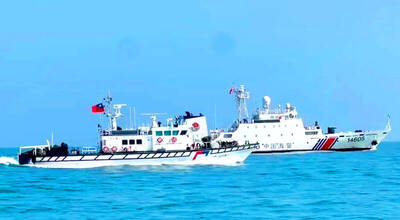
Instead of focusing solely on the threat of a full-scale military invasion, the US and its allies must prepare for a potential Chinese “quarantine” of Taiwan enforced through customs inspections, Stanford University Hoover fellow Eyck Freymann said in a Foreign Affairs article published on Wednesday. China could use various “gray zone” tactics in “reconfiguring the regional and ultimately the global economic order without a war,” said Freymann, who is also a nonresident research fellow at the US Naval War College. China might seize control of Taiwan’s links to the outside world by requiring all flights and ships entering or leaving Taiwan
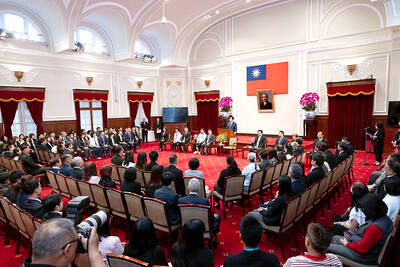
The next minimum wage hike is expected to exceed NT$30,000, President William Lai (賴清德) said yesterday during an award ceremony honoring “model workers,” including migrant workers, at the Presidential Office ahead of Workers’ Day today. Lai said he wished to thank the awardees on behalf of the nation and extend his most sincere respect for their hard work, on which Taiwan’s prosperity has been built. Lai specifically thanked 10 migrant workers selected for the award, saying that although they left their home countries to further their own goals, their efforts have benefited Taiwan as well. The nation’s industrial sector and small businesses lay


 RSS
RSS