


More than 1,000 T91 assault rifles were sold in the US in a single day, the Chinese-language United Daily News reported, after the Ministry of National Defense began exporting the locally made weapon.
Made by the ministry’s 205th Armory, the rifles were exported through the US-based Wolf Performance Ammunition, the first Taiwan-made small arms to be sold commercially, the report, published on April 10, cited sources as saying.
An unnamed ministry official was quoted as saying that the rifle sold well in the US market because of its reliability and favorable price point.
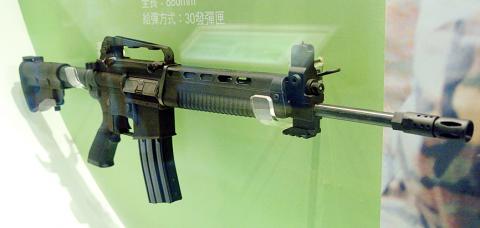
Photo: George Tsorng, Taipei Times
The 205 Armory sold “several hundred million rounds” of 5.56mm ammunition to the US military to meet its combat needs during the Iraq and Afghanistan wars, the official was quoted as saying.
The armory’s ammunition acquired a reputation for quality and Wolf Performance Ammunition signed a contract with the ministry to import the rifles on its behalf, the official said.
To comply with laws and regulations of both countries, the rifles are shipped to the US unassembled and include only their major components, the barrel, receiver and handguard, the official said.
After arriving in the US, the importer assembles the components into upper receivers, which buyers can combine with privately purchased lower receivers to make a complete rifle, the official said.
Assembled T91 uppers are sold under the name Wolf A1 for US$599 and are compatible with lower receivers from any AR-15 rifle, such as the US military’s M16 or M4 carbine, the official said.
In the US, lowers and other components are often modified to comply with US states’, legal requirements, which can include bans on magazines with capacity exceeding 10 rounds or weapons capable of fully automatic fire, the official said.
Many US gun manufacturers are unfamiliar with the Taiwanese interest in military affairs, the official said.
Colt Manufacturing Co, the original M16 and M4 maker, relies on US military contracts for high-end weapons, which are not affordable for many gun buyers, the official said.
The opposite is true of many obscure gun manufactures who make cheap weapons and ammunition of poor quality, the official added.
The T91 is built to military specifications, so the quality of Wolf A1 uppers far exceeds its competitors in the same price range, the official said, adding that the alternative short-stroke piston rifle for US buyers is the Heckler & Koch HK416 and its uppers are sold for US$3,000.
The T91 descended from the T65, produced in 1976. The T65 resembles the M16, but has a tougher short-stroke piston system, the official said.
The T65 had initial flaws and in the 1980s it was phased out by the improved T65K2.
The T91 was improved and became standard-issue in 2002, the official said.
The Armaments Bureau was quoted as saying that contractual obligations do not allow it to confirm sales numbers, but the T91 had been given “highly positive” reviews in US-based gun magazines and Web sites.
Many Taiwanese Americans and Taiwanese citizens in the US have expressed interest in the T91, it said.
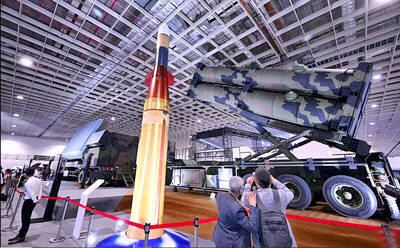
Taiwan is to commence mass production of the Tien Kung (天弓, “Sky Bow”) III, IV and V missiles by the second quarter of this year if the legislature approves the government’s NT$1.25 trillion (US$39.78 billion) special defense budget, an official said yesterday. Commenting on condition of anonymity, a defense official with knowledge of the matter said that the advanced systems are expected to provide crucial capabilities against ballistic and cruise missiles for the proposed “T-Dome,” an advanced, multi-layered air defense network. The Tien Kung III is an air defense missile with a maximum interception altitude of 35km. The Tien Kung IV and V
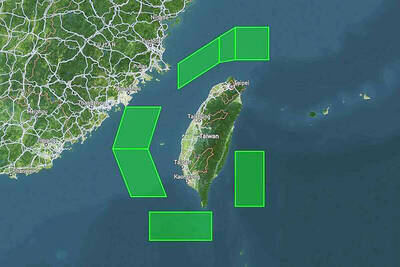
The disruption of 941 flights in and out of Taiwan due to China’s large-scale military exercises was no accident, but rather the result of a “quasi-blockade” used to simulate creating the air and sea routes needed for an amphibious landing, a military expert said. The disruptions occurred on Tuesday and lasted about 10 hours as China conducted live-fire drills in the Taiwan Strait. The Civil Aviation Administration (CAA) said the exercises affected 857 international flights and 84 domestic flights, affecting more than 100,000 travelers. Su Tzu-yun (蘇紫雲), a research fellow at the government-sponsored Institute for National Defense and Security Research, said the air
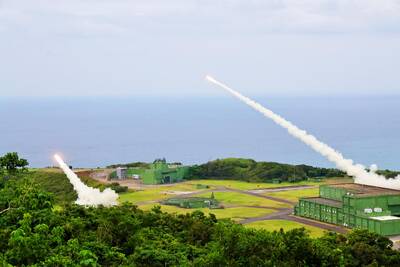
Taiwan lacks effective and cost-efficient armaments to intercept rockets, making the planned “T-Dome” interception system necessary, two experts said on Tuesday. The concerns were raised after China’s military fired two waves of rockets during live-fire drills around Taiwan on Tuesday, part of two-day exercises code-named “Justice Mission 2025.” The first wave involved 17 rockets launched at 9am from Pingtan in China’s Fujian Province, according to Lieutenant General Hsieh Jih-sheng (謝日升) of the Office of the Deputy Chief of the General Staff for Intelligence at the Ministry of National Defense. Those rockets landed 70 nautical miles (129.6km) northeast of Keelung without flying over Taiwan,
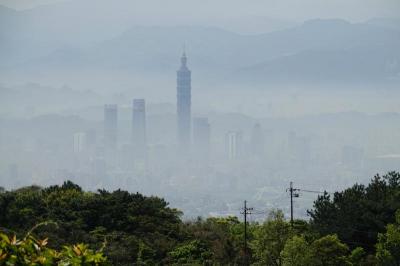
A strong continental cold air mass is to bring pollutants to Taiwan from tomorrow, the Ministry of Environment said today, as it issued an “orange” air quality alert for most of the country. All of Taiwan except for Hualien and Taitung counties is to be under an “orange” air quality alert tomorrow, indicating air quality that is unhealthy for sensitive groups. In China, areas from Shandong to Shanghai have been enveloped in haze since Saturday, the ministry said in a news release. Yesterday, hourly concentrations of PM2.5 in these areas ranged from 65 to 160 micrograms per cubic meter (mg/m³), and pollutants were


 RSS
RSS