


More should be done to enhance sidewalk accessibility, disabled rights advocates said yesterday at a hearing at the Legislative Yuan in Taipei.
“There are more than 16 government agencies that are free to ‘rape’ or trample over sidewalks, but we cannot find a unified government agency responsible for approving things,” Access for All in Taiwan project manager Chen Ming-li (陳明里) said, adding that regulations technically mandate a sidewalk width of 1.5m, but lack of space often leads that to be shrunk to 90cm, potentially creating problems for wheelchairs.
“When wheelchairs are opened up, they take up more than 68cm, so where are they supposed to go if some agency adds a light pole or a traffic light control box to a narrow band of pavement?” Chen said.
A lack of government action and slow progress were common themes from those who testified at the Internal Administration Committee hearing convened by Democratic Progressive Party Legislator Pasuya Yao (姚文智).
“Over the past 30 years, I have been hit by cars three times,” said Liu Yi-yun (劉逸雲), a Republic of China Spinal Cord Injury Victims Association consultant who uses a wheelchair.
“As an electric wheelchair does not count as a ‘vehicle’ under traffic laws, I am actually liable if I am hit while going down a street instead of the sidewalk, but the problem is that sometimes I cannot use the sidewalk,” Liu said.
Parents Association for the Visually Impaired secretary-general Lan Chie-chou (藍介洲) called on government agencies to level pavements inside building arcades and reduce the number of arcade stairs, adding that blind people face huge obstacles crossing roads because of the absence of traffic lights with audio signals.
“People often assume that my guide dog can tell me when the signal turns, but the reality is that dogs are color blind. I have to pay attention to what I hear and order him to take me across the road when it sounds safe,” he said, adding that he has been trapped in the middle of the road numerous times after misjudging the situation.
Taiwan Institute of Landscape Architects president emeritus Monica Kuo (郭瓊瑩) called for a portion of the NT$880 billion (US$29 billion) “Forward-looking Infrastructure Construction Project” announced by Premier Lin Chuan (林全) last week to be allocated to improving accessibility.
“The NT$1.5 billion [budgeted by the Ministry of the Interior’s Construction and Planning Agency for accessibility] might sound like a lot, but after you sprinkle it among all the nation’s townships and cities, it is just the remainder of budgetary scraps,” she said.
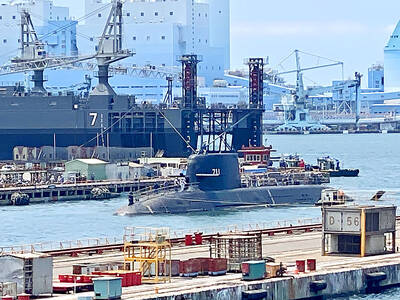
AGING: While Japan has 22 submarines, Taiwan only operates four, two of which were commissioned by the US in 1945 and 1946, and transferred to Taiwan in 1973 Taiwan would need at least 12 submarines to reach modern fleet capabilities, CSBC Corp, Taiwan chairman Chen Cheng-hung (陳政宏) said in an interview broadcast on Friday, citing a US assessment. CSBC is testing the nation’s first indigenous defense submarine, the Hai Kun (海鯤, Narwhal), which is scheduled to be delivered to the navy next month or in July. The Hai Kun has completed torpedo-firing tests and is scheduled to undergo overnight sea trials, Chen said on an SET TV military affairs program. Taiwan would require at least 12 submarines to establish a modern submarine force after assessing the nation’s operational environment and defense
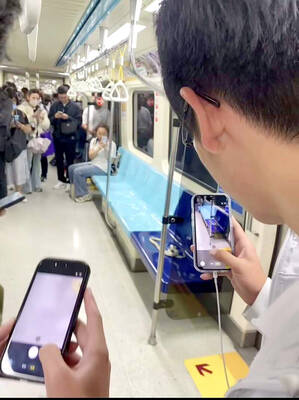
A white king snake that frightened passengers and caused a stir on a Taipei MRT train on Friday evening has been claimed by its owner, who would be fined, Taipei Rapid Transit Corp (TRTC) said yesterday. A person on Threads posted that he thought he was lucky to find an empty row of seats on Friday after boarding a train on the Bannan (Blue) Line, only to spot a white snake with black stripes after sitting down. Startled, he jumped up, he wrote, describing the encounter as “terrifying.” “Taipei’s rat control plan: Release snakes on the metro,” one person wrote in reply, referring
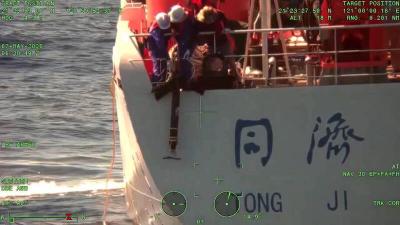
The coast guard today said that it had disrupted "illegal" operations by a Chinese research ship in waters close to the nation and driven it away, part of what Taipei sees a provocative pattern of China's stepped up maritime activities. The coast guard said that it on Thursday last week detected the Chinese ship Tongji (同濟號), which was commissioned only last year, 29 nautical miles (54km) southeast of the southern tip of Taiwan, although just outside restricted waters. The ship was observed lowering ropes into the water, suspected to be the deployment of scientific instruments for "illegal" survey operations, and the coast
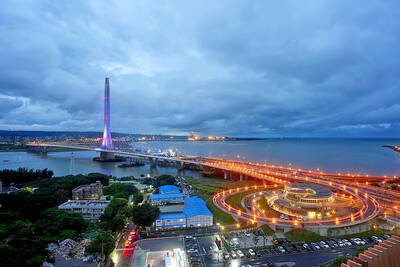
An inauguration ceremony was held yesterday for the Danjiang Bridge, the world’s longest single-mast asymmetric cable-stayed bridge, ahead of its official opening to traffic on Tuesday, marking a major milestone after nearly three decades of planning and construction. At the ceremony in New Taipei City attended by President William Lai (賴清德), Premier Cho Jung-tai (卓榮泰), Minister of Transportation and Communications Chen Shih-kai (陳世凱) and New Taipei City Mayor Hou Yu-ih (侯友宜), the bridge was hailed as both an engineering landmark and a long-awaited regional transport link connecting Tamsui (淡水) and Bali (八里)


 RSS
RSS