


Newly sworn-in Minister of Health and Welfare Chen Shih-chung (陳時中) yesterday said he would continue to carry out current policies and avoid drastic personnel changes, reiterating that the healthcare industry is part of the service industry, as health practitioners are dedicated to serve humanity.
Chen made the remarks in a meeting with the media shortly after a morning inauguration ceremony at the Ministry of Health and Welfare in Taipei.
During the ceremony, former minister of health and welfare Lin Tzou-yien (林奏延) said he was grateful that President Tsai Ing-wen (蔡英文) and Premier Lin Chuan (林全) had given him the opportunity to work with the ministry’s team, saying that it had been the biggest honor of his life.
“Chen was a former deputy minister of the [former] Department of Health and drafted the white paper for the Tsai administration’s medical policies, so he is very familiar with policies and operations,” Lin Tzou-yien said. “He is also skilled at cross-discipline communication and a very appropriate person for the job.”
Lin Tzou-yien said that over the past four months he had focused on managing progress of the “long-term care services program 2.0,” but added that there remain tasks that Chen must complete, including the establishment of the program’s information system, as well as changes to the National Health Insurance and drug addiction prevention programs.
Integration between the social welfare and healthcare sectors is critical to the success of the long-term care program, he said, urging people in related agencies to put aside departmental selfishness and cooperate to create a ministry.
Asked by reporters if he would carry out Lin Tzou-yien’s plan to establish a specialized department to execute long-term care policies, Chen said that as his basic plan is to “continue policies, but strive for personnel stability,” he would prefer to operate in the existing organizational framework for now.
Regarding an earlier remark about the healthcare industry being a part of the services industry, which triggered criticism from medical professionals, Chen quoted the Declaration of Geneva (commonly known as the Physician’s Oath): “I solemnly pledge to consecrate my life to the service of humanity” and said that medical fees are listed as “healthcare and social work services” in the government’s occupational classification.
Minister of Labor Lin Mei-chu (林美珠), Council of Agriculture Minister Lin Tsung-hsien (林聰賢) and Minister of Science and Technology Chen Liang-gee (陳良基) were also sworn in at the event.
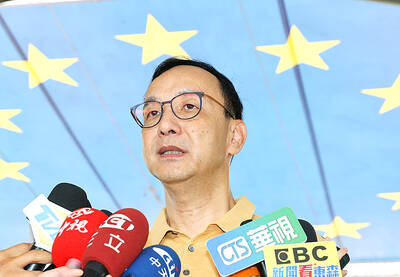
GOOD DIPLOMACY: The KMT has maintained close contact with representative offices in Taiwan and had extended an invitation to Russia as well, the KMT said The Chinese Nationalist Party (KMT) would “appropriately handle” the fallout from an invitation it had extended to Russia’s representative to Taipei to attend its international banquet last month, KMT Chairman Eric Chu (朱立倫) said yesterday. US and EU representatives in Taiwan boycotted the event, and only later agreed to attend after the KMT rescinded its invitation to the Russian representative. The KMT has maintained long-term close contact with all representative offices and embassies in Taiwan, and had extended the invitation as a practice of good diplomacy, Chu said. “Some EU countries have expressed their opinions of Russia, and the KMT respects that,” he
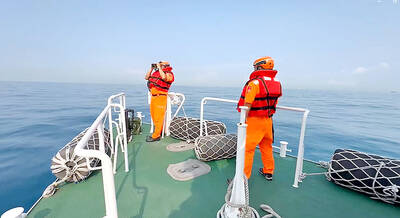
An increase in Taiwanese boats using China-made automatic identification systems (AIS) could confuse coast guards patrolling waters off Taiwan’s southwest coast and become a loophole in the national security system, sources familiar with the matter said yesterday. Taiwan ADIZ, a Facebook page created by enthusiasts who monitor Chinese military activities in airspace and waters off Taiwan’s southwest coast, on Saturday identified what seemed to be a Chinese cargo container ship near Penghu County. The Coast Guard Administration went to the location after receiving the tip and found that it was a Taiwanese yacht, which had a Chinese AIS installed. Similar instances had also
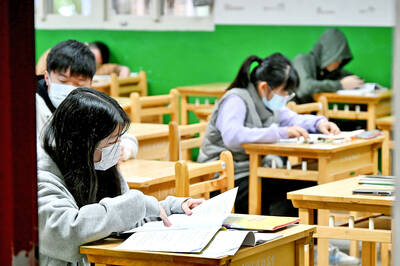
CHANGES: After-school tutoring periods, extracurricular activities during vacations or after-school study periods must not be used to teach new material, the ministry said The Ministry of Education yesterday announced new rules that would ban giving tests to most elementary and junior-high school students during morning study and afternoon rest periods. The amendments to regulations governing public education at elementary schools and junior high schools are to be implemented on Aug. 1. The revised rules stipulate that schools are forbidden to use after-school tutoring periods, extracurricular activities during summer or winter vacation or after-school study periods to teach new course material. In addition, schools would be prohibited from giving tests or exams to students in grades one to eight during morning study and afternoon break periods, the
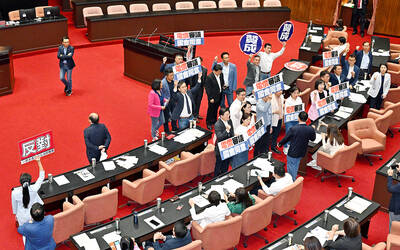
AMENDMENT: Contact with certain individuals in China, Hong Kong and Macau must be reported, and failure to comply could result in a prison sentence, the proposal stated The Chinese Nationalist Party (KMT) and the Taiwan People’s Party (TPP) yesterday voted against a proposed bill by Democratic Progressive Party (DPP) lawmakers that would require elected officials to seek approval before visiting China. DPP Legislator Puma Shen’s (沈伯洋) proposed amendments to the Act Governing Relations Between the People of the Taiwan Area and the Mainland Area (臺灣地區與大陸地區人民關係條例), stipulate that contact with certain individuals in China, Hong Kong and Macau should be reported, while failure to comply would be punishable by prison sentences of up to three years, alongside a fine of NT$10 million (US$309,041). Fifty-six voted with the TPP in opposition


 RSS
RSS