


President Tsai Ing-wen (蔡英文) should push for a constitutional change to eliminate the Control Yuan rather than continuing to nominate new members as terms expire, civic groups said yesterday at an academic forum.
“Even though this issue has been put on the back burner, we expect a list of nominees to emerge soon, making it an important issue to consider given that both Tsai and the Democratic Progressive Party (DPP) promised to abolish the Control Yuan,” Taipei Society head Chiou Wen-tsong (邱文聰) said, adding that his group and other participants all refused the Presidential Office’s invitation to recommend Control Yuan candidates because of their stance.
“A national human rights commission should be established, and the constitutional amendment process should be initiated to fulfill the DPP’s electoral promise to push for the Control Yuan’s abolition. There has never been a better time to make the push,” Taiwan Association for Human Rights executive board member Liu Ching-yi (劉靜怡) said, adding that current human rights work was too reliant on the goodwill of individual Control Yuan members.
The Control Yuan has long opposed the establishment of a separate human rights commission, claiming that investing a commission with investigatory and censorship powers would infringe on its own authority.
“It clearly does not have good judgement on what laws and governmental behavior are in accordance with human rights standards,” Covenants Watch executive board member Huang Song-lih (黃嵩立) said.
A Control Yuan ruling that faulted the executive branch for failing to take action against uncompensated use of government land set into motion a wave of forced eviction cases against disadvantaged residents, he said.
“The motivation behind the government’s move to nominate officials looks suspiciously like sharing political spoils,” Taiwan Democracy Watch president Chen Chao-ju (陳昭如) said, calling for Tsai to explain how the nominations would tie into her pledge to abolish the Control Yuan.
DPP Legislator Lee Chun-yi (李俊俋) said he had initially been opposed to making new nominations, but had been told by Tsai that making the nominations was her constitutional duty and she hoped to use them to strengthen the Control Yuan’s supervision of the judicial branch.
“The Control Yuan should be abolished and a national human rights commission should be established, while the need for fundamental constitutional change remains the same,” he said, comparing the current Republic of China constitutional framework to a piece of illegal architecture that the DPP would to aim to gradually “shake loose,” because the high threshold for constitutional amendments makes “complete demolition” difficult.

The military has spotted two Chinese warships operating in waters near Penghu County in the Taiwan Strait and sent its own naval and air forces to monitor the vessels, the Ministry of National Defense (MND) said. Beijing sends warships and warplanes into the waters and skies around Taiwan on an almost daily basis, drawing condemnation from Taipei. While the ministry offers daily updates on the locations of Chinese military aircraft, it only rarely gives details of where Chinese warships are operating, generally only when it detects aircraft carriers, as happened last week. A Chinese destroyer and a frigate entered waters to the southwest
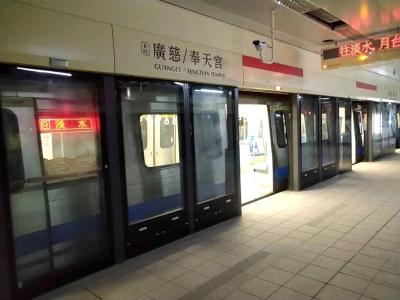
The eastern extension of the Taipei MRT Red Line could begin operations as early as late June, the Taipei Department of Rapid Transit Systems said yesterday. Taipei Rapid Transit Corp said it is considering offering one month of free rides on the new section to mark its opening. Construction progress on the 1.4km extension, which is to run from the current terminal Xiangshan Station to a new eastern terminal, Guangci/Fengtian Temple Station, was 90.6 percent complete by the end of last month, the department said in a report to the Taipei City Council's Transportation Committee. While construction began in October 2016 with an
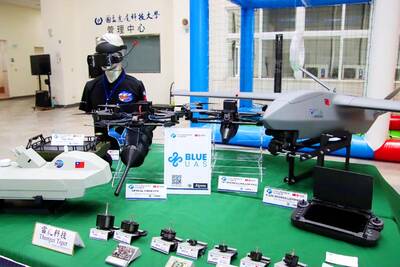
NON-RED SUPPLY: Boosting the nation’s drone industry is becoming increasingly urgent as China’s UAV dominance could become an issue in a crisis, an analyst said Taiwan’s drone exports to Europe grew 41.7-fold from 2024 to last year, with demand from Ukraine’s fight against Russian aggression the most likely driver of growth, a study showed. The Institute for Democracy, Society and Emerging Technology (DSET) in a statement on Wednesday said it found that many of Taiwan’s uncrewed aerial vehicle (UAV) sales were from Poland and the Czech Republic. These countries likely transferred the drones to Ukraine to aid it in its fight against the Russian invasion that started in 2022, it said. Despite the gains, Taiwan is not the dominant drone exporter to these markets, ranking second and fourth

Japanese Prime Minister Sanae Takaichi’s comment last year on Tokyo’s potential reaction to a Taiwan-China conflict has forced Beijing to rewrite its invasion plans, a retired Japanese general said. Takaichi told the Diet on Nov. 7 last year that a Chinese naval blockade or military attack on Taiwan could constitute a “survival-threatening situation” for Japan, potentially allowing Tokyo to exercise its right to collective self-defense. Former Japan Ground Self-Defense Force general Kiyofumi Ogawa said in a recent speech that the remark has been interpreted as meaning Japan could intervene in the early stages of a Taiwan Strait conflict, undermining China’s previous assumptions


 RSS
RSS