


The MRT line between Taiwan Taoyuan International Airport and Taipei Main Station is unlikely to be used during its trial run to transport Lunar New Year holiday travelers, as both the metropolitan railway’s operator and passengers would be exposed to too much uncertainty, the Ministry of Transportation and Communications said yesterday.
Taoyuan Metro Corp, the operator of the airport MRT line, has been addressing 41 minor issues that were identified after it completed a final inspection last month required by the Mass Rapid Transit Act (大眾捷運法), the ministry said, adding that the company would submit a plan to the ministry this week to launch a trial run after correcting the issues.
When asked if the system could be used to transport people traveling abroad during the Lunar New Year holiday, which could coincide with the trial run, Minister of Transportation and Communications Hochen Tan (賀陳旦) said he did not think that would be a good idea.
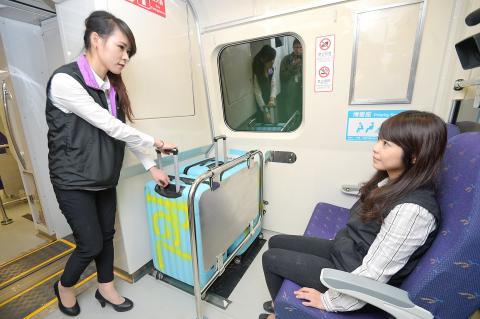
Photo: Chang Chia-ming, Taipei Times
“I would not expect the airport MRT line to be used to transport Lunar New Year holiday travelers to the airport. The operators would face tremendous pressure if given such a task, while users could be exposed to uncertain service quality,” Hochen said.
He said that he agreed with Taoyuan Metro’s proposed plan to only accept group reservations and not activate a baggage check-in system at Taipei Main Station during the system’s trial run.
The minister announced several measures that the ministry would implement to facilitate transportation during one of the nation’s most important holidays of the year.
Tolls are to be waived for travelers on freeways between 11pm and 6am during the holiday from Jan. 27 to Feb. 1, Hochen said.
However, unlike his predecessors, he refused to promise that people would be able to drive from Taipei to Kaohsiung on the freeways in less than six hours during the holiday.
“Nobody can guarantee how long [driving from Taipei to Kaohsiung] would take if drivers choose to take to the road at peak hours. Nor should anyone promise drivers that they can reach their destinations within a certain amount of time,” Hochen said. “It is unnecessary for the ministry to regard the promise of a six-hour drive from Taipei to Kaohsiung during the Lunar New Year holiday as a cross it must bear by itself.”
The ministry’s biggest challenge this year would be to ease traffic on roads to tourist attractions during the six-day holiday, particularly those in Yilan County and central areas, he added.
Regarding a plan to change the pricing scheme for freeway tolls, Hochen said that the ministry is not considering canceling in the short term a 20km toll-free driving distance afforded to drivers each day.
“We will not start charging drivers on east-west freeways either, unless there are alternative routes nearby or public transportation available,” he said.
However, the ministry might start examining whether short-distance drivers and those using freeways to commute should still be provided a daily 20km toll-free distance, as they often cause traffic delays in certain sections of freeways, Hochen said.
The ministry plans to implement a “zero-tolerance” policy for drunk drivers this year and aims to reduce the number of people killed in traffic incidents by 15 percent in three years, he said, adding that deaths in the 18-to-24 age group in particular should drop by 35 percent in that time frame.
Regarding projects proposed by local governments, such as extending the high-speed rail line to Pingtung County and building a railway line between Taichung’s Dajia (大甲) and Houli (后里) districts, Hochen said they were not on the ministry’s list of short-term

Considering that most countries issue more than five denominations of banknotes, the central bank has decided to redesign all five denominations, the bank said as it prepares for the first major overhaul of the banknotes in more than 24 years. Central bank Governor Yang Chin-lung (楊金龍) is expected to report to the Legislative Yuan today on the bank’s operations and the redesign’s progress. The bank in a report sent to the legislature ahead of today’s meeting said it had commissioned a survey on the public’s preferences. Survey results showed that NT$100 and NT$1,000 banknotes are the most commonly used, while NT$200 and NT$2,000

The Centers for Disease Control (CDC) yesterday reported the first case of a new COVID-19 subvariant — BA.3.2 — in a 10-year-old Singaporean girl who had a fever upon arrival in Taiwan and tested positive for the disease. The girl left Taiwan on March 20 and the case did not have a direct impact on the local community, it said. The WHO added the BA.3.2 strain to its list of Variants Under Monitoring in December last year, but this was the first imported case of the COVID-19 variant in Taiwan, CDC Deputy Director-General Lin Ming-cheng (林明誠) said. The girl arrived in Taiwan on

South Korea is planning to revise its controversial electronic arrival card, a step Taiwanese officials said prompted them to hold off on planned retaliatory measures, a South Korean media report said yesterday. A Yonhap News Agency report said that the South Korean Ministry of Foreign Affairs is planning to remove the “previous departure place” and “next destination” fields from its e-arrival card system. The plan, reached after interagency consultations, is under review and aims to simplify entry procedures and align the electronic form with the paper version, a South Korean ministry official said. The fields — which appeared only on the electronic form

The Ministry of Foreign Affairs (MOFA) is suspending retaliation measures against South Korea that were set to take effect tomorrow, after Seoul said it is updating its e-arrival system, MOFA said today. The measures were to be a new round of retaliation after Taiwan on March 1 changed South Korea's designation on government-issued alien resident certificates held by South Korean nationals to "South Korea” from the "Republic of Korea," the country’s official name. The move came after months of protests to Seoul over its listing of Taiwan as "China (Taiwan)" in dropdown menus on its new online immigration entry system. MOFA last week


 RSS
RSS