


Tainan resident Wu Tsang-yuan (吳藏願), a banknote collector who describes himself as the “most loaded man in Tainan,” has a 100 trillion Zimbabwean dollar bill and other economic oddities in his sizable collection.
“I could have been a rich man if they did not take that out of circulation,” Wu said of the 100 trillion dollar bill.
Printed during Zimbabwe’s years of hyperinflation, the bill was reportedly worth US$0.40 in 2009. The nation has since abandoned printing its own currency.
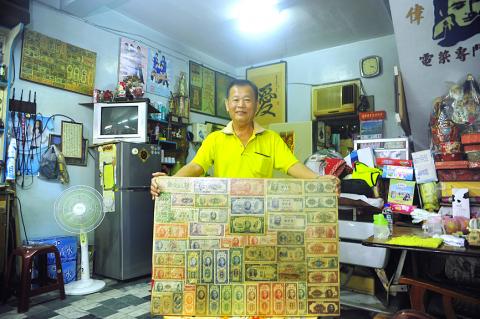
Photo: Wang Chieh, Taipei Times
Other banknotes with a high denomination in his collection include 500 billion dinar bills issued by the former Socialist Federal Republic of Yugoslavia and 3 billion dollar notes issued by the Republic of China (ROC) treasury, printed during Taiwan’s post-Chinese Civil War hyperinflation and prior to the adoption of the New Taiwan dollar, Wu said.
Wu said his hobby began in the late 1970s, when he was serving as a soldier in Kinmen County.
When buying produce at a local market, he said he encountered a strange 10 cent note bearing a stamp that read: “For Kinmen circulation only.”
Intrigued, he asked a vegetable seller about the unfamiliar banknote.
The vendor said that the government had created a special currency for the Kinmen archipelago’s exclusive use that could not be exchanged, an answer that sparked his interest in rare and out-of-circulation bills.
After completing his military service, Wu worked as a barber and began to purchase rare banknotes.
“Some people buy cars and real estate with their money; I buy banknotes with mine,” Wu said, adding that he paid as much as NT$70,000 for some of the rarer ones.
The most valuable item in his collection is a 100 dollar bill printed by the ROC treasury in 1949, which had two concurrent editions: the so-called xiaohua (little colorful) and the dahua (big colorful) notes, so named by collectors because the former were printed in one color, while the latter were printed in several.
One of the rare dahua bills, such as the one he owns, could sell for up to NT$100,000 at auction, Wu said.
His children’s disinterest in the collection has prompted him to consider selling it or donating it to a museum, Wu said, adding that he makes an exception for the dahua bill, which he does not want to part with.
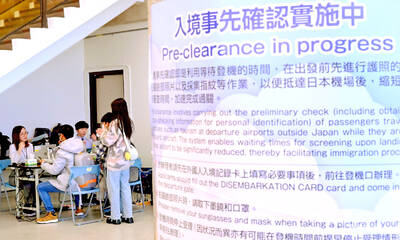
A preclearance service to facilitate entry for people traveling to select airports in Japan would be available from Thursday next week to Feb. 25 at Taiwan Taoyuan International Airport, Taoyuan International Airport Corp (TIAC) said on Tuesday. The service was first made available to Taiwanese travelers throughout the winter vacation of 2024 and during the Lunar New Year holiday. In addition to flights to the Japanese cities of Hakodate, Asahikawa, Akita, Sendai, Niigata, Okayama, Takamatsu, Kumamoto and Kagoshima, the service would be available to travelers to Kobe and Oita. The service can be accessed by passengers of 15 flight routes operated by
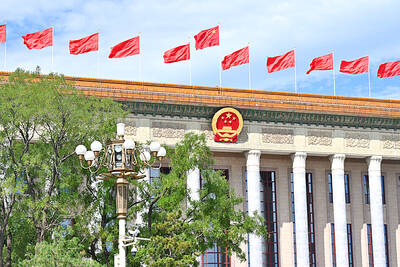
MORE FALL: An investigation into one of Xi’s key cronies, part of a broader ‘anti-corruption’ drive, indicates that he might have a deep distrust in the military, an expert said China’s latest military purge underscores systemic risks in its shift from collective leadership to sole rule under Chinese President Xi Jinping (習近平), and could disrupt its chain of command and military capabilities, a national security official said yesterday. If decisionmaking within the Chinese Communist Party has become “irrational” under one-man rule, the Taiwan Strait and the regional situation must be approached with extreme caution, given unforeseen risks, they added. The anonymous official made the remarks as China’s Central Military Commission Vice Chairman Zhang Youxia (張又俠) and Joint Staff Department Chief of Staff Liu Zhenli (劉振立) were reportedly being investigated for suspected “serious
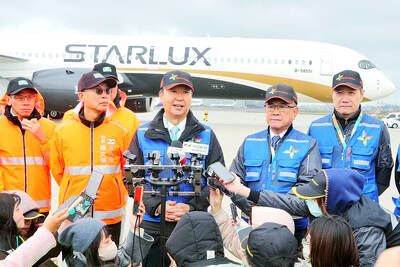
ENHANCING EFFICIENCY: The apron can accommodate 16 airplanes overnight at Taoyuan airport while work on the third runway continues, the transport minister said A new temporary overnight parking apron at Taiwan Taoyuan International Airport is to start operating on Friday next week to boost operational efficiency while the third runway is being constructed, the Ministry of Transportation and Communications said yesterday. The apron — one of the crucial projects in the construction of the third runway — can accommodate 16 aircraft overnight at the nation’s largest international airport, Minister of Transportation and Communications Chen Shih-kai (陳世凱) told reporters while inspecting the new facility yesterday morning. Aside from providing the airport operator with greater flexibility in aircraft parking during the third runway construction,
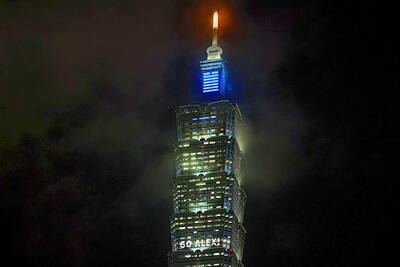
American climber Alex Honnold is to attempt a free climb of Taipei 101 today at 9am, with traffic closures around the skyscraper. To accommodate the climb attempt and filming, the Taipei Department of Transportation said traffic controls would be enforced around the Taipei 101 area. If weather conditions delay the climb, the restrictions would be pushed back to tomorrow. Traffic controls would be in place today from 7am to 11am around the Taipei 101 area, the department said. Songzhi Road would be fully closed in both directions between Songlian Road and Xinyi Road Sec 5, it said, adding that bidirectional traffic controls would


 RSS
RSS