


A 36-year-old woman was found to have a small crack in her spine and cerebrospinal fluid leakage when she visited a doctor with a headache after a neck massage.
The woman, who went for a neck massage once every two weeks, developed a severe headache after one session, and although she took painkillers, the condition worsened until she was in continuous pain unless she laid down, so she sought medical treatment and underwent magnetic resonance imaging.
Weng Hsing-yu (翁興裕), a physician at Taipei Municipal Wan Fang Hospital’s Department of Neurology, cited the case to highlight the potential dangers of incorrect massage technique.
“If a masseur pushes on the spine too hard, the membrane receives a a lot of pressure, and if it involves a strong bending or pressing, damage can ensue,” Weng said.
The brain and spine are a closed system, so if cerebrospinal fluid leaks from a crack, the internal pressure changes, causing headaches, Weng said, adding that the process is “similar to poking a hole in a sealed beverage package, causing the fluid to drip out and the internal pressure to drop.”
The woman was hospitalized three times before she recovered from the injury.
Lian Li-ming (連立明), a physician at Shin Kong Wu Ho-Su Memorial Hospital’s Neurology Department, said that cerebrospinal fluid flows through the brain, and when it leaks, it can cause discomfort when standing or walking, so people should take note if they suffer from a headache when in an upright position, but the pain eases when they lie down.
There are many nerves and ligaments near the neck, he said, adding that cerebrospinal fluid leakage most often occurs at the base of the neck.
Lian urged people to only receive massages from practitioners with medical backgrounds, because incorrect techniques can cause injury, paralysis or strokes.
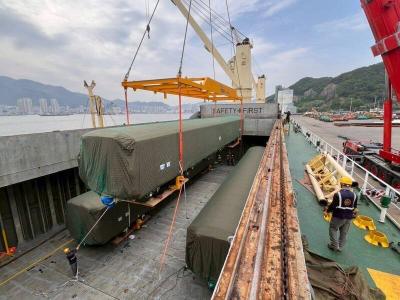
The first of 10 new high-capacity trains purchased from South Korea’s Hyundai Rotem arrived at the Port of Taipei yesterday to meet the demands of an expanding metro network, Taipei Rapid Transit Corp (TRTC) said yesterday. The train completed a three-day, 1,200km voyage from the Port of Masan in South Korea, the company said. Costing NT$590 million (US$18.79 million) each, the new six-carriage trains feature a redesigned interior based on "human-centric" transportation concepts, TRTC said. The design utilizes continuous longitudinal seating to widen the aisles and optimize passenger flow, while also upgrading passenger information displays and driving control systems for a more comfortable
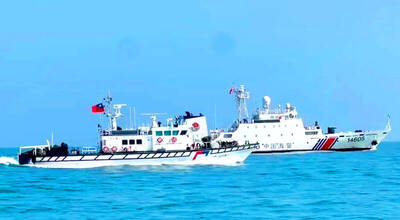
Instead of focusing solely on the threat of a full-scale military invasion, the US and its allies must prepare for a potential Chinese “quarantine” of Taiwan enforced through customs inspections, Stanford University Hoover fellow Eyck Freymann said in a Foreign Affairs article published on Wednesday. China could use various “gray zone” tactics in “reconfiguring the regional and ultimately the global economic order without a war,” said Freymann, who is also a nonresident research fellow at the US Naval War College. China might seize control of Taiwan’s links to the outside world by requiring all flights and ships entering or leaving Taiwan
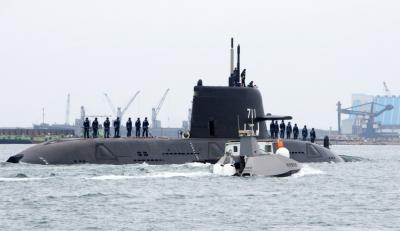
Taiwan's first indigenous defense submarine, the SS-711 Hai Kun (海鯤, or Narwhal), departed for its 13th sea trial at 7am today, marking its seventh submerged test, with delivery to the navy scheduled for July. The outing also marked its first sea deployment since President William Lai (賴清德) boarded the submarine for an inspection on March 19, drawing a crowd of military enthusiasts who gathered to show support. The submarine this morning departed port accompanied by CSBC Corp’s Endeavor Manta (奮進魔鬼魚號) uncrewed surface vessel and a navy M109 assault boat. Amid public interest in key milestones such as torpedo-launching operations and overnight submerged trials,
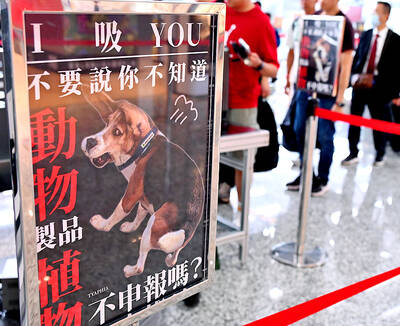
Quarantine awareness posters at Taiwan Taoyuan International Airport have gone viral for their use of wordplay. Issued by the airport branch of the Animal and Plant Health Inspection Agency, the posters feature sniffer dogs making a range of facial expressions, paired with advisory messages built around homophones. “We update the messages for holidays and campaign needs, periodically refreshing materials to attract people’s attention,” quarantine officials said. “The aim is to use the dogs’ appeal to draw focus to quarantine regulations.” A Japanese traveler visiting Taiwan has posted a photo on X of a poster showing a quarantine dog with a


 RSS
RSS