


An exhibition of traditional Paiwan tattoos that draws on research conducted at a community in Pingtung County’s Laiyi Township (來義) opened at the Taichung City Indigenous People Service Center on Tuesday last week.
The exhibition, titled “Ancestral Glory,” features records of interviews and photographs of Paiwan tattoos, a tradition that is vanishing with the passing of the community’s older members.
Common tattoo patterns, rituals surrounding the practice and their cultural significance are highlighted at the exhibit, and several Paiwan Aborigines bearing distinctive tattoos were invited by the organizers to speak at the opening event.
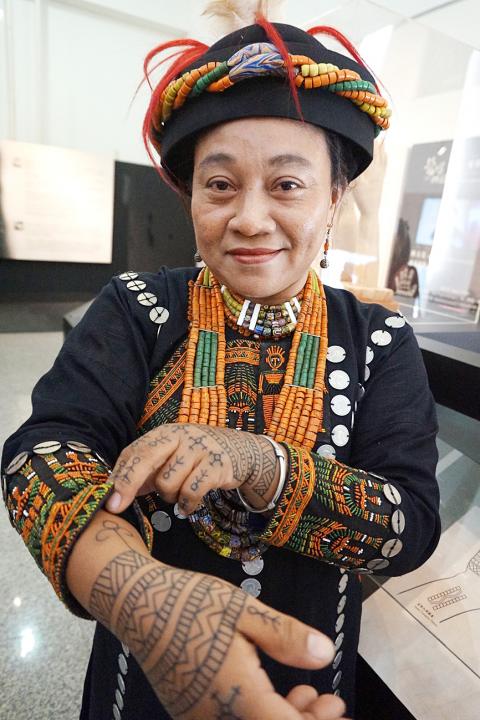
Photo: Ou Su-mei, Taipei Times
A Paiwan shaman blessed the event, and traditional dances were performed.
The Paiwan call torso and upper limb-tattoos yifuchi, and they are steeped in ritual significance, Commission of Indigenous Peoples of Taichung Chairman Kumud Mayaw said.
The tattoos are considered “a painful glory” to pass on the heritage of Paiwan culture from its elder members to young people, he said.
According to information presented at the exhibit, Paiwan men are tattooed on the chest, back and arms, while women are tattooed on the back of their hands.
Laiyi Township Mayor Tou Wang-yi (竇望義) said that government recognition of Aboriginal cultures from nine to 16 in recent years is a positive step toward honoring the distinct cultures of each Aboriginal community, and Taiwanese Aborigines should unite in the spirit of solidarity and mutual assistance.
About two-thirds of the about 30 Paiwan in Pingtung County who still bear traditional tattoos hail from Laiyi, making the township critical for the preservation of Paiwan tattoo culture, the organizers said.
Paiwan tattoo culture was suppressed by the Japanese colonial government and the Republic of China government during the authoritarian period, but the custom was temporarily revived in Laiyi from 1945 to 1947, which accounted for the prevalence of tattooed Paiwan Aborigines in the area, they said.
In 2012, Laiyi Indigenous Museum researcher Chen Wen-shan (陳文山) discovered the prevalence of Paiwan tattoos in the region, and began working on preserving and recording the culture, the organizers said.
Several elders and hunters from Laiyi gave talks at the opening event about their tattoos, including Liao Li-hua (廖莉華), 43, the granddaughter of a couple who had both served as chieftains of the Gulou Community.
Liao said the tattoos on the back of her hands, freshly inked on Oct. 29, were made in accordance with her community’s traditional patterns as recalled by her grandfather.
She said she decided to have the tattoos to preserve her people’s culture.
The tattoos depict the sun and the earth, and were inked on her skin following the ritual sacrifice of a hog and the performance of blessings, Liao said, adding that the day-long tattooing was so excruciating she was in tears throughout the process.

Actor Darren Wang (王大陸) was sentenced to six months in prison, commutable to a fine, by the New Taipei District Court today for contravening the Personal Data Protection Act (個人資料保護法) in a case linked to an alleged draft-dodging scheme. Wang allegedly paid NT$3.6 million (US$114,380) to an illegal group to help him evade mandatory military service through falsified medical documents, prosecutors said. He transferred the funds to Chen Chih-ming (陳志明), the alleged mastermind of a draft-evasion ring, although he lost contact with him as he was already in detention on fraud charges, they said. Chen is accused of helping a

SECURITY: Starlink owner Elon Musk has taken pro-Beijing positions, and allowing pro-China companies to control Taiwan’s critical infrastructure is risky, a legislator said Starlink was reluctant to offer services in Taiwan because of the nation’s extremely high penetration rates in 4G and 5G services, the Ministry of Digital Affairs said yesterday. The ministry made the comments at a meeting of the legislature’s Transportation Committee, which reviewed amendments to Article 36 of the Telecommunications Management Act (電信管理法). Article 36 bans foreigners from holding more than 49 percent of shares in public telecommunications networks, while shares foreigners directly and indirectly hold are also capped at 60 percent of the total, unless specified otherwise by law. The amendments, sponsored by Chinese Nationalist Party (KMT) Legislator Ko

The eastern extension of the Taipei MRT Red Line could begin operations as early as late June, the Taipei Department of Rapid Transit Systems said yesterday. Taipei Rapid Transit Corp said it is considering offering one month of free rides on the new section to mark its opening. Construction progress on the 1.4km extension, which is to run from the current terminal Xiangshan Station to a new eastern terminal, Guangci/Fengtian Temple Station, was 90.6 percent complete by the end of last month, the department said in a report to the Taipei City Council's Transportation Committee. While construction began in October 2016 with an
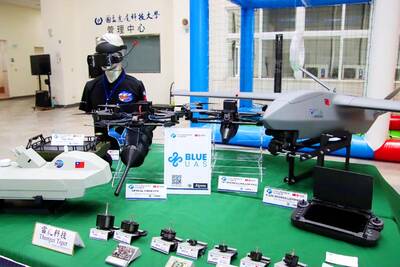
NON-RED SUPPLY: Boosting the nation’s drone industry is becoming increasingly urgent as China’s UAV dominance could become an issue in a crisis, an analyst said Taiwan’s drone exports to Europe grew 41.7-fold from 2024 to last year, with demand from Ukraine’s fight against Russian aggression the most likely driver of growth, a study showed. The Institute for Democracy, Society and Emerging Technology (DSET) in a statement on Wednesday said it found that many of Taiwan’s uncrewed aerial vehicle (UAV) sales were from Poland and the Czech Republic. These countries likely transferred the drones to Ukraine to aid it in its fight against the Russian invasion that started in 2022, it said. Despite the gains, Taiwan is not the dominant drone exporter to these markets, ranking second and fourth


 RSS
RSS