


The Ministry of Education and National Taiwan Normal University (NTNU) on Tuesday last week inaugurated the Office of Global Mandarin Education, with officials saying that they hope to devise strategies and integrate resources to promote the nation as a top destination for foreigners who want to learn the Chinese language.
NTNU president Chang Kuo-en (張國恩) said that when the university founded its Mandarin Training Center in 1956, the institute had only five students, but now about 6,000 students study Chinese at NTNU every year.
About one-third of the students who graduated from the Department of Chinese as a Second Language and the Department of Applied Chinese Language and Culture pursued a career as Chinese teachers at foreign institutions, he added.
With the help of the advisers who the ministry recruited from academia and business, the office is aimed at pooling resources from different sectors of society to promote the nation’s Mandarin education sector, he said.
The office will supply Mandarin teachers to ASEAN members in accordance with the government’s “new southbound policy,” while having a global focus when promoting the nation as a Mandarin-
teaching hub, the ministry’s Department of International and Cross-strait Education Director-General Yang Ming-ling (楊敏玲) said.
Through the joint efforts of NTNU and the ministry, 111 Mandarin teachers were dispatched to 16 nations to teach traditional Chinese, and many of them have built promising careers due to their outstanding work, Yang said.
One of the office’s missions is to identify foreigners’ needs learning Chinese and devise strategies and create teaching methods, she said.
As about half the foreign students studying at NTNU pursue further education after graduating from Chinese programs, 45 universities nationwide have set up language learning centers, which play a pivotal role in the ministry’s initiative to increase the number of foreign students who obtain Taiwanese diplomas, she said.
Responding to media queries about how the nation would respond to competition from China in the field of Chinese education, given the international prevalence of Confucius Institute branches set up by the Chinese government to promote Chinese education, NTNU vice president Sung Yao-ting (宋曜廷) said that even though China has spent profusely on sending teachers abroad to teach Chinese, Taiwan outperforms China with its animated teaching materials.
Sung said the most common criticism about the institute is that its teaching materials are laced with dogmas and that its teaching methods lack ingenuity.
With the help of the Internet, students who sign up for Chinese learning or graduate programs can obtain their diplomas online, he said.
Another edge Taiwan has over China is its technology-driven classes, Sung said, citing NTNU’s Smart Pinyin system, which automatically detects problems with foreign students’ intonation and corrects them.
“I think we have a pretty good chance [against China],” Sung said.
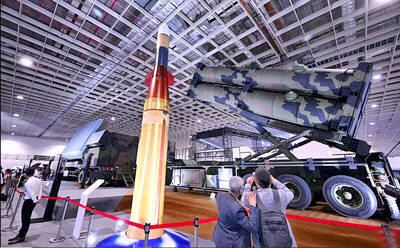
Taiwan is to commence mass production of the Tien Kung (天弓, “Sky Bow”) III, IV and V missiles by the second quarter of this year if the legislature approves the government’s NT$1.25 trillion (US$39.78 billion) special defense budget, an official said yesterday. Commenting on condition of anonymity, a defense official with knowledge of the matter said that the advanced systems are expected to provide crucial capabilities against ballistic and cruise missiles for the proposed “T-Dome,” an advanced, multi-layered air defense network. The Tien Kung III is an air defense missile with a maximum interception altitude of 35km. The Tien Kung IV and V
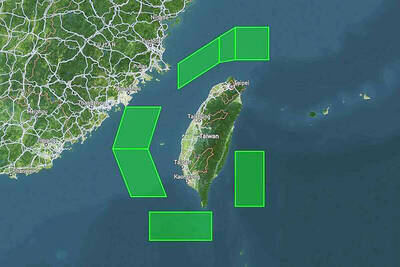
The disruption of 941 flights in and out of Taiwan due to China’s large-scale military exercises was no accident, but rather the result of a “quasi-blockade” used to simulate creating the air and sea routes needed for an amphibious landing, a military expert said. The disruptions occurred on Tuesday and lasted about 10 hours as China conducted live-fire drills in the Taiwan Strait. The Civil Aviation Administration (CAA) said the exercises affected 857 international flights and 84 domestic flights, affecting more than 100,000 travelers. Su Tzu-yun (蘇紫雲), a research fellow at the government-sponsored Institute for National Defense and Security Research, said the air
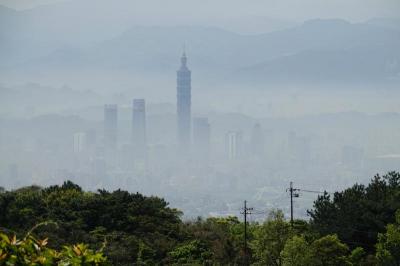
A strong continental cold air mass is to bring pollutants to Taiwan from tomorrow, the Ministry of Environment said today, as it issued an “orange” air quality alert for most of the country. All of Taiwan except for Hualien and Taitung counties is to be under an “orange” air quality alert tomorrow, indicating air quality that is unhealthy for sensitive groups. In China, areas from Shandong to Shanghai have been enveloped in haze since Saturday, the ministry said in a news release. Yesterday, hourly concentrations of PM2.5 in these areas ranged from 65 to 160 micrograms per cubic meter (mg/m³), and pollutants were
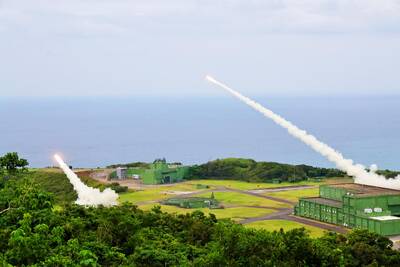
Taiwan lacks effective and cost-efficient armaments to intercept rockets, making the planned “T-Dome” interception system necessary, two experts said on Tuesday. The concerns were raised after China’s military fired two waves of rockets during live-fire drills around Taiwan on Tuesday, part of two-day exercises code-named “Justice Mission 2025.” The first wave involved 17 rockets launched at 9am from Pingtan in China’s Fujian Province, according to Lieutenant General Hsieh Jih-sheng (謝日升) of the Office of the Deputy Chief of the General Staff for Intelligence at the Ministry of National Defense. Those rockets landed 70 nautical miles (129.6km) northeast of Keelung without flying over Taiwan,


 RSS
RSS