


William Theodore de Bary, whose calls for dialogue among different civilizations differ vastly from Samuel Huntington’s focus on clashes between civilizations, was yesterday awarded the Tang Prize in sinology “for his pioneering contributions in Confucian studies.”
“In his remarkable academic career spanning more than seven decades, he has written and edited more than 30 books, with many of them making groundbreaking contributions that provide both enlightening insight and honest critique into Confucianism,” Nobel laureate Lee Yuan-tseh (李遠哲), who chairs the Tang Prize Selection Committee, read from the citation at a news conference in Taipei.
“Recognized for establishing the field of neo-Confucianism in the West, Professor De Bary is indeed a leading authority in the field of sinology,” the Tang Prize citation read.
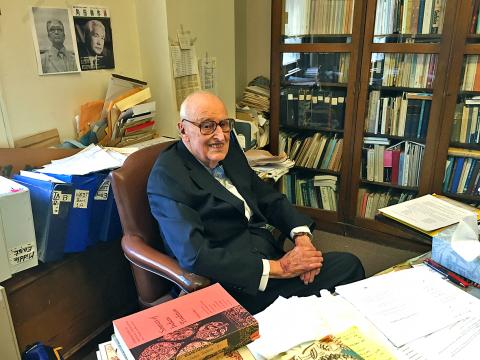
Photo: CNA
De Bary, 96, is recognized as a pioneering academic in the field of Confucian intellectual history. In recent years, he has turned his focus to a comparative study of Western and Eastern civilizations and their areas of compatibility.
In his 2004 book Nobility and Civility: Asian Ideals of Leadership and the Common Good, De Bary propounds that utilizing only a Western perspective as a compass for civilization is not consistent with multiculturalism.
He argued that the East has a long history of independent traditions and will not follow the Western model of development.
He holds an open and multicultural outlook, encouraging dialogue between different cultures as a way to find common ground, showcase the value of human rights and civil society and resolve key issues facing the world today.
He said the Confucian teachings of “restraining oneself” and “the Way and its relationship to all things” still apply today.
In 1988 in East Asian Civilizations: A Dialogue in Five Stages, he analyzed the development and exchanges within East Asian civilization and suggested encouraging dialogue and exchanges between different cultures and civilizations.
Besides his academic achievements, De Bary has headed many academic projects, including the translation and compilation of various texts.
De Bary told the Central News Agency in a recent interview that Taiwan has done well to preserve Confucianism, a key element of Chinese culture and the focus of his lifetime study.
On the question of the complex relations between Taiwan and China, De Bary said the differences between the two sides are not as great now as when the Chinese Nationalist Party (KMT) moved to Taiwan.
The KMT “set up an independent China offshore that was very important to preserving the Chinese tradition in the early years of the Communist regime in the mainland,” he said.
De Bary said he was particularly appreciative of the efforts by the KMT to preserve Confucianism in Taiwan.
“They have done so very well throughout the period when communism on the mainland was very, very damaging,” he said. “Fortunately, the Communists have learned to adjust and to accept Confucianism in many ways.”
However, De Bary said he was not sure the Chinese were using Confucianism in the same way as the “liberals” in Taiwan.
The Tang Prize was established by Taiwanese entrepreneur Samuel Yin (尹衍樑) in 2012 to honor top researchers and leaders in four fields: sustainable development; biopharmaceutical science; sinology; and the rule of law.
Each category carries a prize of NT$50 million (US$1.55 million).
The first Tang Prize award ceremony was held in 2014.

The Ministry of Finance this afternoon announced the winning numbers for the March-April uniform invoice lottery. The winning number for the NT$10 million (US$318,060) special prize is 19531471, and the winning number for the NT$2 million grand prize is 85941329. Three numbers were drawn for the NT$200,000 first prize: 07225810, 20231230 and 83518781. Those with receipts matching the last seven digits of any of the first-prize numbers will win the NT$40,000 second prize, while those matching the last six digits will win the NT$10,000 third prize. Those whose receipts match the last five digits of the first-prize numbers can claim the NT$4,000 fourth prize,

SIX SUBSIDIES: The monthly allowance for older farmers is to increase to NT$10,000, and NT$5,000 is to be given to homemakers under the national pension system, Lai said The government is to implement major welfare policies for disadvantaged groups, including raising the monthly allowance for older farmers to NT$10,000 and providing homemakers with NT$5,000 per month, President William Lai (賴清德) said yesterday. Lai made the remarks during a visit to Wangling Temple in Chiayi County, saying that the planned increases were being introduced amid economic growth and an increase in tax revenue. Touting a policy, in which the government plans to provide a monthly allowance of NT$5,000 for every child under the age of 18 in a bid to address Taiwan’s low birthrate, Lai said that if received for the
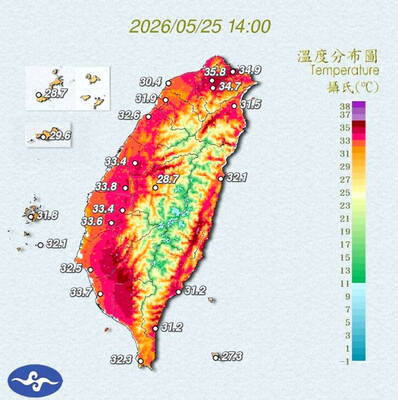
STAY COOL: The HPA recommended that people stay hydrated, use air-conditioning or fans while indoors, wear loose-fitting clothes and walk in the shade while outdoors Employers must implement measures such as installing cooling equipment, and providing drinking water and rest breaks for outdoor workers starting from Monday next week, the Taipei Department of Labor said on Sunday. Employers who fail to comply could face fines of NT$30,000 to NT$300,000 under the Occupational Safety and Health Act (職業安全衛生法), the department said. Businesses in Taipei employing fewer than 100 workers, as well as registered self-employed workers with labor insurance coverage, could receive on-site assessments and guidance from occupational safety consultants to help them apply for central government subsidies to implement or improve heat-protection measures, it said. Under the Ministry of
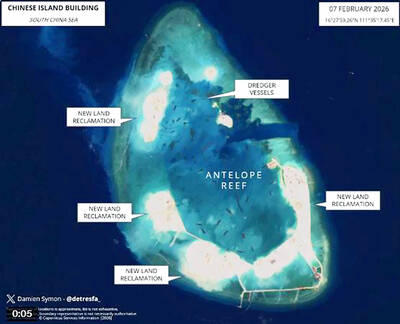
ISOLATION: The outposts would serve as support and backup bases, forcing US forces to either face China head-on or reroute, increasing travel time and operational costs China’s outposts in the South China Sea could be used to delay and constrain foreign forces during a conflict in the Taiwan Strait, giving Beijing a critical window to carry out amphibious landing and blockade operations, a report said. The Chinese Communist Party’s (CCP) forward operating bases on islands and reclaimed features in the South China Sea could delay foreign forces long enough for the Chinese People’s Liberation Army (PLA) to secure a key 48-to-72-hour window in the Taiwan Strait, a report commissioned by the Mainland Affairs Council found. The report, conducted by the Institute for National Defense and Security Research, examined


 RSS
RSS