


The return of the decapitated head of a Gautama Buddha statue from Taiwan to China signified that “both sides of the Taiwan Strait belong to the same family,” Buddhist Master Hsing Yun (星雲法師) said on Sunday.
Hsing Yun made the remarks at a media event in Kaohsiung marking the stolen artifact’s return by air to China on Friday last week, with Hsing Yun escorting the statue.
He is one of Taiwan’s most revered Buddhist monks and a vocal commentator on political issues.
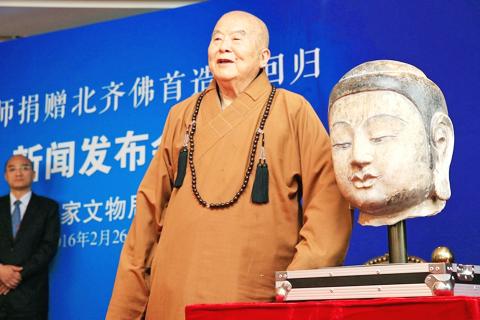
Photo: Courtesy of Fo Guang Shan Monastery
His latest comment mirrored a previous remark he made at the 2009 World Buddhist Forum in China.
He was reported to have said: “Both sides of the Taiwan Strait belong to the same family. There are no Taiwanese in Taiwan and all Taiwanese are Chinese,” a comment for which he was slammed by Taiwanese critics for “inappropriate meddling” in politics.
The white-jade carving of Gautama Buddha’s head — reportedly dated back to the Northern Qi Dynasty (550-577) — was targeted by thieves in 1996 at the Youju Temple (幽居寺) in China’s Hebei Province in 1992.
In response to the incident, officials increased security at the temple, but in 1996, looters decapitated the statue and made off with its head, which was sold on the black market.
An anonymous Taiwanese collector later purchased the head of the decapitated statue through intermediary dealers and gifted it to Hsing Yun in 2014, according to the master.
Working with Chinese authorities, Hsing Yun arranged for the repair of the complete statue in Kaohsiung at his Fo Guang Shan Monastery (佛光山) and displayed the restored statue for 275 days prior to taking it to China on Friday.
A ceremony was held at Beijing Capital International Airport, with Chinese State Administration of Cultural Heritage Director Liu Yuzhu (劉玉珠) in attendance.
Hsing Yun said the unnamed antique collector donated the head of the statue to his monastery, saying that it was too big for his residence and that it should be venerated in a religious temple.
The artifact was purchased for more than NT$10 million (US$298,579) and the unnamed collector knew only that it was created during the Northern Qi Dynasty, Hsing Yun added.
Former Chinese president Jiang Zemin (江澤民) once gave Beijing’s blessing to Fo Guang Shan’s display of Buddhist relics in Taiwan, Hsing Yun said, reciting prose he said Jiang composed for the occasion: “At the lead of Hsing Yun, at our joint invitation, we venerate together, with guaranteed safety.”
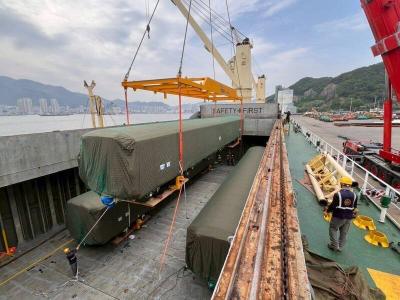
The first of 10 new high-capacity trains purchased from South Korea’s Hyundai Rotem arrived at the Port of Taipei yesterday to meet the demands of an expanding metro network, Taipei Rapid Transit Corp (TRTC) said yesterday. The train completed a three-day, 1,200km voyage from the Port of Masan in South Korea, the company said. Costing NT$590 million (US$18.79 million) each, the new six-carriage trains feature a redesigned interior based on "human-centric" transportation concepts, TRTC said. The design utilizes continuous longitudinal seating to widen the aisles and optimize passenger flow, while also upgrading passenger information displays and driving control systems for a more comfortable
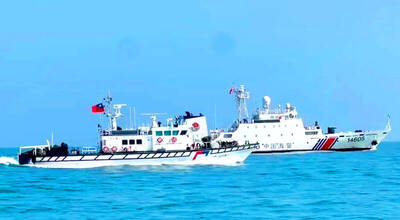
Instead of focusing solely on the threat of a full-scale military invasion, the US and its allies must prepare for a potential Chinese “quarantine” of Taiwan enforced through customs inspections, Stanford University Hoover fellow Eyck Freymann said in a Foreign Affairs article published on Wednesday. China could use various “gray zone” tactics in “reconfiguring the regional and ultimately the global economic order without a war,” said Freymann, who is also a nonresident research fellow at the US Naval War College. China might seize control of Taiwan’s links to the outside world by requiring all flights and ships entering or leaving Taiwan
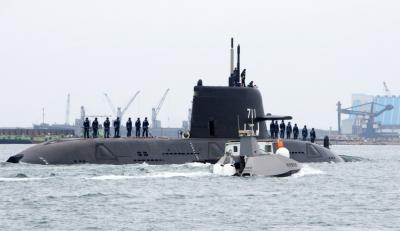
Taiwan's first indigenous defense submarine, the SS-711 Hai Kun (海鯤, or Narwhal), departed for its 13th sea trial at 7am today, marking its seventh submerged test, with delivery to the navy scheduled for July. The outing also marked its first sea deployment since President William Lai (賴清德) boarded the submarine for an inspection on March 19, drawing a crowd of military enthusiasts who gathered to show support. The submarine this morning departed port accompanied by CSBC Corp’s Endeavor Manta (奮進魔鬼魚號) uncrewed surface vessel and a navy M109 assault boat. Amid public interest in key milestones such as torpedo-launching operations and overnight submerged trials,
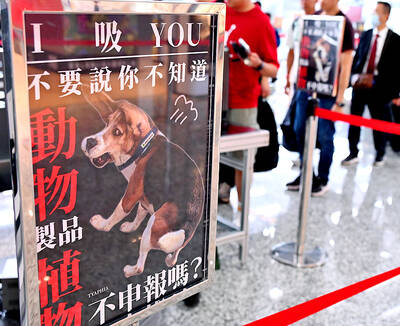
Quarantine awareness posters at Taiwan Taoyuan International Airport have gone viral for their use of wordplay. Issued by the airport branch of the Animal and Plant Health Inspection Agency, the posters feature sniffer dogs making a range of facial expressions, paired with advisory messages built around homophones. “We update the messages for holidays and campaign needs, periodically refreshing materials to attract people’s attention,” quarantine officials said. “The aim is to use the dogs’ appeal to draw focus to quarantine regulations.” A Japanese traveler visiting Taiwan has posted a photo on X of a poster showing a quarantine dog with a


 RSS
RSS