

Amid an ongoing controversy over Sun Yat-sen’s (孫逸仙) status as the nation’s “founding father,” Legislative Speaker Su Jia-chyuan (蘇嘉全) yesterday refused to bow to Sun’s portrait when a Chinese Nationalist Party (KMT) lawmaker asked him to do so during a legislative question-and-answer session.
When taking the floor, KMT Legislator-at-large Chang Li-shan (張麗善) asked Premier Simon Chang (張善政) to walk to the center of the legislative chamber for the ceremonial “three bows” to Sun’s portrait, which hangs above the seat of the legislative speaker facing the chamber.
Chang Li-shan, who is from a politically influential family in Yunlin County, then asked Su, and all officials and lawmakers present at the chamber, to join her in the courtesy bows.
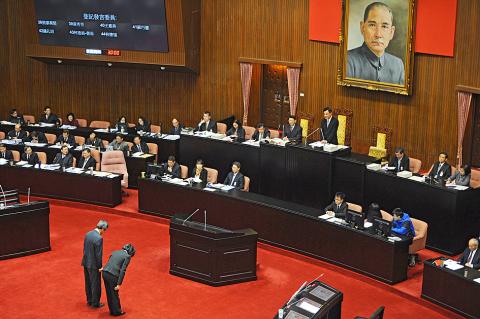
Photo: CNA
Su rebuffed her request, saying it was inappropriate to undertake such an action during a session and there was no precedent for it.
“If every legislator wanted to do so, it would not be in line with procedures,” Su said.
“I urge all legislators to respect their turn on the floor, and they should conduct themselves in an appropriate manner during the question-and-answer session,” Su added.
Chang Li-shan said that since the legislature has not yet approved a proposal to remove Sun’s portraits from public buildings, the legislative speaker, as the head of people’s elected representatives, should pay his respect to the Republic of China’s founding father.
Su replied: “I can decide on my own whether to face the portrait of the ‘founding father’ or not.”
Together with Simon Chang, the KMT legislator performed the courtesy bows to Sun’s portrait, as she bellowed the traditional summons of “first bow, second bow, third bow.” The other legislators and government officials did not join them and remained in their seats.
During the afternoon session, Simon Chang said: “In theory, it is OK to take such bows to Sun’s portrait.”
“It has always been OK to do so, but on what occasions? The legislative speaker has his way of presiding over the chamber, and we should also respect how the speaker conducts the sessions,” he said.
“I was not sure if it had violated the legislature’s regulations, but we should abide by the legislative speaker’s decision. So I will check with the him on this issue later on,” he added.
The premier said he was in a difficult position at the time, so he paid his respects with a slight dipping of his head.
On Friday last week, KMT legislators blocked a proposal to remove Sun’s portrait from public buildings by returning three related draft bills to the Procedure Committee.
DPP Legislator Gao Jyh-peng (高志鵬) met with strong opposition from KMT legislators following his proposal to drop the tradition of saluting the portrait of Sun, referred to as the nation’s “founding father” by decrees under past KMT administrations.
Gao drafted amendments to the National Emblem and National Flag of the Republic of China Act (中華民國國徽國旗法) and the Oath Act (宣誓條例) for his proposal, saying that there is no constitutional basis for Sun’s title.
“The DPP has created a mechanism for transitional justice, which will deliberate on removing Sun’s portrait, and the proposals will be in its reports. As the KMT is opposed to the proposals, we are back to the Procedure Committee,” Gao said.

‘FRIENDSHIP FLEET’: A CGA official is scheduled to meet with the president of the Pacific nation, while one of the ships is to host a banquet and National Day event Two Coast Guard Administration (CGA) patrol vessels have docked at Malakal Harbor in Palau as part of an expedition exercise and diplomatic visit, during which a senior official is expected to meet with Palauan President Surangel Whipps Jr, the agency said yesterday. The two vessels, the 4,000-tonne-class Chiayi and the 1,000-tonne-class Penghu, set sail for Palau from Taiwan last week and arrived on Tuesday at Malakal Harbor, the CGA’s Fleet Branch said in a statement. The journey marks the second time the CGA has dispatched a “friendship fleet” to another country, after it sent its first-ever goodwill fleet, comprising the Hualien and

The Coast Guard Administration (CGA) today said that two of its patrol vessels have docked at Palau's Malakal Harbor as part of an expedition exercise and diplomatic visit, during which a senior official is expected to meet with the Palauan president. The two vessels, the 4,000-tonne-class Chiayi (嘉義) and the 1,000-tonne-class Penghu (澎湖), set sail for Palau from Taiwan last week and arrived at Malakal Harbor yesterday, the CGA's Fleet Branch said in a statement. The journey marked the second time the CGA has dispatched a "Friendship Fleet" to another country, after it sent its first-ever goodwill fleet, comprising the Hualien (花蓮)
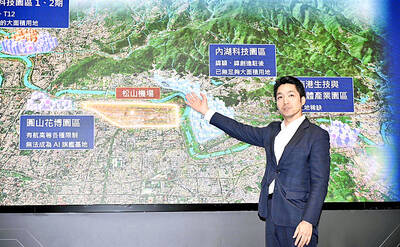
DETAILED PLAN NEEDED: Relocating the airport would affect not just travelers, but also undermine national defense and emergency medical services, a legislator said Taipei Mayor Chiang Wan-an (蔣萬安) yesterday proposed relocating Taipei International Airport (Songshan airport) and turning the site into an artificial intelligence (AI) park, drawing opposition from politicians across party lines. Chiang’s plan would turn the 300 hectares into an AI park featuring tech clusters, residential communities and green space. The industrial cluster would host 200 domestic enterprises, generate NT$12 trillion (US$376.47 billion) in output, and accommodate 65,000 jobs and 35,000 residents, he said. Cabinet spokeswoman Michelle Lee (李慧芝) said the Executive Yuan was surprised by the announcement, as the Taipei City Government did not discuss the proposal with the central government before making
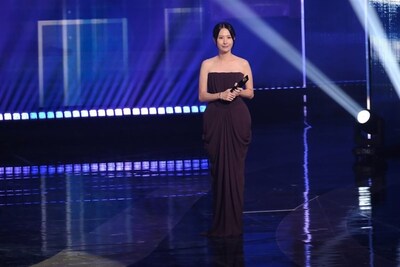
Had I Not Seen the Sun (如果我不曾見過太陽), a coming-of-age mystery romance, yesterday won best series at the Seoul International Drama Awards in South Korea. The show's producer, Phoebe Ma (麻怡婷), accepted the award on behalf of the production team. "Telling this story was difficult," Ma said. "There were moments when I doubted my strength to keep going, but I never doubted the story itself." Ma went on to thank the cast and crew of the show for making the win possible. Released in two parts on Netflix at the end of last year, the 20-episode drama starred Tseng Jing-hua (曾敬驊) and Alice Ko (柯佳嬿). The


 RSS
RSS