


The National Communications Commission (NCC) yesterday approved an application by Television Broadcasts Satellite (TVBS) for changes to its shareholding structure after its majority owner sold all its shareholdings to three Taiwanese firms.
The changes still have to be approved by the Investment Commission.
The Taiwanese cable television network announced last month that Television Broadcasts Ltd (TVB) of Hong Kong, which owned 47 percent of its shareholdings, had sold all of its stake to three Taiwanese shareholders, which now collectively own 53 percent.
The three shareholders are Li Mao (利茂) Investment Co, De En Investment Co and Lien Xin Investment Co — all of which are reportedly affiliated with HTC chairwoman Cher Wang (王雪紅).
NCC Secretary-General Jason Ho (何吉森) said the commission approved the transaction after an investigation that showed it does not include funding from Chinese or other foreign investors, does not violate the Satellite Broadcasting Act (衛星廣播電視法) and that it would not lead to a monopolization of news media.
The commission said that Li Mao and PSU Corp would emerge as the two main shareholders of TVBS, holding 29 percent and 35 percent of its shares respectively.
PSU was the recipient of shares transferred from De En and Lien Xin, which each owned about 17 to 18 percent of TVBS shares.
Li Mao, PSU, De En and Lien Xin are all funded by Taiwanese investors, the commission said.
The approval moves TVBS one step closer to becoming a network funded entirely by Taiwanese investors.
In related news, a survey by the Taiwan Digital Convergence Development Association showed that 68.1 percent of respondents are concerned that China is trying to influence public opinion in Taiwan by acquiring television networks and newspapers through Taiwanese businesspeople based in China, up 2.1 percentage points compared with a similar survey conducted a year ago.
The survey also showed that about 60 percent of respondents thought the government should completely ban Chinese investors from acquiring media outlets in Taiwan, against 27.7 percent who said Chinese investors should be allowed to invest in local media.
In addition, 57 percent said that Taiwanese businesspeople in China should not be permitted to acquire Taiwanese media outlets, while 32.4 percent thought such a restriction is unnecessary.
Asked about Far EasTone Telecommunications’ (FET) proposed acquisition of China Network Systems’ (CNS) cable television systems by subscribing to corporate bonds issued by Morgan Stanley, 64.3 percent said the network should not be sold to Taiwanese businesspeople based in China, and 68 percent said CNS should be turned into a state-owned property and managed by the public television network Taiwan Broadcasting System.
In addition, 68 percent said the FET-CNS case should be handled by the new government and new legislature, 68.89 percent said it was inappropriate for the NCC to approve the deal before the new legislative session opened last week and 76 percent said the case should be reopened and be subject to another review
Commenting on the survey results, New Power Party Legislator Hsu Yung-ming (徐永明) said the incumbent government should not rule on the FET-CNS deal, nor should it rule on deals involving changes in ownerships at Eastern TV network and Taiwan Broadband Communications.
All these cases should be handled by the new government after it takes office on May 20, he said.

REASONS FOR TRAVEL: An assistant professor said that proposed amendments to penalize drivers if they used drugs overseas would not deter people from traveling People who operate a motor vehicle under the influence of marijuana would have their driver’s license revoked, even if they used the substance while overseas, the Ministry of Transportation and Communications said yesterday, citing proposed amendments to the Road Traffic Management and Penalty Act (道路交通管理處罰條例). The amendments would also authorize the government to revoke the licenses of people determined to have used Category 1 or Category 2 narcotics, even if they were not operating a vehicle while under the influence of drugs, as well as ban them from taking the license test for three years, the ministry said. People aged 18 or

GLOBALGIVING: ‘ Caving to external pressure is not acceptable for an organization that has cultivated justice reform and human rights for 30 years,’ one NGO said A slew of non-government organizations (NGOs) have withdrawn from the GlobalGiving fundraising platform after it announced it would use “Chinese Taipei” instead of “Taiwan” from next month. The Taiwan Good Rice Association wrote on Facebook on Friday that it was informed on April 28 via a teleconference call of the change, which was made because the platform wanted to operate in China. Taiwan Good Rice is to terminate all cooperative relationships with GlobalGiving in response to the platform’s “unilateral and non-negotiable” decision to remove references to Taiwan, the NGO said. “Taiwan is in the official name of Taiwan Good Rice Association and the

HEAVY WEATHER: Typhoon Jangmi is due to crash straight into the Ryukyus as airlines look to shift flights to larger aircraft or cancel flights to Okinawa entirely Taiwan’s international air carriers announced flight adjustments over the weekend as Typhoon Jangmi is forecast to hit the Ryukyu Islands today and tomorrow. The Central Weather Administration (CWA) upgraded Jangmi from a tropical storm to a typhoon at 8am yesterday, with the eye located 580km south of Naha city. It was moving north at 19kph. Today, China Airlines’ CI-120, CI-121, CI-122 and CI-123 flights between Taoyuan and Naha, Okinawa, have been canceled as well as CI-132 and CI-133 between Kaohsiung and Naha. EVA Air’s BR-112, BR-113, BR-186 and BR-185 flights between Taoyuan and Naha are also canceled. Low-cost carrier Tigerair Taiwan canceled IT-230,
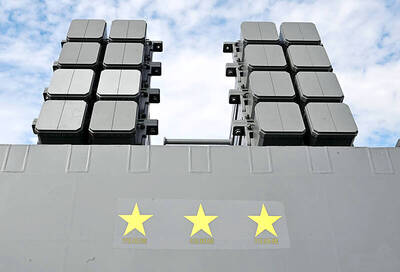
UPGRADE: The Kang Ding-class frigate is replacing its Chaparall missiles with Tien Chien II and Hua Yang VLS, which would provide it with long-range, 360° air defense Taiwan plans to produce 1,200 to 1,376 Hai Chien II missiles (海劍二, Sea Sword II) — also known as TC-2N — to serve as the standard air defense system of the navy’s surface combatant fleet, a source said yesterday. Last week, the Hai Chien II, the naval version of the Tien Kung II missile (天劍二, Sky Sword II), completed a live-fire test in waters off the National Chungshan Institute of Science and Technology’s Jiupeng facility (九鵬) in Pingtung County’s Manjhou Township (滿州). The MIM72 Chaparral and other dated air defense missiles that currently arm Taiwanese ships have inadequate range to combat Chinese


 RSS
RSS