


In both the 2012 and this year’s presidential and legislative elections, the Democratic Progressive Party (DPP) tried to gain more votes from Hakka communities, which are often considered Chinese Nationalist Party (KMT) strongholds. However, taking a closer look into election outcomes in the communities shows that ethnicity might not be such an important factor.
When speaking of “Hakka voters,” many think of Taoyuan, as well as Hsinchu and Miaoli counties and cite election outcomes in those constituencies to show that “Hakka voters are mostly pro-KMT,” and thus for the DPP to win more support from them, it must come up with more “Hakka policies.”
However, that impression is far from the reality.
First, Taoyuan, Hsinchu and Miaoli are not the only regions with large concentrations of Hakka. According to the Hakka Affairs Council, there are 69 townships or municipal districts in the nation with more than one-third of their population being Hakka, notably the Liudui (六堆) region, which includes a number of districts and townships in Kaohsiung and Pingtung County.
In Kaohsiung’s Meinong District (美濃), for example, 86.63 percent of the population is Hakka, in Pingtung’s Sinpi Township (新埤), 53.56 percent of residents are Hakka, in Neipu Township (內埔), 63.45 percent, in Linluo Township (麟洛), it is 68.15 percent, and in Jhutian Township (竹田), more than 71 percent are Hakka, according to council statistics.
In all these areas, president-elect Tsai Ing-wen (蔡英文) garnered more than 50 percent of the votes in Saturday’s election — 59.16 percent in Meinong, 66.19 percent in Sinpi, 68.02 percent in Neipu, 68.94 percent in Linluo and in Jhutian, which has the highest concentration of Hakka, Tsai won 70.23 percent of the votes, according to statistics from the Central Election Commission.
The percentage of people in the areas who voted for Tsai in the 2012 presidential election were more or less the same.
Election outcomes in Hakka communities outside Taoyuan, Hsinchu and Miaoli show that the theory of Hakka voters being pro-KMT is false.
The theory does not even hold true in Taoyuan, Hsinchu and Miaoli.
A man surnamed Huang (黃) from Hsinchu’s Jhubei City (竹北), who was born to a Hakka father and a Hoklo mother, but identifies himself as Hakka, rejected the importance of “Hakkaness” in relation to elections.
“For me, ‘Hakkaness’ is an abstract idea and a non-existant issue. Whether a candidate is Hakka is not a factor that would influence my voting at all,” he said.
What would be a factor then?
“In Hsinchu and Miaoli, political factions as well as large family clans play a key role in elections. Voters do not necessarily judge a candidate by their political affiliation, not even the so-called ‘Hakka policies,’” said a Hakka surnamed Peng (彭), who lives in Hsinchu’s Jhudong Township (竹東).
Historically, Hakka in Taoyuan, Hsinchu and Miaoli were among dissidents who resisted the KMT regime in the 1940s and 1950s.
Gradually, the KMT got a grip on local politics by collaborating with families and native political forces, while winning control of farmers’ associations and irrigation associations in the predominantly agricultural areas.
In Miaoli, the Liu (劉) faction and the Huang (黃) faction took turns in control of the local government. The KMT is believed to have deliberately developed two factions so they would provide checks and balances on each other to avoid one side growing too strong; potentially threatening the KMT’s control over local politics.
In Hsinchu, the large clans of Chen (陳), Lin (林), Cheng (鄭) and Fan (范), as well as minor clans, are in control of local politics.
With the rules of the game established and the KMT making sure it provided benefits from it being in power, it was difficult for a latecomer, the DPP in this case, to join the game.
However, the DPP has also secured some victories.
Former Hsinchu County commissioners Fan Chen-tsung (范振宗), who served two terms from 1989 to 1997, and Lin Kuang-hua (林光華), who served from 1997 to 2001, were both DPP members.
However, Fan and Lin were elected not because voters in Hsinchu wanted a rotation of power, but because the Fan family is one of the larger ones in control of local politics in Hsinchu. Thus the two were elected with the help of the clans.
Fan ran as an independent in 1989 and only joined the DPP after his win, while Lin is not only from an influential local family clan, but also served as an administer, a member of the board of directors and chairperson of Yimin Temple (義民廟) in Hsinchu County’s Sinpu Township (新埔), which was the most important religious center for Hakka not only in Hsinchu, but also in most of northern Taiwan.
The election wins for Fan and Lin in Hsinchu County — the region with highest concentration of Hakka in the nation — show a politician’s party affiliation might not be so important, as long as they have a connection to the right faction or family.
The DPP seems to have learned the lesson, as in this year’s presidential election, it chose to work with local factions.
In Miaoli, the party mobilized support from several local political leaders, including Cholan Township (卓蘭) Mayor Chan Kun-chin (詹坤金) of the KMT, while in Hsinchu County almost all township mayors, regardless of party affiliation, were neutral, if not supportive of Tsai.
In the legislative race, the DPP did not nominate its own candidate in Hsinchu County, but supported independent candidate Cheng Yung-chin (鄭永金), who had served both as county commissioner and legislator, and was backed by the Cheng family.
As for Taoyuan, mobilization of support was easier for the DPP, as Taoyuan Mayor Chen Wen-tsan (鄭文燦) is a DPP member.
The DPP’s strategy has apparently worked.
In 2012, Tsai lost to her KMT rival by nearly 390,000 votes in Miaoli, Hsinchu and Taoyuan — where nearly 40 percent of the population is Hakka — but on Saturday, she defeated KMT presidential candidate Eric Chu (朱立倫) by more than 200,000 votes over the three regions.

FUKUOKA SITUATION: Japanese media reported that the pathogen is expected to be identified by the summer, while the CDC downplayed the idea that it was hMPV A “mysterious cold-like illness” reported in Japan’s Fukuoka Prefecture does not seem to be a new disease, but Japanese authorities have been asked about the situation, the Centers for Disease Control (CDC) said yesterday. The Fukuoka Prefectural Medical Association on Wednesday told a news conference that a “mystery cold” that has become a hot topic on social media is “highly likely to be caused by some kind of viral infection,” Japan’s KBC News reported. “Many people are experiencing symptoms starting with a sore throat, followed by a runny nose, phlegm and a severe cough,” KBC News reported, citing association officials. Health authorities are

Nvidia Corp CEO Jensen Huang (黃仁勳) arrived in Taiwan yesterday ahead of upcoming AI and technology events, saying he plans to meet with clients and Taiwan Semiconductor Manufacturing Co Chairman C.C. Wei (魏哲家) during his visit. After landing at Taipei Songshan Airport, Huang posed for photos with fans and handed out Yakult drinks to reporters and supporters waiting at the scene, saying he has “a lot to do” during the trip. Asked about reports that Nvidia’s planned headquarters site in Taipei’s Beitou Shilin Technology Park could break ground on May 27, Huang said that if the company holds an event, he would

The Ministry of Finance this afternoon announced the winning numbers for the March-April uniform invoice lottery. The winning number for the NT$10 million (US$318,060) special prize is 19531471, and the winning number for the NT$2 million grand prize is 85941329. Three numbers were drawn for the NT$200,000 first prize: 07225810, 20231230 and 83518781. Those with receipts matching the last seven digits of any of the first-prize numbers will win the NT$40,000 second prize, while those matching the last six digits will win the NT$10,000 third prize. Those whose receipts match the last five digits of the first-prize numbers can claim the NT$4,000 fourth prize,
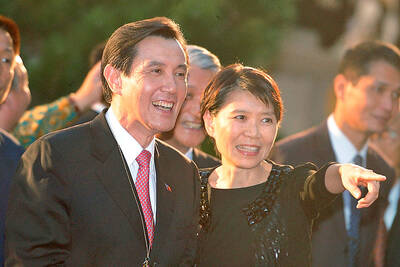
Former president Ma Ying-jeou (馬英九) yesterday expressed “shock and regret” over a statement issued by his wife without his consent, and rejected her assertion that his eldest sister, Ma Yi-nan (馬以南), would manage his medical care or act as his spokesperson amid an ongoing embezzlement probe into his foundation. Ma Ying-jeou in a statement said he was shocked by a statement by his wife, Chou Mei-ching (周美青), regarding his affairs. Ma Yi-nan “must not” be in charge of his healthcare and other personal affairs, nor can she be allowed to represent the Ma family, the former president said. He said he was also


 RSS
RSS