


The Old Tait & Co Merchant House in Tainan is to reopen its doors to the public tomorrow after the first major renovation of its exposition area in more than three decades, combining history and modern technology in the hopes of attracting more people to learn about the city’s heritage.
The building is the former headquarters of the Tait Marketing and Distribution Co (德記洋行), which was established in 1845 as a subsidiary of Britain’s East India Company in the city of Xiamen in China’s Fujian Province and later established a branch office in the town of Anping in 1867.
The administration of the renovated building has invited National Taiwan History Museum associate research fellow Shih Wen-cheng (石文誠) to host a new exhibition focused on trade in the historical area.
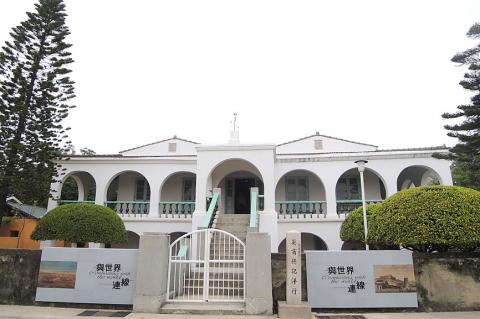
Photo: Liu Wan-chun, Taipei Times
The exhibition features a model of Anping Fort’s (安平古堡) trade districts, leading visitors back in time, starting from the present.
Walking through the exhibition takes visitors from the 21st century to the merchant house’s creation in the 19th century, featuring a document by the Qing Dynasty’s then-governor of Taiwan approving the establishment of the business in Anping.
The exhibition also includes stone tablets used to demarcate borders, as well as scales, typewriters, calculators and utensils used in that era, giving visitors a comprehensive look into the lives of foreign merchants living in Taiwan.
Another item on display is half a barrel facing a landscape painting, which allows visitors to take photographs from the perspective of foreign merchants in the 19th century, who would sit in the bamboo barrels and be ferried between ships across canals and rivers.
Aside from the cultural and historical items on display, the renovated exposition area also includes a popular interactive “room escape” game, in which visitors need to correctly answer 12 questions about the exhibition within 180 seconds to exit the room via a door blocked by laser beams that are deactivated when questions are correctly answered.
Some of the exhibits on the first floor were borrowed from Penghu County’s Bureau of Cultural Affairs, including copper bars that were a staple of Japanese exports in the 17th century that were brought to Taiwan by Dutch merchants.
The first floor also introduces routes Dutch merchants took across the seas, the methods of trade and the beginnings of the merchant house.
Wax statues depicting the early lifestyles and living conditions of Taiwanese in that era were retired from the exhibition, Tainan Bureau of Cultural Affairs Deputy Director Chou Ya-chin (周雅菁) said.
The Chi Mei Culture Foundation and the Netherlands Trade and Investment Office both welcomed and supported the renovation of the exhibition, Chou said, adding that Tainan hoped the renovation and new exhibits would help draw visitors, both old and new, to the facility.
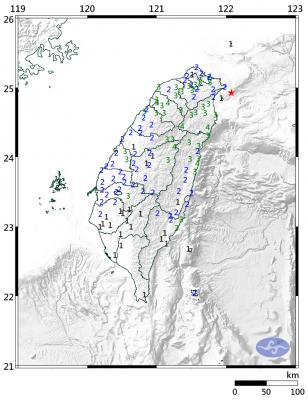
A magnitude 6.1 earthquake struck off the coast of Yilan County at 8:39pm tonight, the Central Weather Administration (CWA) said, with no immediate reports of damage or injuries. The epicenter was 38.7km east-northeast of Yilan County Hall at a focal depth of 98.3km, the CWA’s Seismological Center said. The quake’s maximum intensity, which gauges the actual physical effect of a seismic event, was a level 4 on Taiwan’s 7-tier intensity scale, the center said. That intensity level was recorded in Yilan County’s Nanao Township (南澳), Hsinchu County’s Guansi Township (關西), Nantou County’s Hehuanshan (合歡山) and Hualien County’s Yanliao (鹽寮). An intensity of 3 was
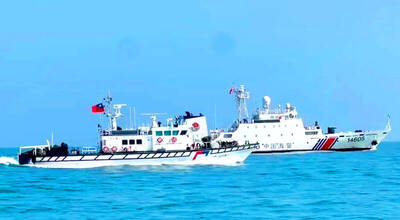
Instead of focusing solely on the threat of a full-scale military invasion, the US and its allies must prepare for a potential Chinese “quarantine” of Taiwan enforced through customs inspections, Stanford University Hoover fellow Eyck Freymann said in a Foreign Affairs article published on Wednesday. China could use various “gray zone” tactics in “reconfiguring the regional and ultimately the global economic order without a war,” said Freymann, who is also a nonresident research fellow at the US Naval War College. China might seize control of Taiwan’s links to the outside world by requiring all flights and ships entering or leaving Taiwan
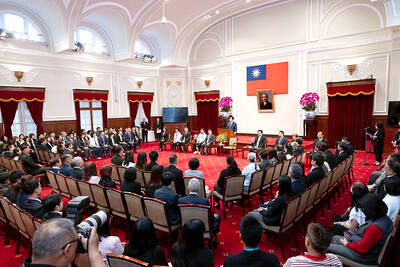
The next minimum wage hike is expected to exceed NT$30,000, President William Lai (賴清德) said yesterday during an award ceremony honoring “model workers,” including migrant workers, at the Presidential Office ahead of Workers’ Day today. Lai said he wished to thank the awardees on behalf of the nation and extend his most sincere respect for their hard work, on which Taiwan’s prosperity has been built. Lai specifically thanked 10 migrant workers selected for the award, saying that although they left their home countries to further their own goals, their efforts have benefited Taiwan as well. The nation’s industrial sector and small businesses lay
Taiwan has activated backup communications for its northernmost territory, the remote and strategically located island of Dongyin (東引), after poor weather conditions apparently shifted the wreckage of a ship onto an undersea cable causing it to break. The vulnerability of undersea communication cables linking Taiwan with its outlying islands has been a persistent cause of concern for Taipei, whose government has on several occasions blamed Chinese ships for intentionally causing damage. Dongyin, home to about 1,500 people, sits in a strategic position at the top of the Taiwan Strait and the island has a heavy military presence. It does not have an


 RSS
RSS