


Democratic Progressive Party (DPP) presidential candidate Tsai Ing-wen (蔡英文) yesterday unveiled an ambitious national policy for Taiwan’s national defense industry, which the party said would help decrease Taiwan’s reliance on foreign arms exports and generate NT$400 billion (US$12.17 billion) in direct and secondary benefits.
The party said that its policies would also help generate 8,000 job opportunities, realize the goal of manufacturing submarines domestically and establish an information technology corps in the military.
The establishment of a “fourth branch” (cyberarmy) was mentioned in a Tsai blue paper in May. Its authority would be on par with the command headquarters of the other branches of the armed forces and headed by a general or the equivalent, with the hopes of being fully staffed and functional by 2024.
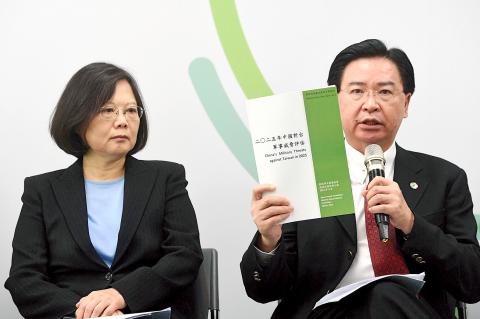
Photo: George Tsorng, Taipei Times
Under the DPP’s policies, the defense industry would generate NT$250 billion in net profit, DPP defense policy convener Chen Wen-cheng (陳文政) said.
The figure, based on future national defense budgets minus foreign purchases, maintenance fees and human resource expenditures, is still in flux due to possible adjustments according to economic growth, Chen said.
Taiwan Institute of Economic Research deputy director Kung Ming-hsin (龔明鑫) said the estimated net profit was the minimum and total profits should exceed NT$400 billion.
Kung said the inter-linking of industries could bring in 1.7 times the original estimate, adding that with calculations based on figures from 2011 — a year of many foreign arms purchases — total profits for the industry could be even higher.
Once the policy is implemented and more military equipment is made in Taiwan, it will have ripple effects, Kung said.
Chen said the figure of 8,000 jobs being created was estimated based on in-depth knowledge of how a number of defense industry factories fared, Chen said, adding that the numbers were not “made in a cloistered study room.”
Chen said that inaction by President Ma Ying-jeou’s (馬英九) administration was to blame for problems facing the domestic production of submarines.
Taiwan lacks key technology to manufacture submarines domestically, technology only accessible through international cooperation, but the Ma administration has done nothing to obtain it during his terms in office, Chen said.
Taiwan must demonstrate sincerity, such as allocating funds, before foreign nations would be willing to start talks on cooperation, Chen said.
Chen said that unlike Ma, the DPP is determined to see the project through, adding that 40 people from 19 companies had attended the US-Taiwan Defense Industry Conference held in Williamsburg, Virginia, from Oct. 4 to Oct. 6, clearly demonstrating to the US the DPP’s resolve.
Chen said the party was not surprised by escalating tensions in the South China Sea and the recent report by the Ministry of National Defense that China’s People’s Liberation Army will soon be capable of launching a full-blown assault on Taiwan.
The disparity in cross-strait military forces is one that cannot be ignored and is the main reason the DPP is stressing the development of the defense industry, DPP Secretary-General Joseph Wu (吳釗燮) said.
The party’s stance on the South China Sea is that it opposes any action that escalates tensions in the area, Wu said, adding that any claims of sovereignty in the South China Sea must be based on international law and most importantly, must be in compliance with both the letter and spirit of the UN’s Convention on the Law of the Sea.
Tsai said that while some of the DPP’s policies may seem similar to the current administration, the capability and methods with which the DPP would implement the ideas greatly differs from Ma’s administration.
Compared with Ma’s lack of an overarching strategy to ensure an obstacle-free environment and comprehensive planning, the DPP will be a cohesive administration with a unified view that is led by a leader with a strong vision of where defense policy is going, Tsai said.
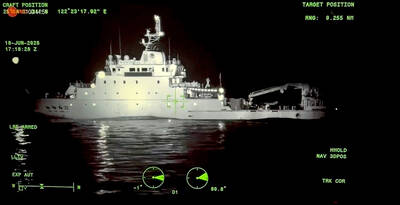
EXCUSES: Beijing is using government and research vessels as a pretext to harass the nation and enter its EEZ, and engage in ‘hegemonic expansion,’ the coast guard said The Coast Guard Administration yesterday said it drove away Chinese oceanographic research vessel Xiang Yang Hong 22 (向陽紅33) from restricted waters after warning it that it was in Taiwan’s exclusive economic zone (EEZ). The Chinese vessel entered restricted waters off the coast of Yilan County’s Suao (蘇澳) at 11:35pm on Thursday, the coast guard said, adding that it dispatched the Lanyu patrol vessel and the boat PP-10077 to shadow the Chinese ship and issue radio warnings ordering it to leave. China has no sovereignty over waters off Taiwan’s east coast, Lanyu’s crew told Xiang Yang Hong 22 over the radio, and demanded
BAIT AND SWITCH: Allowing KMT-run counties to sell to China while the threat of abrupt cancelations hangs overhead is another form of coercion, officials said Beijing is using agricultural purchase offers announced during the Straits Forum to deepen Taiwan’s dependence on the Chinese market, a Taiwanese official said yesterday as they criticized the Taitung County commissioner’s participation in the initiative. During the Straits Forum held in Xiamen on Saturday, Chinese officials announced a sales and purchase agreement for agricultural products from some counties led by the Chinese Nationalist Party (KMT). Taitung County Commissioner Yao Ching-ling (饒慶鈴), who was barred from attending the event in person by the Mainland Affairs Council, participated via video. Under the agreement, China would purchase atemoyas, pomeloes, tea and grouper harvested in Taitung,
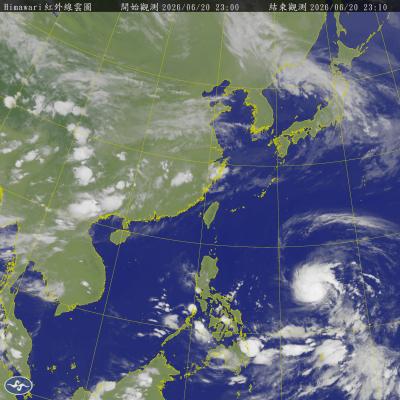
Tropical Storm Mekkhala is forecast to strengthen into a typhoon tomorrow and could come close enough to Taiwan later in the week to prompt a sea warning, the Central Weather Administration (CWA) said yesterday. As of 2 pm, the storm was located 1,870 kilometers southeast of Taiwan's southern tip and moving west- northwest at 23 km per hour. CWA forecaster Cheng Chieh-jen (鄭傑仁) said Mekkhala is expected to continue moving west-northwest through Tuesday under the influence of the Pacific high- pressure system before gradually turning north toward waters east of Taiwan or south of the Ryukyu Islands. The timing and angle of the
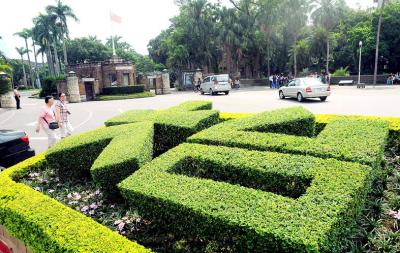
Four Taiwanese universities have been ranked among the world's top 200 institutions in the Quacquarelli Symonds (QS) World University Rankings for next year, the highest Taiwan has ever placed in the category, with National Taiwan University (NTU) achieving its best performance at 54th globally and 17th in Asia. The four Taiwanese institutions in the global top 200 are NTU (54th), National Tsing Hua University (142nd), National Yang Ming Chiao Tung University (177th) and National Cheng Kung University (191st), the rankings showed. All four universities achieved their highest-ever global rankings this year, QS data showed. National Cheng Kung University entered the top 200 for


 RSS
RSS