


Researchers have discovered that human disturbance is behind the diminishing population of black-faced spoonbills and declining habitat conditions in the threatened species’ major habitats in Tainan, despite a recorded increase in the birds’ local and global population.
Listed on the International Union for Conservation of Nature’s red list of threatened species, the black-faced spoonbill is an endangered species, both domestically and internationally.
The bird’s global population hit a record high this year at 3,259 birds, up nearly 20 percent from the number last year, while a total of 2,034 birds were spotted in Taiwan this year, compared with 1,659 in January last year, according to the Chinese Wild Bird Federation.
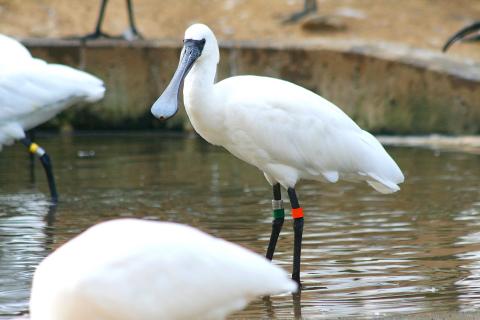
Photo: Provided by Taipei Zoo.
However, the number of birds recorded in Zengwen River (曾文溪) and Sihcao Wetlands (四草溼地) in Tainan — traditionally the birds’ major winter habitat — have decreased and the population has spread to surrounding wetlands, which researchers said suggests a decline in habitat conditions due to an increase in human activity.
A research team, consisting of the Council of Agriculture’s Endemic Species Research Institute and the National Chung Hsing University said on Wednesday that it analyzed the number of overwintering years, maximum number of spoonbills, size of hospitable area and a land development intensity index to calculate the habitat value and connectivity of 23 selected wetlands to understand why the birds spread to other locations.
Institute researcher Chen Tien-shui (陳添水) said that development surrounding Tsengwen and Sihcao, especially the expansion of a local fish farming industry that has replaced seasonal, shallow ponds with permanent deeper pools, has reduced the food supply and forced the spoonbills to move to wetlands in Putai (布袋) and Beimen (北門) townships and Kaohsiung City’s Cieding wetlands (茄萣溼地).
“The spoonbill population in those areas has reached more than 100, making them important habitats that require conservation,” Chen said.
Higher habitat connectivity could ensure higher contact between different bird populations and the survival of the species. Large gap areas exist on the Changhua and Yunlin County coasts, where local spoonbill populations were once extinct, he said.
Heightened conservation of wetlands in central Taiwan to reconnect the ecological corridor in western coasts would help preserve spoonbill populations and increase biodiversity, he said.
The research results could be applied to other species and serves as a baseline for habitat linkage, corridor planning, and refuge design, he said.
The full research, titled A framework on Habitat Connectivity among Taiwan’s Wetlands for Overwintering Black-faced Spoonbill, is to be published in the journal Ocean and Coastal Management.

AGING: While Japan has 22 submarines, Taiwan only operates four, two of which were commissioned by the US in 1945 and 1946, and transferred to Taiwan in 1973 Taiwan would need at least 12 submarines to reach modern fleet capabilities, CSBC Corp, Taiwan chairman Chen Cheng-hung (陳政宏) said in an interview broadcast on Friday, citing a US assessment. CSBC is testing the nation’s first indigenous defense submarine, the Hai Kun (海鯤, Narwhal), which is scheduled to be delivered to the navy next month or in July. The Hai Kun has completed torpedo-firing tests and is scheduled to undergo overnight sea trials, Chen said on an SET TV military affairs program. Taiwan would require at least 12 submarines to establish a modern submarine force after assessing the nation’s operational environment and defense

A white king snake that frightened passengers and caused a stir on a Taipei MRT train on Friday evening has been claimed by its owner, who would be fined, Taipei Rapid Transit Corp (TRTC) said yesterday. A person on Threads posted that he thought he was lucky to find an empty row of seats on Friday after boarding a train on the Bannan (Blue) Line, only to spot a white snake with black stripes after sitting down. Startled, he jumped up, he wrote, describing the encounter as “terrifying.” “Taipei’s rat control plan: Release snakes on the metro,” one person wrote in reply, referring

The coast guard today said that it had disrupted "illegal" operations by a Chinese research ship in waters close to the nation and driven it away, part of what Taipei sees a provocative pattern of China's stepped up maritime activities. The coast guard said that it on Thursday last week detected the Chinese ship Tongji (同濟號), which was commissioned only last year, 29 nautical miles (54km) southeast of the southern tip of Taiwan, although just outside restricted waters. The ship was observed lowering ropes into the water, suspected to be the deployment of scientific instruments for "illegal" survey operations, and the coast

Taiwan’s two cases of hantavirus so far this year are on par with previous years’ case numbers, and the government is coordinating rat extermination work, so there should not be any outbreaks, Centers for Disease Control (CDC) Director-General Philip Lo (羅一鈞) said today in an interview with the Liberty Times (the Taipei Times’ sister newspaper). An increase in rat sightings in Taipei and New Taipei City has raised concerns about the spread of hantavirus, as rats can carry the disease. In January, a man in his 70s who lived in Taipei’s Daan District (大安) tested positive posthumously for hantavirus, Taiwan’s


 RSS
RSS