


Airborne operations to test the defensive capabilities of a vital air force base and a simulation of Chinese People’s Liberation Army (PLA) forces making a beach landing were the main events on the fourth day of the annual Han Kuang military exercises yesterday.
Fighter jets and C-130 Hercules transport planes dotted the sky over Cingcyuangang Air Base (清泉崗) in Taichung in the morning, with paratroopers descending from the planes in a combined combat operation with infantry forces and armored battalions to repel a simulated enemy advance on the base.
Troops delivered parachuted pallets of munitions and supplies from the C-130 planes, while the successful drop of a 2.75-tonne Humvee drew applause from observers.
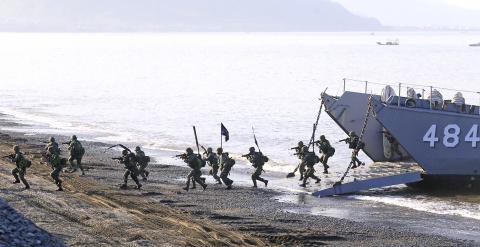
Photo: CNA
The exercise was coordinated by Air Force 439 Composite Wing and Army Airborne Special Forces Command, postulating a raid by PLA airborne units to take over the base, with combat operations by troops to secure the vital airport.
Elsewhere, the simulation had a mock PLA “tank lander vessel” make an amphibious incursion onto a beach in Pingtung County’s Fangliao Township (枋寮), where “enemy” forces rolled out battle tanks, self-propelled howitzers, armored personnel carriers and trucks aiming to cut off main roads.
According to Ministry of National Defense officials, the war game in Pingtung showed that the region’s units were able to mobilize quickly in the defense of key installations while mounting countermeasures to neutralize PLA tank and armored vehicle forces before they could make significant advances inland.
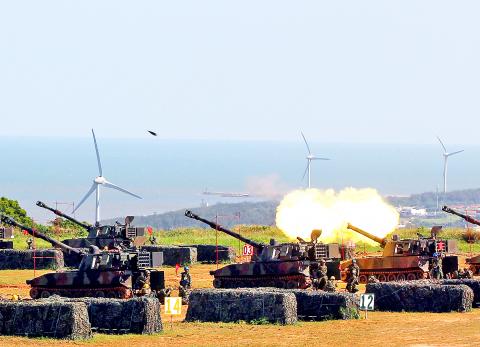
Photo: CNA
Live-fire drills saw artillery bombardment on offshore target areas in the Taiwan Strait at the Kengzikou range in Hsinchu County, with President Ma Ying-jeou (馬英九) in attendance.
The drills incorporated 18 8-inch M110 self-propelled howitzers and 20 M109 self-propelled 155mm howitzers from the 6th Corps of the 21st Artillery Command joined by the 542nd Armored Brigade.
A total of 304 shells were fired during the drill to fend off ships attempting to make a landing, with a total of 800 soldiers and officers participating.
Ma said Taiwan would not let its guard down and remains committed to self-defense.
The week-long exercises combine the mobilization of army, navy and air force units to test joint operations in the face of threats from China.
A new radar system, developed by National Chung-shan Institute of Science and Technology, was deployed for the first time during the exercises.
The Point Defense Array Radar System (PODARS) was used during a drill by artillery troops and the army’s 542nd Armored Brigade, which involved medium-range and long-range shelling.
It was deployed near the artillery forces in tandem with Avenger anti-aircraft missile launchers, according to a ministry official.
The army has 14 PODARS, which cost a total of NT$6.165 billion (US$187.6 million), the official said.
The system was introduced to the public on July 4 to demonstrate national defense capabilities.
Additional reporting by CNA

UPGRADE: The Kang Ding-class frigate is replacing its Chaparall missiles with Tien Chien II and Hua Yang VLS, which would provide it with long-range, 360° air defense Taiwan plans to produce 1,200 to 1,376 Hai Chien II missiles (海劍二, Sea Sword II) — also known as TC-2N — to serve as the standard air defense system of the navy’s surface combatant fleet, a source said yesterday. Last week, the Hai Chien II, the naval version of the Tien Kung II missile (天劍二, Sky Sword II), completed a live-fire test in waters off the National Chungshan Institute of Science and Technology’s Jiupeng facility (九鵬) in Pingtung County’s Manjhou Township (滿州). The MIM72 Chaparral and other dated air defense missiles that currently arm Taiwanese ships have inadequate range to combat Chinese

REASONS FOR TRAVEL: An assistant professor said that proposed amendments to penalize drivers if they used drugs overseas would not deter people from traveling People who operate a motor vehicle under the influence of marijuana would have their driver’s license revoked, even if they used the substance while overseas, the Ministry of Transportation and Communications said yesterday, citing proposed amendments to the Road Traffic Management and Penalty Act (道路交通管理處罰條例). The amendments would also authorize the government to revoke the licenses of people determined to have used Category 1 or Category 2 narcotics, even if they were not operating a vehicle while under the influence of drugs, as well as ban them from taking the license test for three years, the ministry said. People aged 18 or

HEAVY WEATHER: Typhoon Jangmi is due to crash straight into the Ryukyus as airlines look to shift flights to larger aircraft or cancel flights to Okinawa entirely Taiwan’s international air carriers announced flight adjustments over the weekend as Typhoon Jangmi is forecast to hit the Ryukyu Islands today and tomorrow. The Central Weather Administration (CWA) upgraded Jangmi from a tropical storm to a typhoon at 8am yesterday, with the eye located 580km south of Naha city. It was moving north at 19kph. Today, China Airlines’ CI-120, CI-121, CI-122 and CI-123 flights between Taoyuan and Naha, Okinawa, have been canceled as well as CI-132 and CI-133 between Kaohsiung and Naha. EVA Air’s BR-112, BR-113, BR-186 and BR-185 flights between Taoyuan and Naha are also canceled. Low-cost carrier Tigerair Taiwan canceled IT-230,

Johanne Liou (劉喬安), a Taiwanese woman who shot to unwanted fame during the Sunflower movement protests in 2014, returned to Taiwan last night after being deported from the US. She is to stand trial in Taiwan for charges involving embezzlement, fraud and drug crimes. The Criminal Investigation Bureau (CIB) said it took her into custody at Taiwan Taoyuan International Airport and would first question her before transferring her to the New Taipei District Prosecutors’ Office. She was arrested upon disembarking a flight from San Francisco that landed shortly before 7pm. Liou absconded to the US in 2019 after jumping bail


 RSS
RSS