


Indian Prime Minister Narendra Modi is to take his global investment push to China this week, as Asia’s rival superpowers look to put aside a festering border dispute and identify areas of economic cooperation.
Modi is to fly out for his first visit as premier to China before heading to South Korea where he is also set to seek help to upgrade India’s creaking infrastructure. After Modi hosted Chinese President Xi Jingping (習近平) last year in his home state of Gujarat, Xi is to return the favor by giving him a tour of his ancestral home province of Shaanxi, before they head to Beijing. Modi is due to meet business chiefs in the financial hub of Shanghai, seeking to deliver on election promises for foreign investment in India’s crumbling rail and other infrastructure.
“I firmly believe this visit to China will strengthen the stability, development and prosperity of Asia,” Modi wrote on Sina Weibo about his three-day visit that begins tomorrow.
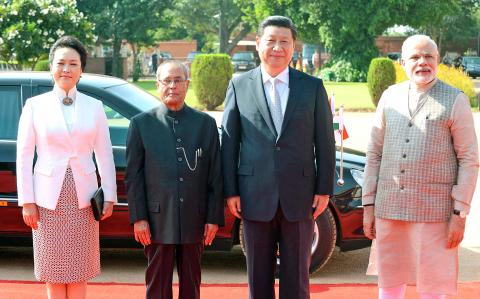
Photo: AFP
Despite a reputation as a hardline nationalist, Modi moved quickly to engage with Beijing after winning power in May last year. His main focus in his first year in office has been to revive India’s stuttering economy, courting other economic powerhouses such as the US, Japan and Germany.
Ties between China and India have long been strained over a border dispute, and Beijing’s recent push to forge closer ties with nations in India’s backyard has caused some alarm in New Delhi.
However, in a sign of Modi’s pragmatic approach toward Beijing, he has appeared relaxed about China’s ambitions, saying it has a “right” to seek greater influence.
During Xi’s visit to India in September last year — the first visit by a Chinese president in eight years — the two men spoke of their desire to place cooperation above competition and ensure “tranquility” along their border.
The two nations fought a brief, but bloody, border war in 1962 over the northeastern Indian state of Arunachal Pradesh, areas of which Beijing claims as South Tibet.
However, in an interview last week with Time magazine, Modi said the two nations have shown “great maturity” in recent decades over the border issue and were committed to “economic cooperation.”
Chinese Premier Li Keqiang (李克強) said the “boundary question is a problem left over from history,” albeit a “difficult” one for the two nations.
Phunchok Stobdan, a China expert at the Institute of Defence Studies and Analysis in New Delhi, said mutual “mistrust” remained below the surface, but Modi knows there is little point in being confrontational.
“China is our immediate neighbor so there are compelling reasons for India to be mellow with Beijing,” Stobdan said. “It’s a very pragmatic thing to understand and recognize China’s strength rather than try and compete with them. Cooperation with China is the need of the hour as far as India is concerned.”
Li told India Today magazine that China stands ready to “deepen our strategic and cooperative partnership” as well as economic ties that include two Chinese industrial parks in India.
“Cooperation between China and India is a huge treasure house waiting to be discovered,” Li said.
Analysts said Modi would be seeking greater access to China’s markets for its vast pharmaceuticals industry, and progress on funding for Indian infrastructure projects.
“There will clearly be a focus on trade and on infrastructure, such as the development of high-speed rail,” Renmin University professor of international relations Shi Yinhong (時殷弘) said.
China is India’s biggest trading partner with two-way commerce totaling US$71 billion last year. However, India’s trade deficit with China has soared from just US$1 billion in 2001-2002 to more than US$38 billion last year.

Through the noise of rushing papers and whirring belts at a print factory in Kyoto, two creators watch their photo essay come to life in broadsheet form — part of an effort to win new audiences in the age of artificial intelligence (AI). Despite the decline of the publishing industry, self-publication and handmade “zine” magazines are growing in popularity in Japan, reflecting the nation’s enduring love of paper in the digital era. While speaking to Agence France-Presse at the plant, his hands black with ink, one of the creators, Kazuma Obara, said: “I think [paper] is a medium that engages all five

‘CROSSING THE LINE’: China’s embassy in Seoul criticized US Forces Korea Commander General Xavier Brunson, asking if his ‘hostile’ remarks were authorized by Washington South Korea and the US are in talks over recent public remarks by the commander of US Forces Korea, Seoul’s presidential office said yesterday, after the comments drew sharp criticism from China. In a recent podcast interview, US Forces Korea Commander General Xavier Brunson described South Korea as “the dagger in the heart of Asia” from China’s east coast, prompting the Chinese embassy in Seoul to say that he had “truly crossed the line.” The interview came amid growing speculation that Washington might seek to expand the role of US Forces Korea in countering the growing regional influence of China, a key

Australian researchers have trained lab-grown brain cells on a silicon computer chip to play the 1990s shooter game Doom and said they are just scratching the surface of what the neurons could be capable of doing. It is the science-fiction work of biotech boffins at Cortical Labs, who researched and developed the technology that harnesses the workings of the brain’s networking system. Each so-called “biological computer” contains about 200,000 living human brain cells, grown from stem cells that were harvested from blood donations. Having mastered the simple computer game Pong, where a paddle is moved up and down to send a ball

France experienced its hottest spring on record, the French weather service said on Tuesday, after an exceptional early heat wave that also broke highs for the season in England and Wales. Meteo-France said the average nationwide temperature over March to May was 13.8°C — about 1.7°C above the norm, and surpassing records set in 2011 and 2020. “The warmest spring since records began in 1900,” it said in a bulletin. All three months were warmer than average, but the onset of an “unprecedented heatwave” late last month pushed the mercury to highs typically seen at the height of the summer. “Our country had never


 RSS
RSS