


Clothing with culturally loaded symbols of the rainbow bridge, diamond shapes and bean-shaped dots were put on exhibition by the Taroko Gorge National Park’s Buluowan administrative office at a traditional handicrafts exposition on Friday to symbolize an injection of fresh blood in the Truku people’s waning traditional weaving arts.
Traditional methods of weaving are time-consuming processes and are physically very demanding, often causing twitches as well as back pain, Wu Ma-li (吳瑪琍) of the Truku people said, adding that for these reasons many youths are unwilling to learn the craft.
“Retired women comprise the majority of those who are learning how to weave,” she said, adding that, “if our handicrafts with their long history suffer a gap in succession, it would be a cultural disaster for all of our people.”
Speaking of her craft, Wu said that everything seemed difficult in the beginning.
Wrapping threads around a warping frame is an important first step, as the weaver must arrange the threads in the position they want their final product to turn out, Wu said, adding that next the weaver has to focus on texture so that all of the threads end up in their correct place.
Weaving the shape of totems on any given cloth product is the most challenging process, as it not only requires a mental image of the shape beforehand, but also positioning, the number of shapes and the size, Wu said.
Properly aligning the warp and weft of threads, as well as slices of bamboo used for battening, are also important techniques for a weaver to realize their vision, Wu said.
While some of the older artisans use threads made from ramie and dyed with grass roots and other plants such as cassava, most weavers use cotton or a mixture of cotton and linen, Wu said, adding that the choice of cotton makes it possible to skip steps, such as skinning the linen and twining the products into thread.
One piece of cloth 1m long and 50cm wide is made from about 600 strands of cotton and, when observing traditional methods, would require one-and-a-half months to weave, Wu said, adding that two such pieces could be made into either a vest or a skirt, while three could form a blanket.
Weaving pieces of cloth provides flexibility in what the product will become, as it would depend on the intended use of the product, Wu said.
Those just starting to learn the craft would take about half a year to finish one segment of cloth, she said, adding that the complexity of shapes chosen also affects the time to complete the work.
Elderly weavers tend to use plain weave methods and only stitch on patterns that symbolize blessings during ceremonies or grand events, Wu said.
According to Wu, bean-shaped dots symbolize wishes for a bountiful harvest, while road-like and stair-like patterns or rainbows symbolize paths for posterity, so that people would not lose their way.
“The diamond-shaped patterns are the eyes of the ancestors and symbolize that the ancestors are watching over their descendants,” Wu said. “Patterns of a boar’s tusks are reserved for the tribe’s warriors who have demonstrated great bravery.”

REASONS FOR TRAVEL: An assistant professor said that proposed amendments to penalize drivers if they used drugs overseas would not deter people from traveling People who operate a motor vehicle under the influence of marijuana would have their driver’s license revoked, even if they used the substance while overseas, the Ministry of Transportation and Communications said yesterday, citing proposed amendments to the Road Traffic Management and Penalty Act (道路交通管理處罰條例). The amendments would also authorize the government to revoke the licenses of people determined to have used Category 1 or Category 2 narcotics, even if they were not operating a vehicle while under the influence of drugs, as well as ban them from taking the license test for three years, the ministry said. People aged 18 or

GLOBALGIVING: ‘ Caving to external pressure is not acceptable for an organization that has cultivated justice reform and human rights for 30 years,’ one NGO said A slew of non-government organizations (NGOs) have withdrawn from the GlobalGiving fundraising platform after it announced it would use “Chinese Taipei” instead of “Taiwan” from next month. The Taiwan Good Rice Association wrote on Facebook on Friday that it was informed on April 28 via a teleconference call of the change, which was made because the platform wanted to operate in China. Taiwan Good Rice is to terminate all cooperative relationships with GlobalGiving in response to the platform’s “unilateral and non-negotiable” decision to remove references to Taiwan, the NGO said. “Taiwan is in the official name of Taiwan Good Rice Association and the

HEAVY WEATHER: Typhoon Jangmi is due to crash straight into the Ryukyus as airlines look to shift flights to larger aircraft or cancel flights to Okinawa entirely Taiwan’s international air carriers announced flight adjustments over the weekend as Typhoon Jangmi is forecast to hit the Ryukyu Islands today and tomorrow. The Central Weather Administration (CWA) upgraded Jangmi from a tropical storm to a typhoon at 8am yesterday, with the eye located 580km south of Naha city. It was moving north at 19kph. Today, China Airlines’ CI-120, CI-121, CI-122 and CI-123 flights between Taoyuan and Naha, Okinawa, have been canceled as well as CI-132 and CI-133 between Kaohsiung and Naha. EVA Air’s BR-112, BR-113, BR-186 and BR-185 flights between Taoyuan and Naha are also canceled. Low-cost carrier Tigerair Taiwan canceled IT-230,
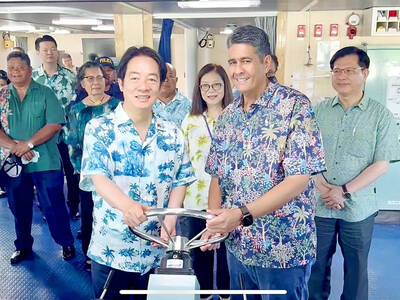
MULTIPRONGED APPROACH: China has sought to pressure Palau across a number of fronts, but the island nation has staunchly resisted overtures to ditch Taiwan Palau has been firm in backing Taiwan despite Chinese pressure that uses tourism economics, cyberattacks and criminal infiltration as tools to threaten the Pacific ally into renouncing its recognition of Taiwan as a sovereign state. The Presidential Office yesterday announced that Vice President Hsiao Bi-khim (蕭美琴) would visit Palau from Saturday to Wednesday next week at the invitation of Palauan President Surangel Whipps Jr. Whipps in April said in an interview that China had outspokenly asked Palau to “denounce Taiwan.” “And we have said: ‘We have no enemies, but nobody tells us who our friends are,’” he said. Whipps has told reporters multiple times


 RSS
RSS