


Cutting-edge virtual reality technology is set to be used at a concert at the Taipei Arena today to honor the 20th anniversary of the death of famed singer Teresa Teng (鄧麗君). Teng died following an asthma attack aged 42 in May 1995 while on vacation in Chiang Mai, Thailand.
The Teresa Teng Foundation has collaborated with California-based Digital Domain 3.0 to hold the concert, which is set to feature a hologram of the singer.
Wearers of virtual reality headsets provided by the company will be able to see a stage, the audience on the back row if they look behind them and even the audience on either side, Digital Domain chief executive officer Daniel Seah (謝安) said, adding that the 3D images make viewers feel as if they are attending a live event.

Screen grab from Digital Domain Holdings Ltd’s Facebook account
Seah said that future developments in 3D technology would allow people to enjoy such concerts from their own homes, adding that the idea to make a virtual rendition of Teng came from watching the movie Tron: Legacy.
The movie, filmed using advanced 3D cameras, features then-61-year-old actor Jeff Bridges playing two characters, one a computer avatar that bears an image of his face altered to appear 35, which is grafted onto the body of a younger actor using special effects.
Using motion-capture technology, the company has managed to recreate a concert featuring late rap artist Tupac Shakur and a previous concert featuring Teng, Seah said.
A recording of the concert featuring a 3D hologram of Shakur at the Coachella Valley Music and Arts Festival in California in 2012 received more than 6 million views on YouTube in one day, Seah said, while a representation of Teng featured on-stage with Mando-pop king Jay Chou (周杰倫) in 2013.
Digital Domain 3.0 was the company behind the computer imagery that transformed Brad Pitt in The Curious Tale of Benjamin Button filmed in 2008.
Pitt, ostensibly playing the lead role, actually performed for less than 20 percent of the time his character was on screen, Seah said, adding that the movie won Academy Awards for Best Achievement in Art Direction, Best Achievement in Makeup and Best Achievement in Visual Effects.
“Do you know why films about world destruction tend to be shot around the White House and New York? It’s because we’ve done [the virtual simulations] for both cities and they are ready to be implemented. It saves on production costs,” Seah said, adding that it was the reason the movies 2012 and The Day After Tomorrow had some similar scenes.
Seah said the company has video clips featuring volcanic eruptions, tsunamis, earthquakes and simulations of dinosaurs that are easy for them to turn into virtual reality backdrops.
Using the movie Jurassic World as an example, Seah said that an audience wearing the virtual headsets would see themselves sitting in cars used by the characters in the film and see dinosaurs running past them if they opened the car door.
Audiences watching a Los Angeles Lakers game, filmed by a camera in the VIP seats, would experience the game as if they were in those seats and could see Kobe Bryant or Jeremy Lin (林書豪) up close, Seah said.
Such an effect is achieved by the company’s understanding of “360° environmental direct playback technology,” Seah said, adding that such technology has not been mastered by competitors such as Google or Facebook.
Digital Domain 3.0 is working on signing more authorization deals from companies or family members of deceased celebrities, Seah said, adding that such technology could eventually be used to watch auroras in Iceland, exhibits in museums, or to attend a class at National Taiwan University by day and a seminar at Cambridge University by night, Seah said.
When the audience is exposed to virtual reality that gives them a 360° perspective, they might become more observant, Seah said, adding that the technology puts a new spin on the saying “seeing is believing.”

Actor Darren Wang (王大陸) was sentenced to six months in prison, commutable to a fine, by the New Taipei District Court today for contravening the Personal Data Protection Act (個人資料保護法) in a case linked to an alleged draft-dodging scheme. Wang allegedly paid NT$3.6 million (US$114,380) to an illegal group to help him evade mandatory military service through falsified medical documents, prosecutors said. He transferred the funds to Chen Chih-ming (陳志明), the alleged mastermind of a draft-evasion ring, although he lost contact with him as he was already in detention on fraud charges, they said. Chen is accused of helping a

SECURITY: Starlink owner Elon Musk has taken pro-Beijing positions, and allowing pro-China companies to control Taiwan’s critical infrastructure is risky, a legislator said Starlink was reluctant to offer services in Taiwan because of the nation’s extremely high penetration rates in 4G and 5G services, the Ministry of Digital Affairs said yesterday. The ministry made the comments at a meeting of the legislature’s Transportation Committee, which reviewed amendments to Article 36 of the Telecommunications Management Act (電信管理法). Article 36 bans foreigners from holding more than 49 percent of shares in public telecommunications networks, while shares foreigners directly and indirectly hold are also capped at 60 percent of the total, unless specified otherwise by law. The amendments, sponsored by Chinese Nationalist Party (KMT) Legislator Ko
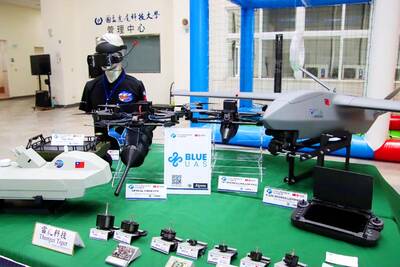
NON-RED SUPPLY: Boosting the nation’s drone industry is becoming increasingly urgent as China’s UAV dominance could become an issue in a crisis, an analyst said Taiwan’s drone exports to Europe grew 41.7-fold from 2024 to last year, with demand from Ukraine’s fight against Russian aggression the most likely driver of growth, a study showed. The Institute for Democracy, Society and Emerging Technology (DSET) in a statement on Wednesday said it found that many of Taiwan’s uncrewed aerial vehicle (UAV) sales were from Poland and the Czech Republic. These countries likely transferred the drones to Ukraine to aid it in its fight against the Russian invasion that started in 2022, it said. Despite the gains, Taiwan is not the dominant drone exporter to these markets, ranking second and fourth

The eastern extension of the Taipei MRT Red Line could begin operations as early as late June, the Taipei Department of Rapid Transit Systems said yesterday. Taipei Rapid Transit Corp said it is considering offering one month of free rides on the new section to mark its opening. Construction progress on the 1.4km extension, which is to run from the current terminal Xiangshan Station to a new eastern terminal, Guangci/Fengtian Temple Station, was 90.6 percent complete by the end of last month, the department said in a report to the Taipei City Council's Transportation Committee. While construction began in October 2016 with an


 RSS
RSS