


On the eve of the World Hemophilia Day, a physician yesterday drew attention to the predicament of the nation’s more than 1,300 hemophiliacs, some of whom suffer as many as 30 episodes of spontaneous bleeding per year.
Hemophilia is a rare genetic bleeding disorder in which blood does not clot normally due to the lack of sufficient blood-clotting proteins called coagulation factors. There are two common types of hemophilia, hemophilia A, which involves a lack of clotting factor VIII; and hemophilia B, which manifests because of a deficiency of clotting factor IX.
Hemophilia affects mostly males.

Photo: Wu Liang-yi, Taipei Times
“Research shows that patients with hemophilia A experience an average of 14.4 episodes of spontaneous bleeding each year, while those with hemophilia B suffer about 8.6,” Chang Gung Memorial Hospital physician Chang Hung (張鴻) told a news conference in Taipei yesterday afternoon.
Chang, who works in the hospital’s Hemophilia and Blood Clotting Medical Center, said that up to 80 percent of bleeding episodes occur into joints, especially knees (45 percent), elbows (30 percent) and ankles (15 percent), followed by muscles.
As repeated bleeds into the same joints could cause synovitis and arthritis and result in chronic swelling or deformity, many hemophiliacs suffer some level of disability, Chang said.
There are two types of treatment for the disease, prophylaxis, a preventive treatment, and on-demand therapy.
Before prophylaxis treatment was covered by the National Health Insurance (NHI) program last year, Chang said most financially disadvantaged hemophiliacs with moderate or severe hemophilia would wait until they experienced pain or a bleeding episode to receive an injection of the clotting factors they lacked.
Chang cited the case of a middle-aged hemophiliac as an example.
The man had suffered more than 30 episodes of spontaneous bleeding per year since he was five months old, Chang said, adding that the illness and damage to the man’s joints had prevented him from doing any exercise except strolling.
“Since he started receiving the injection regularly last year, he has scarcely experienced any bleeding episodes,” Chang said. “With a total left-knee replacement in December last year, he is no longer confined to indoor activities and has set his mind on trying a bicycle trip in the near future.”
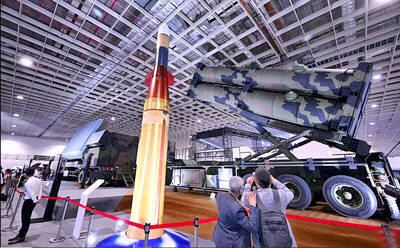
Taiwan is to commence mass production of the Tien Kung (天弓, “Sky Bow”) III, IV and V missiles by the second quarter of this year if the legislature approves the government’s NT$1.25 trillion (US$39.78 billion) special defense budget, an official said yesterday. Commenting on condition of anonymity, a defense official with knowledge of the matter said that the advanced systems are expected to provide crucial capabilities against ballistic and cruise missiles for the proposed “T-Dome,” an advanced, multi-layered air defense network. The Tien Kung III is an air defense missile with a maximum interception altitude of 35km. The Tien Kung IV and V
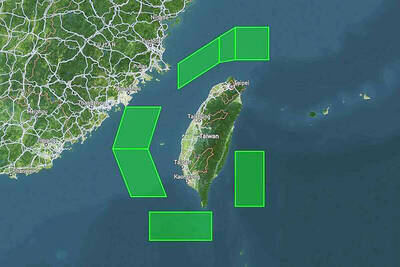
The disruption of 941 flights in and out of Taiwan due to China’s large-scale military exercises was no accident, but rather the result of a “quasi-blockade” used to simulate creating the air and sea routes needed for an amphibious landing, a military expert said. The disruptions occurred on Tuesday and lasted about 10 hours as China conducted live-fire drills in the Taiwan Strait. The Civil Aviation Administration (CAA) said the exercises affected 857 international flights and 84 domestic flights, affecting more than 100,000 travelers. Su Tzu-yun (蘇紫雲), a research fellow at the government-sponsored Institute for National Defense and Security Research, said the air
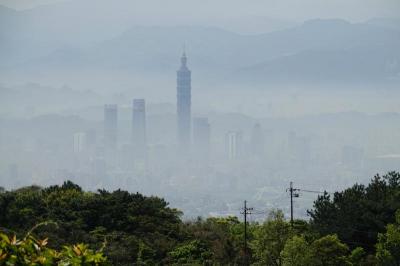
A strong continental cold air mass is to bring pollutants to Taiwan from tomorrow, the Ministry of Environment said today, as it issued an “orange” air quality alert for most of the country. All of Taiwan except for Hualien and Taitung counties is to be under an “orange” air quality alert tomorrow, indicating air quality that is unhealthy for sensitive groups. In China, areas from Shandong to Shanghai have been enveloped in haze since Saturday, the ministry said in a news release. Yesterday, hourly concentrations of PM2.5 in these areas ranged from 65 to 160 micrograms per cubic meter (mg/m³), and pollutants were
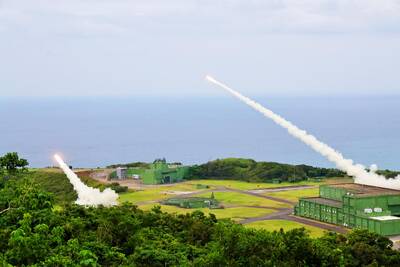
Taiwan lacks effective and cost-efficient armaments to intercept rockets, making the planned “T-Dome” interception system necessary, two experts said on Tuesday. The concerns were raised after China’s military fired two waves of rockets during live-fire drills around Taiwan on Tuesday, part of two-day exercises code-named “Justice Mission 2025.” The first wave involved 17 rockets launched at 9am from Pingtan in China’s Fujian Province, according to Lieutenant General Hsieh Jih-sheng (謝日升) of the Office of the Deputy Chief of the General Staff for Intelligence at the Ministry of National Defense. Those rockets landed 70 nautical miles (129.6km) northeast of Keelung without flying over Taiwan,


 RSS
RSS