


Since rebuilding his first Japanese heavy-duty motorcycle 27 years ago, Chiayi County Mobile Division Police Officer Huang Wen-shan (黃文杉) has earned a reputation as an expert in vintage Japanese bikes from his devotion to collecting and restoring them.
Prized in his collection are six vintage motorcycles that are between 20 and 30 years old, and the old warhorses still perform excellently due to his meticulous maintenance, 46-year-old Huang said.
A ban on importing heavy-duty motorcycles was still in effect in 1988 — it was lifted only in 2002, following Taiwan’s entry into the WTO — when Huang was a novice police officer in Taipei, so he had to take the imported parts of a Honda CBR400F roadster he bought as scrap iron and assemble them into a functional bike, he said.
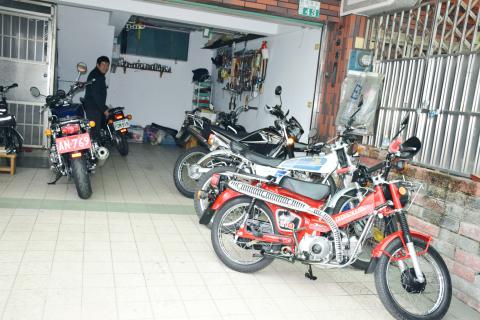
Photo: Wu Shih-tsung, Taipei Times
The parts cost him NT$100,000, amounting to three months of his salary at that time, he said.
Few mechanics were able to repair or remodel a heavy-duty bike at the time, so he learned how to do the work himself, he said.
Huang had trained as a mechanic at a vocational school before he entered police college, and vintage Japanese motorcycles rekindled his passion, he said.
“My wife complains that my love for her is nothing compared with my love for motorcycles,” Huang said.
Huang converted his garage into a well-equipped workshop, which unknowing bypassers would mistake for a professional motorcycle repair shop, he said.
Saying that Japanese motorcycles are as beautiful as they are practical, Huang said that his favorites are Honda’s classic CB series, and he just spent another NT$500,000 on a Honda CB1100 — a deluxe retro roadster — in July last year, he added.
Fully functional and immaculately polished, all the motorbikes in his collection are carefully maintained and never fail to turn heads on the road, he said.
Asked about the most classic motorcycle in his collection, he said that his 30-year-old Honda CT110 is a real gem, with an eight-speed transmission, an upward exhaust pipe, an auxiliary fuel tank and luggage racks at the bike’s front and rear, making it perfect for load-carrying, hill-climbing and river-trekking.
To preserve the CT110’s authenticity, Huang went to Japan to fetch an original auxiliary fuel tank as a replacement, restoring the bike to its former glory, while declining another collector’s offer for his treasured bike, he said.
He had wanted to purchase the rare CT110 for more than 20 years, but he did not have the opportunity to buy one until 14 years ago with another NT$90,000, he added.
Also in his collection are a Honda TL and a Yamaha XTZ125 — both of which are dual-sport bikes — along with a Yamaha RX125 manufactured by Yamaha’s Taiwan branch and a Kymco Fox Hunt 150, a rare model especially manufactured for overseas markets that somehow came with a Kinmen County license plate, he said.
Saying that one must have an illustrated handbook and a maintenance manual at hand to remodel a vintage motorcycle, Huang added that the most difficult part of the job is acquiring rare parts.
He personally collects the components he has been hunting regardless of price and distance, and if the parts are not available, he fashions a substitute himself, he said.
He said the most rewarding experiences always derive from discovering a solution to a complicated mechanical problem or acquiring a rare component, which gives him a feeling not unlike winning the lottery.
Restoring a cold, dead vintage motorcycle is like giving birth to a beautiful daughter, he said, adding that the happiness is redoubled if someone praises his work.
Vintage bike addicts used to depend on word of mouth to solve a mechanical problem or to secure a rare part, but people these days can find all the answers on the Internet, and the difficulty involved in remodeling a vintage motorcycle has largely diminished, Huang said.

Considering that most countries issue more than five denominations of banknotes, the central bank has decided to redesign all five denominations, the bank said as it prepares for the first major overhaul of the banknotes in more than 24 years. Central bank Governor Yang Chin-lung (楊金龍) is expected to report to the Legislative Yuan today on the bank’s operations and the redesign’s progress. The bank in a report sent to the legislature ahead of today’s meeting said it had commissioned a survey on the public’s preferences. Survey results showed that NT$100 and NT$1,000 banknotes are the most commonly used, while NT$200 and NT$2,000

The Centers for Disease Control (CDC) yesterday reported the first case of a new COVID-19 subvariant — BA.3.2 — in a 10-year-old Singaporean girl who had a fever upon arrival in Taiwan and tested positive for the disease. The girl left Taiwan on March 20 and the case did not have a direct impact on the local community, it said. The WHO added the BA.3.2 strain to its list of Variants Under Monitoring in December last year, but this was the first imported case of the COVID-19 variant in Taiwan, CDC Deputy Director-General Lin Ming-cheng (林明誠) said. The girl arrived in Taiwan on

South Korea is planning to revise its controversial electronic arrival card, a step Taiwanese officials said prompted them to hold off on planned retaliatory measures, a South Korean media report said yesterday. A Yonhap News Agency report said that the South Korean Ministry of Foreign Affairs is planning to remove the “previous departure place” and “next destination” fields from its e-arrival card system. The plan, reached after interagency consultations, is under review and aims to simplify entry procedures and align the electronic form with the paper version, a South Korean ministry official said. The fields — which appeared only on the electronic form

The Ministry of Foreign Affairs (MOFA) is suspending retaliation measures against South Korea that were set to take effect tomorrow, after Seoul said it is updating its e-arrival system, MOFA said today. The measures were to be a new round of retaliation after Taiwan on March 1 changed South Korea's designation on government-issued alien resident certificates held by South Korean nationals to "South Korea” from the "Republic of Korea," the country’s official name. The move came after months of protests to Seoul over its listing of Taiwan as "China (Taiwan)" in dropdown menus on its new online immigration entry system. MOFA last week


 RSS
RSS