


President Ma Ying-jeou (馬英九) is suing a Democratic Progressive Party (DPP) legislator and two media personalities for NT$10 million (US$316,500) over allegations that he had accepted dubious political donations. However, it is by no means certain that these lawsuits will work out in Ma’s favor.
Consider the case involving a media pundit’s recent accusation that Ma received illegal political donations. According to Paragraph 3 of Article 310 of the Criminal Code, defendants accused of slander must prove that what they said is true to be found not guilty. However, this rule gives rise to a procedural contradiction, because if defendants are required to prove that their statements are true, they will have to give up their right to remain silent to be able to present evidence. Aside from contravening the principle of the presumption of innocence, this undermines the right not to be compelled to be a witness against oneself.
To resolve this, the Council of Grand Justices’ Interpretation No. 509 extends the scope of non-culpability, finding that even when the accused cannot prove the truthfulness of their statements, if, based on the evidence they present, the court finds that they had reasonable grounds to think the statements were true, it cannot find them guilty.
This is what is known as the maxim that when a deed may be considered both good and bad, the law should look more to the good. Accordingly, in relation to Ma’s defamation suits, if criminal proceedings are initiated, the accused may contend that anything they said or wrote had not only already been reported by news media, but was being investigated by the Special Investigation Division of the Supreme Prosecutors’ Office. They may argue that since what they said was not smoke without fire, it cannot be proven to be malicious. Presented with such arguments, the court would naturally be unable to find the defendants guilty.
Although the chances of the accused being found guilty of defamation are extremely low, because Interpretation No. 509 applies to criminal cases, there are doubts as to whether it can be used to absolve defendants of liability for civil damages. It is especially difficult in lawsuits seeking damages for harm done to a person’s reputation, for as long as the plaintiff can prove that their moral rights have been harmed, the defendant will have to prove the veracity of any source they may have quoted, making it very hard to refute the plaintiff’s contentions.
And, while there is no law stating that the president cannot be subpoenaed, any court he attends would certainly accord him a courteous reception. The result will be that the two parties will not be evenly matched.
Furthermore, civil actions are conducted according to the adversarial system, under which judges basically do not intervene in the investigation, in addition to which all the information and material evidence are in the hands of the more powerful party to the case. This makes it extremely difficult for defendants to prove the truthfulness of their words. If they lose because of this, it will be a blow to freedom of expression.
Therefore, for the sake of safeguarding freedom of expression, the maxim that the law looks more to the good than the bad, as established by the Council of Grand Justices in their interpretation, must not be limited to absolving defendants of criminal liability for defamation, but should also apply to civil proceedings.
Furthermore, if Ma insists on trying to prove his innocence by suing people on every occasion, the public will only become more suspicious that he has some kind of connection with business corporations.
Wu Ching-chin is an associate professor and chair of the Department of Law at Aletheia University.
Translated by Julian Clegg
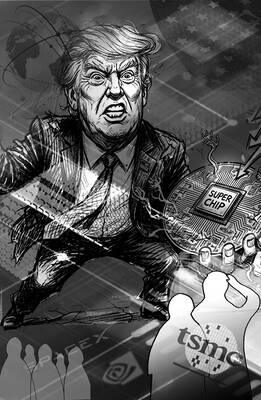
The White House’s decision to take a 9.9 percent stake in Intel Corp is looking like very shrewd business indeed. Since the government bought in at US$20.47 a share last August, the US chipmaker’s surging stock price has delivered the US a US$43 billion return. One of the reasons the investment has so far proved so sound is that the White House has made sure of it. According to The Wall Street Journal, Howard personally pushed deals on Intel’s behalf with some of the most lucrative clients imaginable. They include Nvidia Corp, the company at the heart of the AI
A single photograph can cut through a lot of noise, but it can also be used to misrepresent the truth. At the very least, it can concentrate the mind on something that requires further investigation. On Monday last week, Ma Ying-jeou Foundation CEO Tai Hsia-ling (戴遐齡) and former National Security Council secretary-general King Pu-tsung (金溥聰) held a news conference in which they showed a photograph of former foundation CEO Hsiao Hsu-tsen (蕭旭岑), now Chinese Nationalist Party (KMT) deputy chairman. In the image Hsiao is seated next to Xiamen Taiwan Businessmen Association chairman Han Ying-huan (韓螢煥). The two men were holding
I first met Professor Ray Jiing (井迎瑞) as a film and documentary student at Shih Hsin University’s (SHU) Department of Radio Television and Film in 1988. The following year, he went on to become the director of the Chinese Taipei Film Archive — forerunner of the Taiwan Film and Audiovisual Institute (TFAI). Over his eight-year tenure, Jiing rescued and restored over 200 classic Taiwanese films. In 1997, he established the Graduate Institute of Studies in Documentary and Film Archiving at Tainan National University of the Arts (TNNUA), and I joined the program in his third cohort of students. Beyond a
President William Lai Ching-te’s (賴清德) May 20 second-anniversary address was not just a routine policy review; it was damage control. US President Donald Trump’s remarks — that he did not want to see anyone move toward independence and that the delivery of a major Taiwan arms package could depend on the progress of US-China relations — unsettled Taiwan’s public and created an opening for opposition parties to question whether Taiwan was being treated as a bargaining chip in Washington’s dealings with Beijing. Lai’s speech was designed to close that opening. The address covered the expected ground: sovereignty, cross-strait relations, defense spending,


 RSS
RSS