

With the Chinese Nationalist Party (KMT) chairperson election scheduled for Saturday next week, information from the party’s Organization and Development Department showed that the number of KMT members entitled to vote has dropped by 8 percent compared with the previous election less than two years ago.
Party sources said the marked decline in its membership is linked to the governing party’s poor performance and its decision to cut the pensions of some civil servants and members of the armed forces.
Compared with the previous KMT chairperson election, which had 380,000 eligible voters, the party now has just 350,000 members entitled to vote, information from the department showed.
The decline is even more striking when compared with the election in 2009, showing a 30 percent drop.
Sources close to the party said that many members had withdrawn or refused to pay their membership fees, therefore relinquishing their membership by default resulting in a considerable loss of grassroots party members.
Under the party’s statutes, a candidate must obtain at least half the total votes to become chairperson, which means New Taipei Mayor Eric Chu (朱立倫), the sole contender in the upcoming election, must receive at least 87,500 votes if 50 percent of members take part.
If the election records a 60 percent turnout, he would have to surpass a steeper threshold of at least 105,000 votes.
The sources said Vice President Wu Den-yih (吳敦義), who is the acting KMT chairman, has vowed to help the party make a comeback from its crushing defeat in the Nov. 29 nine-in-one elections by increasing the turnout, as the party is desperately in need of the support of its grassroots members.
Meanwhile, Chu, despite choosing not to set up a campaign office, is sparing no effort to boost the turnout, as civil servants affiliated with the KMT strive to use their influence to attain that goal, the sources said.
Based on statistics produced in the previous two KMT leadership elections — in which President Ma Ying-jeou (馬英九) won 94.18 and 91.85 percent of votes respectively — Chu, who garnered more than 100,000 signatures from party members before announcing his bid, has a fair chance at securing more votes than Ma did six years ago, the sources said.
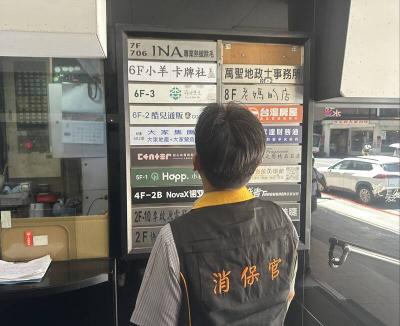
Taipei police today said they have launched an investigation into a well-known Pokemon Trading Card Game store in Taipei's Ximending (西門町) area after its sudden closure, with customers suspecting the owner absconded with up to NT$300 million (US$9.24 million). Little Sheep Card Shop (小羊卡牌社) in Wanhua District (萬華) — which specializes in card purchases and pre-orders, card grading services in Japan, submissions to the US and consignment sales — opened a physical storefront in January. Its three official Line groups, hosting up to 5,000 members each, and social media accounts on Facebook and Instagram all disappeared overnight, with the Ximending
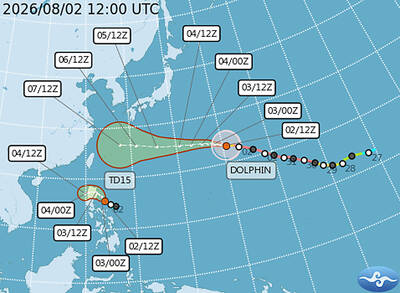
Typhoon Dolphin could bring heavy rain to northern Taiwan later this week if it tracks closer to the nation after passing the Ryukyu Islands, the Central Weather Administration (CWA) said yesterday. The CWA said forecast models agree the storm is to move toward the Ryukyu Islands through Thursday, but diverge over its path after that. One scenario has Typhoon Dolphin passing north of Taiwan, while another has it curving toward the Korean Peninsula if the Pacific high pressure system currently over the East China Sea and Taiwan weakens. Because of the uncertainty, it is still too

NEW AND IMPROVED: The N700ST is based on Japan’s N700S Shinkansen, and features a lighter design, better energy efficiency and upgraded accessibility facilities The first set of N700ST high-speed rail carriages, scheduled to arrive in Taiwan next month, would begin service on July 1 next year, Taiwan High Speed Rail Corp (THSRC) said yesterday. THSRC chairman Shih Che (史哲) made the remarks during a ceremony in Hitachi Ltd’s Kasado Works in Yamaguchi Prefecture, Japan, where he and Hitachi Railway Systems Business Unit CEO Giuseppe Marino unveiled the locomotive of the first N700ST train. More than 200 guests attended the unveiling. “The first set of N700ST trains will soon be shipped to Taiwan from the prefecture’s Kasado Port. Hopefully, all the required tests will be completed successfully
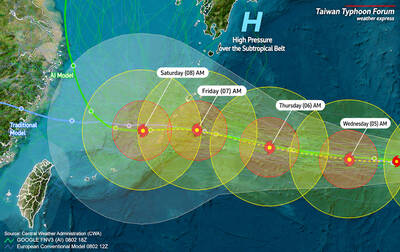
Taiwan could issue a sea warning for Typhoon Dolphin as early as Friday afternoon if the storm maintains its current westward track, the Central Weather Administration (CWA) said yesterday. As of 2pm yesterday, the center of the typhoon was about 2,590km east of Taipei and moving west at 21kph, potentially bringing hazardous conditions to waters surrounding Taiwan by Saturday. Dolphin is expected to reach waters south of the Ryukyu Islands around Saturday, but its track beyond that remains highly uncertain, CWA forecaster Lin Ping-yu (林秉煜) said. The typhoon could either continue moving westward or veer northward, Lin said. A westward track would bring


 RSS
RSS