


Lesbian, gay, bisexual and transsexual (LGBT) groups and more than 2000 demonstrators assembled outside the Legislative Yuan in Taipei yesterday to urge lawmakers to make Taiwan the first Asian country to legalize same-sex marriage.
Led by a coalition of LGBT advocates from the Taiwan Alliance to Promote Civil Partnership Rights (TAPCPR) and other groups, the demonstrators demanded that the “Marriage Equality Amendment” be applied to the Civil Code by the end of the current legislative session in December.
The rally followed a month-long campaign by the groups to get legislators to publicize their stance on same-sex marriage and took on a jubilant tone, with colorful banners draped across a stage on Qingdao E Road next to the Legislative Yuan and large rainbow flags flying from the rooftops of buildings nearby.
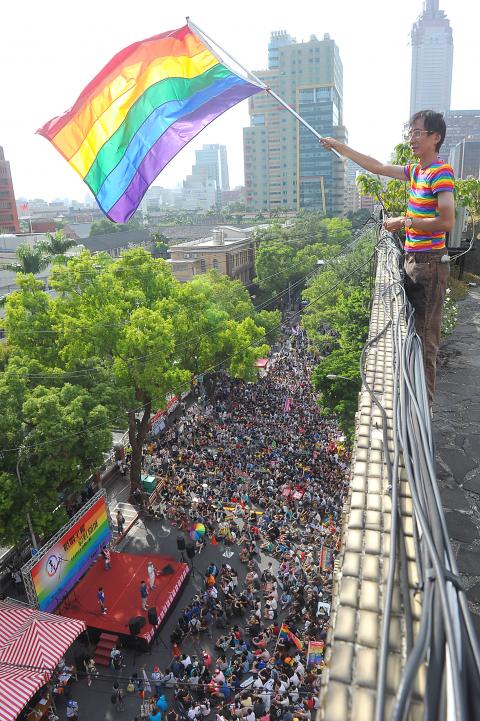
Photo: CNA
At one point, demonstrators danced in unison to a satirical techno remix of homophobic remarks made by Kuo Mei-chiang (郭美江), a Christian pastor who gained notoriety among netizens after characterizing homosexuality as “an interpretation of witchcraft” in a sermon last year.
Democratic Progressive Party (DPP) Legislator Yu Mei-nu (尤美女) attended the event to show her support.
As convener of the legislature’s Judiciary and Organic Laws and Statutes Committee, Yu vowed to organize public hearings for the cause this month, while also restating her wish to place the amendment on the committee’s agenda during her term as convener.
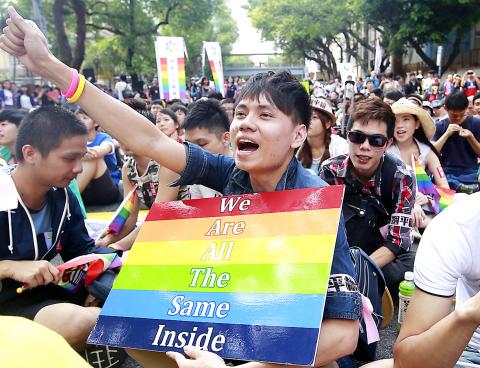
Photo: Reuters
DPP legislators Tuan Yi-kang (段宜康) and Cheng Li-chiun (鄭麗君) also attended the event. Along with Yu, the three lawmakers unlocked “locks of homophobia” attached to the fences outside the legislature by the activists in a symbolic gesture to promote understanding.
Approval at committee stage is required before the amendment can be voted on at the legislature’s plenary session.
LGBT activists see a “difficult battle” ahead, as DPP members are outnumbered nine to four in the committee by their Chinese Nationalist Party (KMT) counterparts.
Out of the 112 total legislators, the movement has secured the support of 15 DPP and four KMT lawmakers, as well as of two legislators from smaller parties.
Notably, some legislators who had previously been against same-sex marriage have agreed to support legislative deliberation for the amendment, including KMT lawmakers Ting Shou-Chung (丁守中) and Chi Kuo-tung (紀國棟).
Legislation to legalize same-sex marriage in Taiwan has already experienced several failed attempts.
Clashes occurred when opposing rallies for and against gay marriage took to the streets on the same day in November last year.
As of last year, public support for same-sex marriage has grown to 53 percent, while 37 percent of Taiwanese are opposed to it, according to a poll jointly conducted by TAPCPR and Academia Sinica.

Considering that most countries issue more than five denominations of banknotes, the central bank has decided to redesign all five denominations, the bank said as it prepares for the first major overhaul of the banknotes in more than 24 years. Central bank Governor Yang Chin-lung (楊金龍) is expected to report to the Legislative Yuan today on the bank’s operations and the redesign’s progress. The bank in a report sent to the legislature ahead of today’s meeting said it had commissioned a survey on the public’s preferences. Survey results showed that NT$100 and NT$1,000 banknotes are the most commonly used, while NT$200 and NT$2,000

The Centers for Disease Control (CDC) yesterday reported the first case of a new COVID-19 subvariant — BA.3.2 — in a 10-year-old Singaporean girl who had a fever upon arrival in Taiwan and tested positive for the disease. The girl left Taiwan on March 20 and the case did not have a direct impact on the local community, it said. The WHO added the BA.3.2 strain to its list of Variants Under Monitoring in December last year, but this was the first imported case of the COVID-19 variant in Taiwan, CDC Deputy Director-General Lin Ming-cheng (林明誠) said. The girl arrived in Taiwan on

ANNUAL EVENT: Two massive Pokemon balloons are to be set up in Daan Park, with an event zone operating from 10am to 6pm This year’s Taipei Floral Picnic is to be held at Daan Park today and tomorrow, featuring an exclusive Pokemon Go event, a themed food market, a coffee rave picnic area and stage performances, the Taipei Department of Information and Tourism said yesterday. Two massive Pokemon balloons are to be set up in the park as attractions, with an exclusive event zone operating from 10am to 6pm, it said. Participants who complete designated tasks on-site would have a chance to receive limited-edition souvenirs, it added. People could also try the newly launched game Pokemon Pokopia in the trial area, the department said. Three PokeStops are

South Korea is planning to revise its controversial electronic arrival card, a step Taiwanese officials said prompted them to hold off on planned retaliatory measures, a South Korean media report said yesterday. A Yonhap News Agency report said that the South Korean Ministry of Foreign Affairs is planning to remove the “previous departure place” and “next destination” fields from its e-arrival card system. The plan, reached after interagency consultations, is under review and aims to simplify entry procedures and align the electronic form with the paper version, a South Korean ministry official said. The fields — which appeared only on the electronic form


 RSS
RSS