


With the experience of turning the small town of Jiji (集集) in Nantou County into a nationally recognized tourist hotspot, Chinese Nationalist Party (KMT) Legislator and county commissioner candidate Lin Ming-chen (林明溱) said that he is certain that if the county were to develop its hostel, restaurant and cultural creativity industries, it would benefit economically and ease the burden of lacking a significant industrial sector.
Lin, who had been Jiji mayor and Nantou County councilor, said in a recent interview with the Liberty Times (the Taipei Times’ sister newspaper) that innovation is a core value in his campaign to bring better service to the public, adding that only through innovation would Nantou have a brighter future.
With Sun Moon Lake (日月潭), Sitou Township (溪頭), Cingjing (清境), Jhushan Township’s (竹山) Ladder Scenic Park and the Skyway Bridge, Nantou’s many tourist destinations have plenty of businesses that fills the county’s coffers, he said.
To complement such an advantage, the county needs to improve its hostels, eateries and cultural creative industries, Lin said, adding that if he were elected county commissioner, he would seek to make all 13 of Nantou County’s townships into tourist hotspots.
Lin said that would further local development and increase county revenue, adding that the county would also seek to promote refined agriculture to benefit area farmers.
Lin said that government policies need to be friendly to common people, adding that under his guidance, the county government would help businesses invest in the area and hopefully encourage Nantou residents working in other townships to return.
In terms of finance, Lin said the county government must make a thorough review of its spending and carefully superintend the county’s resources.
Faced with the low popularity of President Ma Ying-jeou’s (馬英九) administration and a corruption lawsuit involving KMT member and incumbent County Commissioner Lee Chao-ching (李朝卿), Lin acknowledged the KMT’s morale in the area is almost at rock-bottom.
Lee was indicted by the Nantou District Prosecutors’ Office on corruption charges last year. The Control Yuan had also voted 11-to-1 in favor of impeaching Lee.
However, the Executive Yuan has repealed the Ministry of the Interior’s decision to relieve Lee of his office and called on the ministry to determine new punitive measures in the next two months.
“Many actions, although well-intended, are being disparaged by the Democratic Progressive Party [DPP] and have seen little to no effect,” Lin said. “The voter base is extremely tired of the usual war of words between candidates and are hoping to hear about concrete plans and practical policies.”
Lin said his recent surge in popularity shows that the voter base in the county identifies with the policies he has offered.
Lin added that his many years of hard work at building trust among area residents is paying off, adding that he was certain that their trust in him would offset any unfavorable aspects brought on by the Ma administration’s low popularity.
Lee’s wife, Chien Su-tuan (簡素端), recently announced her bid to run in the election as an independent candidate. Asked if the development would hurt his chances, Lin said that everyone has the right to participate in the election.
“It is my belief that the voters of the pan-blue bloc possess great wisdom and will stand united,” Lin said, adding that he also believed the voters would not waste their votes, and would support him by voting for a brighter future.
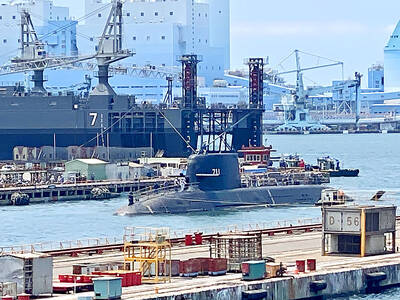
AGING: While Japan has 22 submarines, Taiwan only operates four, two of which were commissioned by the US in 1945 and 1946, and transferred to Taiwan in 1973 Taiwan would need at least 12 submarines to reach modern fleet capabilities, CSBC Corp, Taiwan chairman Chen Cheng-hung (陳政宏) said in an interview broadcast on Friday, citing a US assessment. CSBC is testing the nation’s first indigenous defense submarine, the Hai Kun (海鯤, Narwhal), which is scheduled to be delivered to the navy next month or in July. The Hai Kun has completed torpedo-firing tests and is scheduled to undergo overnight sea trials, Chen said on an SET TV military affairs program. Taiwan would require at least 12 submarines to establish a modern submarine force after assessing the nation’s operational environment and defense

Yangmingshan National Park authorities yesterday urged visitors to respect public spaces and obey the law after a couple was caught on a camera livestream having sex at the park’s Qingtiangang (擎天崗) earlier in the day. The Shilin Police Precinct in Taipei said it has identified a suspect and his vehicle registration number, and would summon him for questioning. The case would be handled in accordance with public indecency charges, it added. The couple entered the park at about 11pm on Thursday and began fooling around by 1am yesterday, the police said, adding that the two were unaware of the park’s all-day live
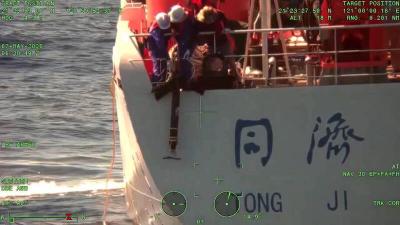
The coast guard today said that it had disrupted "illegal" operations by a Chinese research ship in waters close to the nation and driven it away, part of what Taipei sees a provocative pattern of China's stepped up maritime activities. The coast guard said that it on Thursday last week detected the Chinese ship Tongji (同濟號), which was commissioned only last year, 29 nautical miles (54km) southeast of the southern tip of Taiwan, although just outside restricted waters. The ship was observed lowering ropes into the water, suspected to be the deployment of scientific instruments for "illegal" survey operations, and the coast

A former soldier and an active-duty army officer were yesterday indicted for allegedly selling classified military training materials to a Chinese intelligence operative for a total of NT$79,440. The Taipei District Prosecutors’ Office indicted Chen Tai-yin (陳泰尹) and Lee Chun-ta (李俊達) for contravening the National Security Act (國家安全法) and the Anti-Corruption Act (貪污治罪條例). Chen left the military in September 2013 after serving alongside then-staff sergeant Lee, now an army lieutenant, at the 21st Artillery Command of the army’s Sixth Corps from 2011 to 2013, according to the indictment. Chen met a Chinese intelligence operative identified as “Wang” (王) through a friend in November


 RSS
RSS