


In addition to other mango-affiliated products, pillows in the shape and color of the fruit made by members of the Saint Theresa Opportunity Center (德蘭啟智中心) in Yujing District (玉井) have been a great success and well-received by tourists.
Hand-sewn by the students of the Telan Special Education Center, the pillows were developed in an effort to provide the students at the center with a skill, center director Yang Mei-hua (楊美華) said.
“Though the income is limited, it nonetheless bolsters the students’ confidence in their own ability,” Yang said.
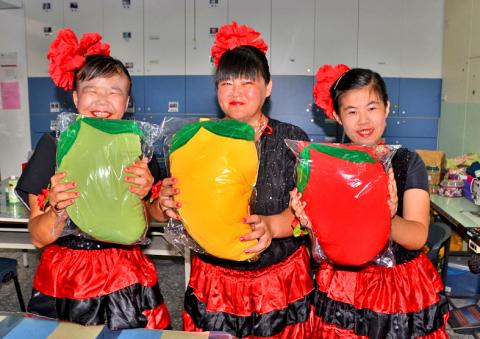
Photo: Wu Chun-feng, Taipei Times
The pillows, named after popular Taiwanese singer Wang Li-hom (王力宏), were intended to be homophones of the three primary colors, yellow, green and red, which also represent the three most popular mango types in the township, Yang said.
The three types are the chinhuang (yellow), the local mango (green) and the aiwen (red).
The students took care of all the work for the pillows, including pattern making, the cutting of original material, rabbeting, stuffing and sewing the pillows closed, Yang said, adding that the process helped them make a living for themselves
All income from the sale of the pillows went to the students after the deduction of material fees, but since the pillows did not cost a lot per item there was little to go around, Yang said, adding that the students nonetheless worked hard at the job.
The pillows are quite well received by tourists, Yang said, adding that the center has been receiving calls ordering more pillows.
The center is also selling dried mangoes in an effort to raise more money for its students and members, Yang said.
The township center also has other activities to help its members and students learn skills aiding them in the process of applying for gainful employment, including car washing, cleaning, gardening, packaging, cooking, sewing and making postcards.
The members at the center are free to choose which activity to participate in and professionals oversee them all, Yang said, adding that to date all the classes and activities have yielded exceptional results.
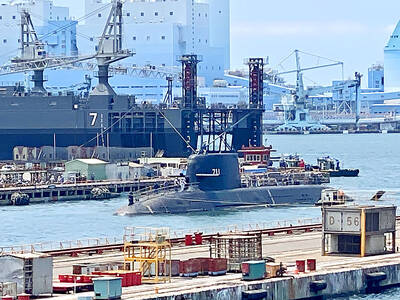
AGING: While Japan has 22 submarines, Taiwan only operates four, two of which were commissioned by the US in 1945 and 1946, and transferred to Taiwan in 1973 Taiwan would need at least 12 submarines to reach modern fleet capabilities, CSBC Corp, Taiwan chairman Chen Cheng-hung (陳政宏) said in an interview broadcast on Friday, citing a US assessment. CSBC is testing the nation’s first indigenous defense submarine, the Hai Kun (海鯤, Narwhal), which is scheduled to be delivered to the navy next month or in July. The Hai Kun has completed torpedo-firing tests and is scheduled to undergo overnight sea trials, Chen said on an SET TV military affairs program. Taiwan would require at least 12 submarines to establish a modern submarine force after assessing the nation’s operational environment and defense

Yangmingshan National Park authorities yesterday urged visitors to respect public spaces and obey the law after a couple was caught on a camera livestream having sex at the park’s Qingtiangang (擎天崗) earlier in the day. The Shilin Police Precinct in Taipei said it has identified a suspect and his vehicle registration number, and would summon him for questioning. The case would be handled in accordance with public indecency charges, it added. The couple entered the park at about 11pm on Thursday and began fooling around by 1am yesterday, the police said, adding that the two were unaware of the park’s all-day live
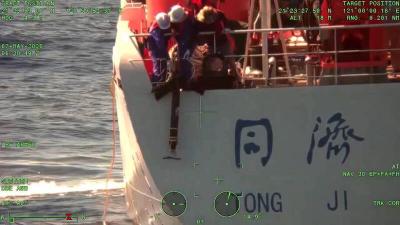
The coast guard today said that it had disrupted "illegal" operations by a Chinese research ship in waters close to the nation and driven it away, part of what Taipei sees a provocative pattern of China's stepped up maritime activities. The coast guard said that it on Thursday last week detected the Chinese ship Tongji (同濟號), which was commissioned only last year, 29 nautical miles (54km) southeast of the southern tip of Taiwan, although just outside restricted waters. The ship was observed lowering ropes into the water, suspected to be the deployment of scientific instruments for "illegal" survey operations, and the coast

A former soldier and an active-duty army officer were yesterday indicted for allegedly selling classified military training materials to a Chinese intelligence operative for a total of NT$79,440. The Taipei District Prosecutors’ Office indicted Chen Tai-yin (陳泰尹) and Lee Chun-ta (李俊達) for contravening the National Security Act (國家安全法) and the Anti-Corruption Act (貪污治罪條例). Chen left the military in September 2013 after serving alongside then-staff sergeant Lee, now an army lieutenant, at the 21st Artillery Command of the army’s Sixth Corps from 2011 to 2013, according to the indictment. Chen met a Chinese intelligence operative identified as “Wang” (王) through a friend in November


 RSS
RSS