


Chinese Nationalist Party (KMT) Legislator Lo Shu-lei (羅淑蕾) yesterday accused Taipei mayoral independent candidate Ko Wen-je (柯文哲) of corruption, tax evasion and money laundering while serving as head of National Taiwan University Hospital’s (NTUH) surgical intensive care unit (SICU).
Ko’s campaign office denied the allegations and sued Lo for defamation.
Lo told a press conference yesterday morning that Ko had “privately” set up an account called MG149 under the hospital’s special account “402,” which was originally set up for donations to stamp out “red envelope culture.”
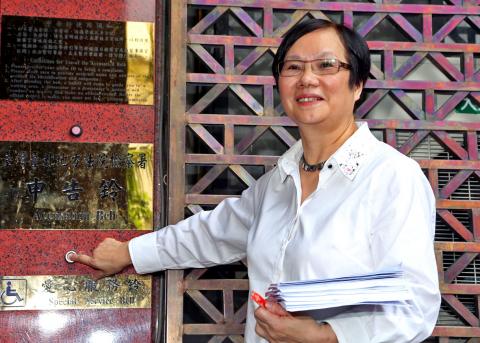
Photo: CNA
According to Lo and the documents she provided, which included the “MG149 regulations” allegedly drawn up by Ko himself, the capital for the account comes from sponsorships from subcontractors, enterprises or individuals, research and clinical trial funding, capitation tax from the unit’s team members and earnings of research assistants and research nurses from institutions outside the NTUH.
Citing the clinical trial funding as an example, Lo said: “The regulations [allegedly drawn up by Ko] state that the remainder of the clinical trial funding after deducting the required expenditure is to be shared fifty-fifty: half is to go to the person who presided over the trial and half to the MG149 account, which can later be transferred to the SICU common fund account, but would require payment of ‘10 percent as a money laundering fee.’”
“Ko is also guilty of encouraging tax evasion since these regulations point out that participants can first donate and then withdraw [the money from the account] to claim income tax deductions,” Lo added.
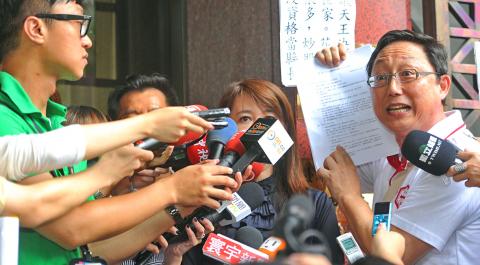
Photo: Liu Hsin-de, Taipei Times
When asked whether there are other NTUH departments that have similar accounts, Lo said there might be, but “no one would do it as overtly as Ko did.”
“The MG149 bank system, which could not have been publicly set up, used figurehead accounts,” Lo said, adding that the system even provided “loan services” to those in need.
Lo called Ko “a black force in the white tower” who had been “covering his illegal activities with legal formalities.”
“I’ve had of these documents for more than six months, and I had warned Ko that if he decided to run for office I would make them public,” she said.
Lo went to the Taipei District Prosecutors’ Office after the press conference to call for an investigation into the matter.
According to a copy of the so-called “MG149 regulations” that Lo made public, the “motto of the establishment of MG149” is that “money may not be omnificent, but lack thereof could be a disaster.”
“In order to avoid conflict within the team because of money problems, the SICU research fee shall be managed based on the following principles: (1) open rules, rather than personal will, dominate the spending management; (2) routine displays of expenditure details; (3) separation of ownership and management,” the MG149 regulations state.
Ko’s campaign office issued a statement yesterday afternoon rebutting the accusations, saying the MG149 account is an NTUH public — rather than Ko’s private — account and that all attending physicians and higher-ranked officials in public hospitals have special accounts for research.
The statement underscored the aim of the regulations, which is the institutionalization of the fund management, to lower risks of legal violations. It accused Lo of quoting text out of context to distort its aim.
“Not a penny from the account went to Ko’s pocket,” Ko’s spokesperson Chien Yu-yen (簡余晏) said. “Lo is crying wolf, for the fifth time.”
“The prosecution and investigation units conducted an in-depth and thorough probe into Ko’s research funds and the [MG149] account from 2012 to 2013. The case closed in 2013 and nothing illegal was found,” Chien said.
“This is defamation and a serious accusation during the campaign period. If Lo cannot present concrete evidence to support her accusations, we will take legal action,” she said.
Ko’s campaign director, Yao Li-ming (姚立明), asked whether KMT Taipei mayoral candidate Sean Lien (連勝文) endorses Lo’s remarks and behavior, and whether the documents that Lo presented came from prosecutors or the “KMT administration’s top echelons.”
Yao said that using mudslinging as a campaign tactic would not win the public’s support.
It was not the first time that Lo accused Ko of wrongdoing during his time as a physician. She claimed that Ko, dubbed the “father of extracorporeal membrane oxygenation” technology in Taiwan, does not know how to install the life-support equipment, and alleged that Ko had treated patients as “guinea pigs” in clinical trials.

NATIONAL SECURITY: Authorities are working to confirm the identities of the military personnel involved and investigating possible illegal conduct and regulatory violations Authorities are probing possible national security implications after Kinmen police and immigration officers on Sunday found a Chinese woman allegedly posing as a tourist while engaging in prostitution involving more than 10 military personnel. The woman, surnamed Chen (陳), has since been deported, authorities said, adding that investigators are still working to confirm the identities of those implicated, as the records only listed code names and aliases. The case stemmed from a report received by the Kinmen District Prosecutors’ Office on Friday last week from the Jinhu Precinct of the Kinmen County Police Bureau. On Sunday, police, along with the National Immigration

GLOBALGIVING: ‘ Caving to external pressure is not acceptable for an organization that has cultivated justice reform and human rights for 30 years,’ one NGO said A slew of non-government organizations (NGOs) have withdrawn from the GlobalGiving fundraising platform after it announced it would use “Chinese Taipei” instead of “Taiwan” from next month. The Taiwan Good Rice Association wrote on Facebook on Friday that it was informed on April 28 via a teleconference call of the change, which was made because the platform wanted to operate in China. Taiwan Good Rice is to terminate all cooperative relationships with GlobalGiving in response to the platform’s “unilateral and non-negotiable” decision to remove references to Taiwan, the NGO said. “Taiwan is in the official name of Taiwan Good Rice Association and the

HEAVY WEATHER: Typhoon Jangmi is due to crash straight into the Ryukyus as airlines look to shift flights to larger aircraft or cancel flights to Okinawa entirely Taiwan’s international air carriers announced flight adjustments over the weekend as Typhoon Jangmi is forecast to hit the Ryukyu Islands today and tomorrow. The Central Weather Administration (CWA) upgraded Jangmi from a tropical storm to a typhoon at 8am yesterday, with the eye located 580km south of Naha city. It was moving north at 19kph. Today, China Airlines’ CI-120, CI-121, CI-122 and CI-123 flights between Taoyuan and Naha, Okinawa, have been canceled as well as CI-132 and CI-133 between Kaohsiung and Naha. EVA Air’s BR-112, BR-113, BR-186 and BR-185 flights between Taoyuan and Naha are also canceled. Low-cost carrier Tigerair Taiwan canceled IT-230,
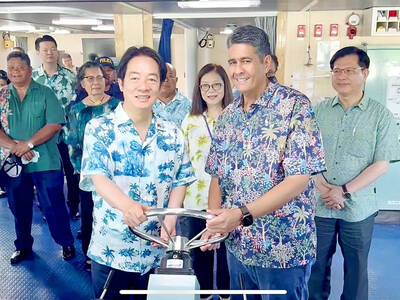
MULTIPRONGED APPROACH: China has sought to pressure Palau across a number of fronts, but the island nation has staunchly resisted overtures to ditch Taiwan Palau has been firm in backing Taiwan despite Chinese pressure that uses tourism economics, cyberattacks and criminal infiltration as tools to threaten the Pacific ally into renouncing its recognition of Taiwan as a sovereign state. The Presidential Office yesterday announced that Vice President Hsiao Bi-khim (蕭美琴) would visit Palau from Saturday to Wednesday next week at the invitation of Palauan President Surangel Whipps Jr. Whipps in April said in an interview that China had outspokenly asked Palau to “denounce Taiwan.” “And we have said: ‘We have no enemies, but nobody tells us who our friends are,’” he said. Whipps has told reporters multiple times


 RSS
RSS