


“I’ve always been competent in completing the big projects that the Chinese Nationalist Party (KMT) fails to execute and leaves unfinished for years,” Democratic Progressive Party (DPP) New Taipei City mayoral candidate and former premier Yu Shyi-kun said in a recent interview with the Chinese-language Liberty Times (the Taipei Times’ sister newspaper).
“I entered the New Taipei City race to keep fulfilling my lifelong mission and promise to the Taiwanese public and to this country of ours,” Yu said, before going on to list the projects completed under his premiership, including the Formosa Freeway (National Freeway No. 3), the Hsuehshan Tunnel and flood control engineering works on the Keelung River (基隆河).
Yu said that all these projects had either been delayed, or were making arduously slow and difficult progress under the former KMT administration, but after assuming the post of premier, he brought them to completion within two to three years.
Turning to his campaign platform, the DPP hopeful said he sees New Taipei City Mayor Eric Chu’s (朱立倫) housing policy as “unfair, since it is not equitable to all sectors of society.”
“My proposed social housing and government-directed urban renewal programs meet the criteria for housing justice,” he said.
“Before 1974, buildings were not required to be earthquake-resistant. New Taipei City has about 250,000 of these non-quake-proof buildings that are more than 40 years old,” Yu said. “Citing data from the National Center for Research on Earthquake Engineering, former minister of the interior Lee Hong-yuan (李鴻源) has said that if a magnitude 6.3 or greater earthquake were to strike the Greater Taipei area, 4,000 buildings would collapse. Despite this, no politician has given earnest though to how to deal with this problem.”
The 66-year-old politician said that all those old buildings and homes should be given the chance to undergo renewal.
“With open-ended policies, we could enable citizens to either choose their preferred plan from the private sector, or opt for a state-led urban revitalization plan, which they can trust as it would include guaranteed protection and the lowest condition requirements,” he said.
“Under my urban revitalization plan directed by the government, there would be clear transparency and a high degree of public credibility that would facilitate overall integration,” Yu said. “Renewal projects would be planned out and coordinated over a large area, thereby improving the quality of life of local residents. Furthermore, my plan would incentivize having a higher ratio of building volume-to-floor area, better utilization of public land and the installation of public facilities.”
Yu said that if elected, he would raise NT$1 trillion (US$33.35 billion) throughout the four-year mayoral term “to fund the renewal of 90,000 buildings under the public sector plan. We can transform old residential blocks into new neighborhoods.”
Under a 300 percent building volume-to-floor space ratio for four-story apartment buildings, Yu said “citizens could trade a new house for their old one, while retaining the same amount of floor space, in addition to increased parking space and access to a public park next door.”
Turning to his social housing plan, Yu proposed having the public sector borrow NT$1 trillion from financial institutions to build public housing complexes of 50,000 units with a low rents of NT$300 per ping (3.3m2) over the four-year mayoral term.
“This would provide affordable housing for young people. I want to stress that this is a self-financing plan: It enables most people to live within an affordable price range and does not add any financial burden to the government. In the long-term, this scheme would see the government profit from the eventual increase in property value,” Yu said.
“Under my social housing initiative, the units would be exclusively rentals and would be built by the New Taipei City Government. Residents would be responsible for paying rent and building management fees, but the plan is not-for-profit, since the rent money would go toward covering construction costs, maintenance and administration management fees. Therefore, the rental rates would be much lower than market price. Any young person who applies for such housing can enjoy these benefits,” Yu said.
As for his plans to improve transportation, Yu said he is hopeful that if both he and independent Taipei mayoral candidate Ko Wen-je (柯文哲) are elected, then right-of-way issues for buses could be revamped and certain bus-only lanes in Taipei could be extended to New Taipei City so the public transport system can run more smoothly between the two areas.
About the municipality’s social welfare policy, Yu said that Chu has spent too much money on fixed-location facilities.
“Social welfare programs must be fair and equitable to all, but Chu’s public daycare centers are selected by lottery, meaning that eligibility for those daycares and public elementary schools is left to luck of the draw,” the former premier said.
“We have about 10,000 children under the age of three in New Taipei City. Chu spent lot of money to set up the public daycare centers, but they can only accommodate 2,000 to 3,000 kids,” Yu said. “To resolve this problem, I propose giving financial subsidies to parents and enhance programs for nannies.”

UPGRADE: The Kang Ding-class frigate is replacing its Chaparall missiles with Tien Chien II and Hua Yang VLS, which would provide it with long-range, 360° air defense Taiwan plans to produce 1,200 to 1,376 Hai Chien II missiles (海劍二, Sea Sword II) — also known as TC-2N — to serve as the standard air defense system of the navy’s surface combatant fleet, a source said yesterday. Last week, the Hai Chien II, the naval version of the Tien Kung II missile (天劍二, Sky Sword II), completed a live-fire test in waters off the National Chungshan Institute of Science and Technology’s Jiupeng facility (九鵬) in Pingtung County’s Manjhou Township (滿州). The MIM72 Chaparral and other dated air defense missiles that currently arm Taiwanese ships have inadequate range to combat Chinese

REASONS FOR TRAVEL: An assistant professor said that proposed amendments to penalize drivers if they used drugs overseas would not deter people from traveling People who operate a motor vehicle under the influence of marijuana would have their driver’s license revoked, even if they used the substance while overseas, the Ministry of Transportation and Communications said yesterday, citing proposed amendments to the Road Traffic Management and Penalty Act (道路交通管理處罰條例). The amendments would also authorize the government to revoke the licenses of people determined to have used Category 1 or Category 2 narcotics, even if they were not operating a vehicle while under the influence of drugs, as well as ban them from taking the license test for three years, the ministry said. People aged 18 or
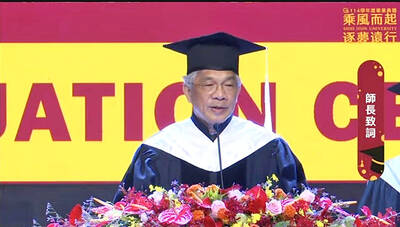
Shih Hsin University President Chen Ching-he (陳清河) yesterday issued a public apology for comments made in his commencement speech last week, stating that he has asked the school to suspend his duties and halt his wages for two months as a show of contrition. At the commencement ceremony on May 30, Chen said, “If you don’t manage your time well, or your own emotions, or your health, then I am telling every one of you — put a quick end to ‘you,’ because the world has no need for ‘you.’” The comments have sparked significant controversy online, and Chen through an open
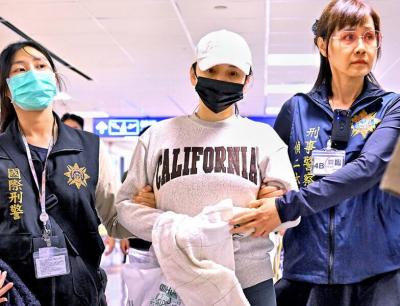
Johanne Liou (劉喬安), a Taiwanese woman who shot to unwanted fame during the Sunflower movement protests in 2014, returned to Taiwan last night after being deported from the US. She is to stand trial in Taiwan for charges involving embezzlement, fraud and drug crimes. The Criminal Investigation Bureau (CIB) said it took her into custody at Taiwan Taoyuan International Airport and would first question her before transferring her to the New Taipei District Prosecutors’ Office. She was arrested upon disembarking a flight from San Francisco that landed shortly before 7pm. Liou absconded to the US in 2019 after jumping bail


 RSS
RSS