


By day, Lin Tzu-yao (林子堯) is a devoted psychologist at the Taoyuan Psychiatric Center, but by night, he is the creator of a well-received comic book series that uses humor to underscore some of the unspoken challenges facing today’s doctors and healthcare providers.
Lin studied at the China Medical University, before starting his internship at the National Taiwan University Hospital, one of the nation’s most prestigious medical facilities.
Lin had lived a life that was not much different from that of his colleagues, until the aggravation of excessive overtime work among medical staff and the flaws plaguing the nation’s medical system prompted him to transform the bitter experiences shared by many doctors into four-panel comic strips.
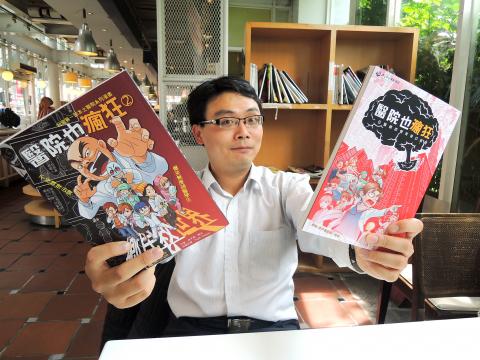
Photo: Tsai Shu-yuan, Taipei Times
The 31-year-old published his first comic book, titled Crazy Hospital (醫院也瘋狂), in November last year, in which he appears as a character named Lei Ya (雷亞) who works as a hospital intern.
The book has garnered popular acclaim since its publication and made Lin the first physician in the nation to be honored by the Ministry of Culture with a New Comic Artist Award.
The success of his debut prompted Lin to roll out a sequel, released on Sunday, which not only retains the humorous, ironic style that characterized his first book, but also incorporates some closely watched current events.
For instance, a comic strip titled Death-Grip Handshake (死亡之握) depicts a talented physician turning into a black-hearted person who enjoys exploiting his subordinates after his brain is penetrated by toxic substances emitted by his superior’s hands when they shook hands.
The strip might be inspired by the nickname netizens have given President Ma Ying-jeou’s (馬英九) handshakes, which are said to bring bad luck.
Another comic strip, titled A New Uniform for Emergency Room Staff (急診新制服), is based on a high-profile assault case in November last year, in which a local representative allegedly slapped a nurse in the face at Linkou Chang Gung Memorial Hospital for refusing to update her on her father’s condition over the telephone.
In the strip, employees working at the emergency room are given an Iron Man suit as uniforms, so that they can emit lasers out of their hands like the fictional superhero does to destroy whoever attacks them.
The 10-month-old panda cub Yuan Zai (圓仔), who has become a media darling since her birth on July 6 last year, also appears in Lin’s strips.
A strip dedicated to the cub depicts a large crowd of people flocking to the Taipei Zoo to have a glimpse of the fluffy animal, while two passers-by jokingly attribute her huge popularity to the public’s desperate need for a black-and-white animal, since “they can no longer distinguish between black and white.”
Lin said his infatuation with comics began when he was little as his favorite childhood pastime was reading Taiwanese cartoonist Liu Hsing-chin’s (劉興欽) comic series Brother A-san and Great Auntie (阿三哥與大嬸婆) and Japanese manga series Doraemon.
“I have always dreamed of creating a comic book series that could not only surpass legendary Japanese manga artist Osamu Tezuka’s popular work, Black Jack, but also truthfully reflect the lives of Taiwanese doctors,” Lin said.

The military has spotted two Chinese warships operating in waters near Penghu County in the Taiwan Strait and sent its own naval and air forces to monitor the vessels, the Ministry of National Defense (MND) said. Beijing sends warships and warplanes into the waters and skies around Taiwan on an almost daily basis, drawing condemnation from Taipei. While the ministry offers daily updates on the locations of Chinese military aircraft, it only rarely gives details of where Chinese warships are operating, generally only when it detects aircraft carriers, as happened last week. A Chinese destroyer and a frigate entered waters to the southwest

A magnitude 6.1 earthquake struck off the coast of Yilan County at 8:39pm tonight, the Central Weather Administration (CWA) said, with no immediate reports of damage or injuries. The epicenter was 38.7km east-northeast of Yilan County Hall at a focal depth of 98.3km, the CWA’s Seismological Center said. The quake’s maximum intensity, which gauges the actual physical effect of a seismic event, was a level 4 on Taiwan’s 7-tier intensity scale, the center said. That intensity level was recorded in Yilan County’s Nanao Township (南澳), Hsinchu County’s Guansi Township (關西), Nantou County’s Hehuanshan (合歡山) and Hualien County’s Yanliao (鹽寮). An intensity of 3 was

Japanese Prime Minister Sanae Takaichi’s comment last year on Tokyo’s potential reaction to a Taiwan-China conflict has forced Beijing to rewrite its invasion plans, a retired Japanese general said. Takaichi told the Diet on Nov. 7 last year that a Chinese naval blockade or military attack on Taiwan could constitute a “survival-threatening situation” for Japan, potentially allowing Tokyo to exercise its right to collective self-defense. Former Japan Ground Self-Defense Force general Kiyofumi Ogawa said in a recent speech that the remark has been interpreted as meaning Japan could intervene in the early stages of a Taiwan Strait conflict, undermining China’s previous assumptions
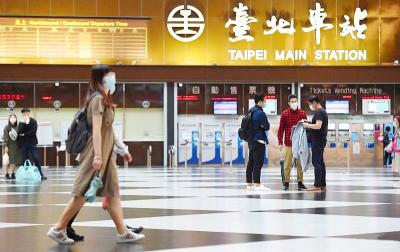
Taiwan Railways Corp (TRC) today announced that Shin Kong Mitsukoshi has been selected as the preferred bidder to operate the Taipei Railway Station shopping mall, replacing the current operator, Breeze Development Co Ltd. Among eight qualified firms that delivered presentations and were evaluated by a review committee, Shin Kong Mitsukoshi was ranked first, while Breeze was named the runner-up, the rail company said in a statement. Contract negotiations are to proceed in accordance with regulations, it said, adding that if negotiations with the top bidder fail, it could invite the second-ranked applicant to enter talks. Breeze in a statement today expressed doubts over


 RSS
RSS