


The issue of the Fourth Nuclear Power Plant is about more than a controversy over nuclear power, Premier Jiang Yi-huah (江宜樺) said yesterday, stressing that it should be considered within the bigger picture of the nation’s heavy dependence on imported energy.
Jiang said yesterday at the legislature’s floor meeting that focusing only on the construction of the Fourth Nuclear Power Plant in New Taipei City’s Gongliao District (貢寮) is “[inappropriately] narrowing the problem,” since more than 90 percent of Taiwan’s energy has to be imported.
In this context, a post-safety-check Fourth Nuclear Power Plant, along with the three operational nuclear power plants, will play a crucial role in supplying the nation with the energy it needs, he added.
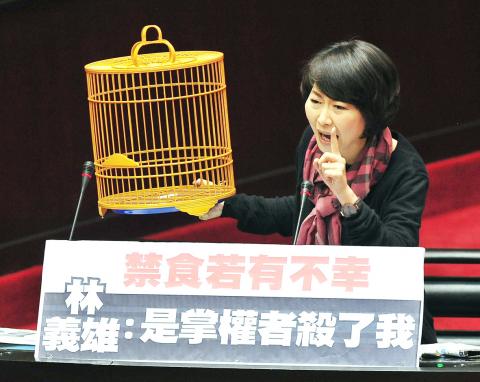
Photo: Chien Jung-fong, Taipei Times
“Many people have concerns or fears about nuclear power. A nuclear-free [nation] might be our long-term, eventual goal, but as we already have three nuclear power plants in operation, it will not be possible to achieve that goal in a single leap,” Jiang said.
“We have to face the problem of where to get the needed energy [if nuclear power is no longer the generator of our electricity]. We also have to face the [dilemma] of environmental protection, since we would have to acquire electricity through burning coal or using natural gas, which would lead to an increase in carbon dioxide emissions. Compared with nuclear power’s safety concerns, global warming is a more imminent challenge,” he added.
Jiang said that coal-generated power, natural gas and renewable energy have also raised objections, “such as alternative energy-source wind turbines, which have been opposed for the noise they make and ruining the landscape.”
He was referring to the Yuanli Self-Help Group, which has been protesting against a wind turbine project in Miaoli County’s Yuanli Township (苑裡), prompted by the government reaching a unilateral decision with German wind-power company InfraVest Wind Power Group without consulting the residents, and a law that sets the minimum distance between wind turbines and habitation at 250m, which is shorter than a range of between 400m and 1,500m maintained in countries such as Denmark and Germany.
In another round of protests staged by Yuanli residents on Wednesday last week, a protester said “the group welcomes the government promoting alternative, clean sources of energy, but it should develop a mechanism for local residents to participate in projects and not stand on the side of large enterprises.”
Jiang said that anyone who opposes nuclear power “has the responsibility of tabling an alternative energy development policy for the nation.”
On a potential referendum to decide whether to activate the Fourth Nuclear Power Plant by inserting the fuel rods, Jiang said the position of the Executive Yuan and the Presidential Office is nothing but “completing safety checks first before any possibility of a referendum.”
“But that does not mean once the safety check has been conducted by the Atomic Energy Council, a referendum automatically ensues,” the premier said, adding that the safety check report would be made public and discussed in the Legislature before any further discussion of a referendum.
The meaning of a referendum, Jiang said, is to have the people decide, “while well aware of the consequences, such as higher electricity tariffs and possible rationing of electricity, which suspension of the Fourth Nuclear Power Plant might instigate,” whether they want to shoulder those burdens.
Responding to former Democratic Progressive Party chairman Lin I-hsiung’s (林義雄) hunger strike, Jiang said he does not want to see Lin suffer, and that in a democratic society “there are [other] ways, in accordance with democratic procedures, to express one’s opinion.”
Lin’s wording [of accusing the government of murdering him should anything unfortunate happen], “implying that those in power should bow to his urge or be a murderer, is extreme,” Jiang said. “We will leave it to the judgement of the public.”
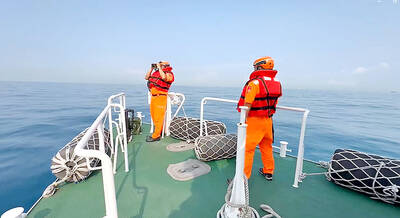
An increase in Taiwanese boats using China-made automatic identification systems (AIS) could confuse coast guards patrolling waters off Taiwan’s southwest coast and become a loophole in the national security system, sources familiar with the matter said yesterday. Taiwan ADIZ, a Facebook page created by enthusiasts who monitor Chinese military activities in airspace and waters off Taiwan’s southwest coast, on Saturday identified what seemed to be a Chinese cargo container ship near Penghu County. The Coast Guard Administration went to the location after receiving the tip and found that it was a Taiwanese yacht, which had a Chinese AIS installed. Similar instances had also

GOOD DIPLOMACY: The KMT has maintained close contact with representative offices in Taiwan and had extended an invitation to Russia as well, the KMT said The Chinese Nationalist Party (KMT) would “appropriately handle” the fallout from an invitation it had extended to Russia’s representative to Taipei to attend its international banquet last month, KMT Chairman Eric Chu (朱立倫) said yesterday. US and EU representatives in Taiwan boycotted the event, and only later agreed to attend after the KMT rescinded its invitation to the Russian representative. The KMT has maintained long-term close contact with all representative offices and embassies in Taiwan, and had extended the invitation as a practice of good diplomacy, Chu said. “Some EU countries have expressed their opinions of Russia, and the KMT respects that,” he
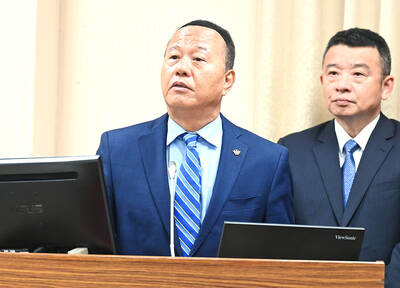
VIGILANCE: The military is paying close attention to actions that might damage peace and stability in the region, the deputy minister of national defense said The People’s Republic of China (PRC) might consider initiating a hack on Taiwanese networks on May 20, the day of the inauguration ceremony of president-elect William Lai (賴清德), sources familiar with cross-strait issues said. While US Secretary of State Anthony Blinken’s statement of the US expectation “that all sides will conduct themselves with restraint and prudence in the period ahead” would prevent military actions by China, Beijing could still try to sabotage Taiwan’s inauguration ceremony, the source said. China might gain access to the video screens outside of the Presidential Office Building and display embarrassing messages from Beijing, such as congratulating Lai
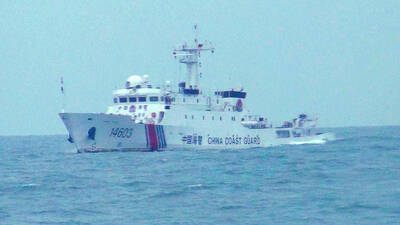
Four China Coast Guard ships briefly sailed through prohibited waters near Kinmen County, Taipei said, urging Beijing to stop actions that endanger navigation safety. The Chinese ships entered waters south of Kinmen, 5km from the Chinese city of Xiamen, at about 3:30pm on Monday, the Coast Guard Administration said in a statement later the same day. The ships “sailed out of our prohibited and restricted waters” about an hour later, the agency said, urging Beijing to immediately stop “behavior that endangers navigation safety.” Ministry of National Defense spokesman Sun Li-fang (孫立方) yesterday told reporters that Taiwan would boost support to the Coast Guard


 RSS
RSS