


Several environmentalists yesterday accused Chinese Nationalist Party (KMT) Legislator Lin Te-fu (林德福) of benefiting from a revision to construction plans on a section of the MRT’s Wanda line, a planned addition to the MRT mass rapid transit system that serves metropolitan Taipei.
The environmentalists held banners that read: “Lin — one of the ‘four bandits’ — is wrongly profiting” and “The MRT Wanda line’s Environmental Impact Assessment [EIA] report is a forgery.”
Lin has been named by student-led protesters against the government’s handling of cross-strait service trade agreement, as one of “four major bandits” for following President Ma Ying-jeou’s (馬英九) orders to the letter as opposed to listening to the opinions of the public.
According to the environmentalists, the plans for a section of the Wanda line in Yonghe District (永和), New Taipei City, gained approval at an EIA specialists’ meeting late last month, but the revised route will require that tens of billions of New Taiwan dollars be added to the project’s construction budget and pollution prevention measures were not clearly explained in its EIA report.
Taiwan Water Resources Protection Union spokesperson Wu Li-huei (吳麗慧) said the revisions have relocated a station to a spot in front of Yong Ping Elementary School, and an additional 700m of track are to pass through an old landfill site in the area.
The revisions would cause pollution in the area by disturbing the landfill site, Wu said, adding that the union was skeptical about the EIA report because it lacked clear waste removal and cleanup measures.
She said that the union also had questions over whether the revisions were made to benefit Lin, because the revised route passes through land owned by the lawmaker.
In response, Lin’s office said the legislator had no part in the revisions to the construction project.
Meanwhile, the Environmental Protection Administration said that although the project gained initial approval at the specialists’ meeting, it still needs to be discussed in an EIA assembly meeting.
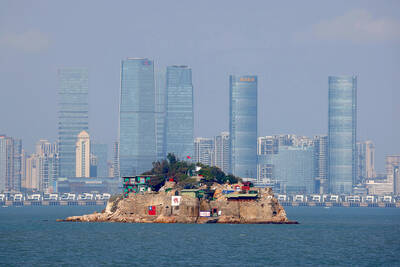
The Chinese Communist Party (CCP) is pushing for residents of Kinmen and Lienchiang counties to acquire Chinese ID cards in a bid to “blur national identities,” a source said. The efforts are part of China’s promotion of a “Kinmen-Xiamen twin-city living sphere, including a cross-strait integration pilot zone in China’s Fujian Province,” the source said. “The CCP is already treating residents of these outlying islands as Chinese citizens. It has also intensified its ‘united front’ efforts and infiltration of those islands,” the source said. “There is increasing evidence of espionage in Kinmen, particularly of Taiwanese military personnel being recruited by the
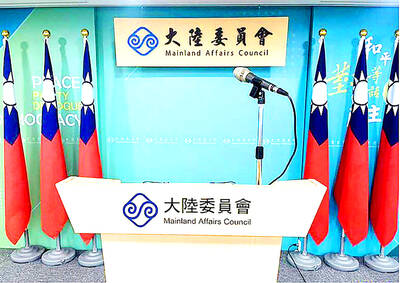
ENTERTAINERS IN CHINA: Taiwanese generally back the government being firm on infiltration and ‘united front’ work,’ the Asia-Pacific Elite Interchange Association said Most people support the government probing Taiwanese entertainers for allegedly “amplifying” the Chinese Communist Party’s propaganda, a survey conducted by the Asia-Pacific Elite Interchange Association showed on Friday. Public support stood at 56.4 percent for action by the Mainland Affairs Council and the Ministry of Culture to enhance scrutiny on Taiwanese performers and artists who have developed careers in China while allegedly adhering to the narrative of Beijing’s propaganda that denigrates or harms Taiwanese sovereignty, the poll showed. Thirty-three percent did not support the action, it showed. The poll showed that 51.5 percent of respondents supported the government’s investigation into Taiwanese who have

Left-Handed Girl (左撇子女孩), a film by Taiwanese director Tsou Shih-ching (鄒時擎) and cowritten by Oscar-winning director Sean Baker, won the Gan Foundation Award for Distribution at the Cannes Critics’ Week on Wednesday. The award, which includes a 20,000 euro (US$22,656) prize, is intended to support the French release of a first or second feature film by a new director. According to Critics’ Week, the prize would go to the film’s French distributor, Le Pacte. "A melodrama full of twists and turns, Left-Handed Girl retraces the daily life of a single mother and her two daughters in Taipei, combining the irresistible charm of

South Korean K-pop girl group Blackpink are to make Kaohsiung the first stop on their Asia tour when they perform at Kaohsiung National Stadium on Oct. 18 and 19, the event organizer said yesterday. The upcoming performances will also make Blackpink the first girl group ever to perform twice at the stadium. It will be the group’s third visit to Taiwan to stage a concert. The last time Blackpink held a concert in the city was in March 2023. Their first concert in Taiwan was on March 3, 2019, at NTSU Arena (Linkou Arena). The group’s 2022-2023 “Born Pink” tour set a


 RSS
RSS