


A new National Taiwan Museum exhibition uses interactive booths and educational commentaries to provide a close-up look into the world of trees, flowers, grass and bamboo, while demonstrating how seeds grow.
The Magic of Plants exhibition opened on Jan. 28 and runs through Aug. 31 on the museum’s first floor, which is next to the 228 Peace Park in Taipei.
One of the exhibition’s objectives is to introduce chloroplasts, which is an organelle found in green leaves that makes photosynthesis possible. Photosynthesis is a process that converts light energy into chemical energy.
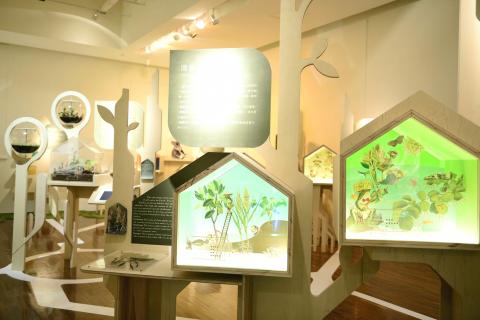
Photo: Courtesy of National Taiwan Museum
The exhibition also presents different capabilities plants have, describing them as incredibly simple yet brilliant tricks and survival strategies designed to help plants combat predators.
The museum’s Web site describes the exhibition as “magic.”
“By using specimens, models and images to demonstrate the magic, this exhibition creates a wonderland of plants for visitors,” the Web site says.
“The magic tricks that plants have are the reason this beautiful world of ours is full of green forests, colorful flowers and fruit. The exhibition is presented in a lively way, with hands-on interactive learning for young people,” Taiwan Society of Plant Systematics chairman Chiu Wen-liang (邱文良) said at the exhibition’s opening last month.
The society and National Taiwan Museum are the exhibition’s main organizers.
Contributions toward the exhibition were made by the Council of Agriculture, the Taiwan Forestry Research Institute, Taipei Zoo, the National Museum of Prehistory, the Taiwan Science Education Center, Fu Jen Catholic University’s Department of Life Sciences and Wellcome Library in London.
“Most people do not notice plants in their daily lives, because plants are fixed in place, they do not move or make sounds. However, to grow, survive and reproduce, plants have what we like to call ‘magic.’ They have an extraordinary design and structure and have a unique relationship with the environment and other life forms,” Chiu said.
Cultural and historical perspectives are highlighted in the museum’s first-floor corridors, where the displays teach the importance of the plant kingdom to people and nations throughout history.
The presentations show how early human civilizations cultivated cereal crops, including rice, wheat, corn, barley and oats. They also tell the story of spices used in different nations and the development of beverages and sugar.
Other highlights include displays of insect-eating plants, a specimen of the world’s largest flower, plants that use a chemical defense system and a variety of flowers that are used to make perfumes.
Museum officials said the exhibition presents more than 60 plant specimens, 15 scientific models and more than 60 pictorial illustrations to detail the many activities and processes of the botanical world.
The museum is open from Tuesday to Sunday from 9:30am to 5pm. Admission is NT$20 for adults and NT$10 for children.

The military has spotted two Chinese warships operating in waters near Penghu County in the Taiwan Strait and sent its own naval and air forces to monitor the vessels, the Ministry of National Defense (MND) said. Beijing sends warships and warplanes into the waters and skies around Taiwan on an almost daily basis, drawing condemnation from Taipei. While the ministry offers daily updates on the locations of Chinese military aircraft, it only rarely gives details of where Chinese warships are operating, generally only when it detects aircraft carriers, as happened last week. A Chinese destroyer and a frigate entered waters to the southwest

A magnitude 6.1 earthquake struck off the coast of Yilan County at 8:39pm tonight, the Central Weather Administration (CWA) said, with no immediate reports of damage or injuries. The epicenter was 38.7km east-northeast of Yilan County Hall at a focal depth of 98.3km, the CWA’s Seismological Center said. The quake’s maximum intensity, which gauges the actual physical effect of a seismic event, was a level 4 on Taiwan’s 7-tier intensity scale, the center said. That intensity level was recorded in Yilan County’s Nanao Township (南澳), Hsinchu County’s Guansi Township (關西), Nantou County’s Hehuanshan (合歡山) and Hualien County’s Yanliao (鹽寮). An intensity of 3 was

Japanese Prime Minister Sanae Takaichi’s comment last year on Tokyo’s potential reaction to a Taiwan-China conflict has forced Beijing to rewrite its invasion plans, a retired Japanese general said. Takaichi told the Diet on Nov. 7 last year that a Chinese naval blockade or military attack on Taiwan could constitute a “survival-threatening situation” for Japan, potentially allowing Tokyo to exercise its right to collective self-defense. Former Japan Ground Self-Defense Force general Kiyofumi Ogawa said in a recent speech that the remark has been interpreted as meaning Japan could intervene in the early stages of a Taiwan Strait conflict, undermining China’s previous assumptions
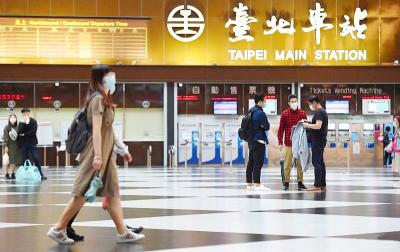
Taiwan Railways Corp (TRC) today announced that Shin Kong Mitsukoshi has been selected as the preferred bidder to operate the Taipei Railway Station shopping mall, replacing the current operator, Breeze Development Co Ltd. Among eight qualified firms that delivered presentations and were evaluated by a review committee, Shin Kong Mitsukoshi was ranked first, while Breeze was named the runner-up, the rail company said in a statement. Contract negotiations are to proceed in accordance with regulations, it said, adding that if negotiations with the top bidder fail, it could invite the second-ranked applicant to enter talks. Breeze in a statement today expressed doubts over


 RSS
RSS