


President Ma Ying-jeou (馬英九) yesterday vowed to uncover the truth behind the killings in the 228 Massacre and defend human rights in an effort to prevent similar tragedies in the future.
“I will continue to pay attention to the 228 Incident and care about the families of the people killed no matter what role I take on. The government’s efforts to protect human rights and act in accordance with the law will not stop. We will not allow similar incidents to happen again,” he said in a speech at a memorial ceremony in Taipei’s 228 Memorial Park.
People and families affected by the 228 Massacre are invited to the annual ceremony in Taipei.
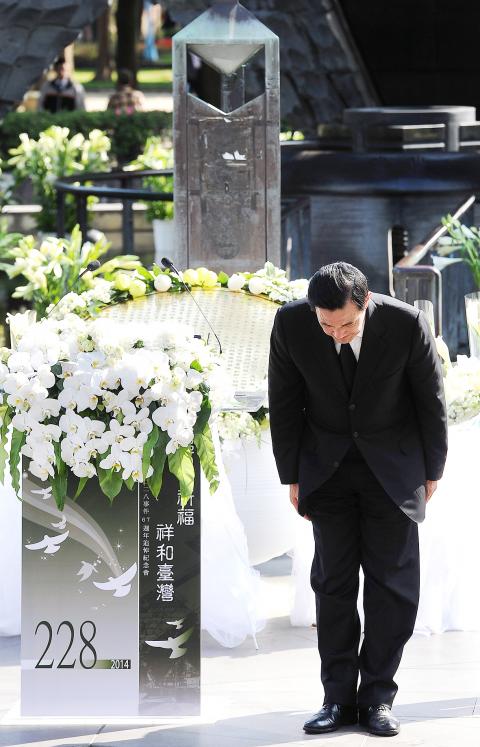
Photo: Liao Chen-huei, Taipei Times
Ma, accompanied by Taipei Mayor Hau Lung-bin (郝龍斌) and government officials, led guests at the ceremony in a moment of silence in honor of the people killed in the 228 Incident.
Ma, who has promoted efforts to bring reconciliation between the Chinese Nationalist Party (KMT) and families affected by the 228 Incident since serving as Taipei mayor, said he has attended memorial events over the past 20 years and that the efforts to offer a proper apology and uncover the truth would continue.
“Historical mistakes can be forgiven, but truths cannot be forgotten. I have asked the KMT’s history center to search for related documents about the incident to help uncover the truth,” he said.
Earlier yesterday, Ma addressed a state ceremony held in Hualien County to mark the event.
Before the ceremony, Ma led government officials to pay tribute as he laid a wreath at the tomb of Chang Chi-lang (張七郎), who was killed in the 228 Incident, and apologized to Chang’s family over his killing.
Having visited Chang’s grave three times to pay his condolences, Ma, who doubles as KMT chairman, said the party accepts responsibility for the death.
Chang was a National Assembly member who was killed by the then-KMT troops in the aftermath of the 228 Incident. His two sons were practicing medicine at a hospital their father founded in Fonglin Township (鳳林), Hualien County. They were also executed by the KMT after being accused of “betraying the party and the country” and “organizing assassinations.”
Chang’s grandson, Chang An-man (張安滿), thanked Ma for his efforts, but expressed frustration over the government’s definition of the 228 Incident as a civil uprising against the government. He said his grandfather did not oppose the government and was killed over groundless accusations.
“The government’s definition is a self-deception. If the government cannot face the truth, it will not find the path to reality,” he said.
Ma said he understood that the suffering and pain of the people killed in the incident and their family members could not be erased, and pledged to reveal the truth.
“We should work harder to uncover the truths behind the 228 Incident, and there should be no taboos or off-limits areas. I will spare no effort to reveal the truth,” he said.
Yesterday marked the 67th anniversary of the 228 Massacre, which refers to a brutal crackdown by the then-KMT regime starting on Feb. 27, 1947, against tens of thousands of Taiwanese, many of them among the intellectual elite. The incident led to nearly four decades of martial law in Taiwan.
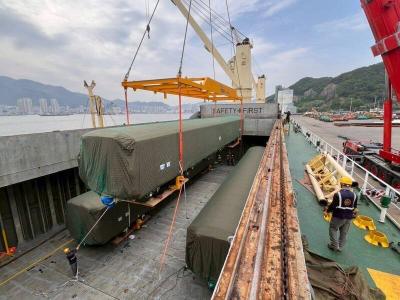
The first of 10 new high-capacity trains purchased from South Korea’s Hyundai Rotem arrived at the Port of Taipei yesterday to meet the demands of an expanding metro network, Taipei Rapid Transit Corp (TRTC) said yesterday. The train completed a three-day, 1,200km voyage from the Port of Masan in South Korea, the company said. Costing NT$590 million (US$18.79 million) each, the new six-carriage trains feature a redesigned interior based on "human-centric" transportation concepts, TRTC said. The design utilizes continuous longitudinal seating to widen the aisles and optimize passenger flow, while also upgrading passenger information displays and driving control systems for a more comfortable
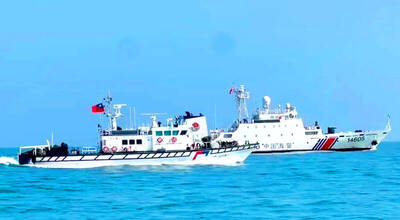
Instead of focusing solely on the threat of a full-scale military invasion, the US and its allies must prepare for a potential Chinese “quarantine” of Taiwan enforced through customs inspections, Stanford University Hoover fellow Eyck Freymann said in a Foreign Affairs article published on Wednesday. China could use various “gray zone” tactics in “reconfiguring the regional and ultimately the global economic order without a war,” said Freymann, who is also a nonresident research fellow at the US Naval War College. China might seize control of Taiwan’s links to the outside world by requiring all flights and ships entering or leaving Taiwan
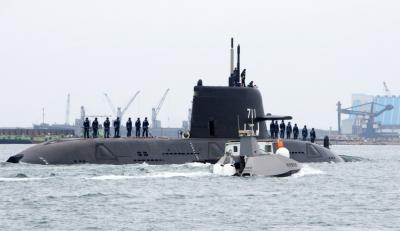
Taiwan's first indigenous defense submarine, the SS-711 Hai Kun (海鯤, or Narwhal), departed for its 13th sea trial at 7am today, marking its seventh submerged test, with delivery to the navy scheduled for July. The outing also marked its first sea deployment since President William Lai (賴清德) boarded the submarine for an inspection on March 19, drawing a crowd of military enthusiasts who gathered to show support. The submarine this morning departed port accompanied by CSBC Corp’s Endeavor Manta (奮進魔鬼魚號) uncrewed surface vessel and a navy M109 assault boat. Amid public interest in key milestones such as torpedo-launching operations and overnight submerged trials,
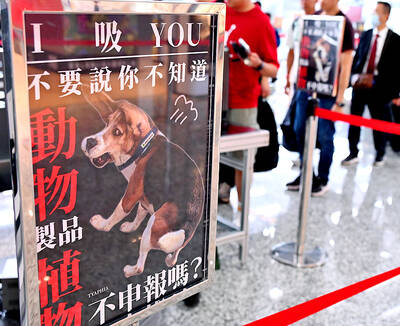
Quarantine awareness posters at Taiwan Taoyuan International Airport have gone viral for their use of wordplay. Issued by the airport branch of the Animal and Plant Health Inspection Agency, the posters feature sniffer dogs making a range of facial expressions, paired with advisory messages built around homophones. “We update the messages for holidays and campaign needs, periodically refreshing materials to attract people’s attention,” quarantine officials said. “The aim is to use the dogs’ appeal to draw focus to quarantine regulations.” A Japanese traveler visiting Taiwan has posted a photo on X of a poster showing a quarantine dog with a


 RSS
RSS