


China should refrain from treating Taiwan in the “brutal” and “unilateral” manner it adopted when announcing the six-point proposal on cross-strait media exchanges, Minister of Culture Lung Ying-tai (龍應台) said yesterday.
The way in which Beijing behaved at the forum on cross-strait exchanges during which the proposal was presented has set a “very negative example” for the conduct of cross-strait relations and “undermined the mutual trust” between the two sides, Lung said.
China should take a lesson from Taiwan’s reaction to the proposal, she added.
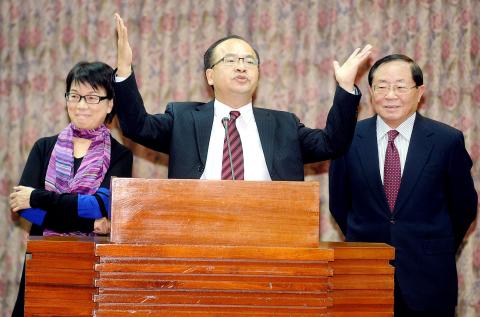
Photo: Chu Pei-hsiung, Taipei Times
Lung made the remarks when asked by Democratic Progressive Party (DPP) Legislator Ho Hsin-chun (何欣純) to comment on the controversial initiative at a meeting of the legislature’s Education and Culture Committee yesterday.
The proposal calls for fostering closer cross-strait ties in the areas of culture and media through measures such as signing a bilateral cultural agreement, having media on both sides make concerted efforts by to promote “Zhonghua culture” (中華文化) and establishing reciprocal media offices on both sides, among others. However, it made no mention of press freedom.
Central News Agency (CNA) chairman Chen Kuo-hsiang (陳國祥) and Public Television Service chairman Shao Yu-ming (邵玉銘) were among the more than 70 Taiwanese and Chinese media officials who attended the forum.
Echoing earlier comments by Mainland Affairs Council Minister Wang Yu-chi (王郁琦), Lung said: “If Beijing is sincere about promoting cross-strait exchanges and building mutual trust, I hope that it will never do this [to Taiwan] again.”
Several DPP lawmakers have said that the presence of CNA and PTS executives at the forum sent the message that the government has endorsed the initiatives, since the two media outlets are state-owned.
Yet Chen and Shao have distanced themselves from the proposal, saying that their presence at the forum did not mean they agreed with the proposal.
Chen was reportedly irritated when DPP Legislator Chiu Chih-wei (邱志偉) asked him why he did not voice any disagreement at the forum.
“Should I have grabbed the microphone while the proposal was being read out and knocked [whoever was reading out the statement] to the ground in protest?” the CNA chairman said.
In response to DPP Legislator Chen Ting-fei’s (陳亭妃) suggestion that Shen should have walked out of the meeting in protest, Shao said that would have been “rude.”
“We are a civilized society and believe that people can have different points of view. Therefore, I didn’t think I needed to walk out of the meeting at that time,” the PTS head said. “I have been to many international conferences. It’s rude to walk out of a meeting just because people say something you don’t agree with.”

SPACE VETERAN: Kjell N. Lindgren, who helps lead NASA’s human spaceflight missions, has been on two expeditions on the ISS and has spent 311 days in space Taiwan-born US astronaut Kjell N. Lindgren is to visit Taiwan to promote technological partnerships through one of the programs organized by the US for its 250th national anniversary. Lindgren would be in Taiwan from Tuesday to Saturday next week as part of the US Bureau of Educational and Cultural Affairs’ US Speaker Program, organized to celebrate the 250th anniversary of the signing of the Declaration of Independence, the American Institute in Taiwan (AIT) said in a statement yesterday. Lindgren plans to engage with key leaders across the nation “to advance cutting-edge technological partnerships and inspire the next generation of scientists and engineers,”

UNREASONABLE SURVEILLANCE: A camera targeted on an road by a neighbor captured a man’s habitual unsignaled turn into home, netting him dozens of tickets The Taichung High Administrative Court has canceled all 45 tickets given to a man for failing to use a turn signal while driving, as it considered long-term surveillance of his privacy more problematic than the traffic violations. The man, surnamed Tseng (曾), lives in Changhua County and was reported 45 times within a month for failing to signal while driving when he turned into the alley where his residence is. The reports were filed by his neighbor, who set up security cameras that constantly monitored not only the alley but also the door and yard of Tseng’s house. The surveillance occurred from July

A Japan Self-Defense Forces vessel entered the Taiwan Strait yesterday, Japanese media reported. After passing through the Taiwan Strait, the Ikazuchi was to proceed to the South China Sea to take part in a joint military exercise with the US and the Philippines, the reports said. Japan Self-Defense Force vessels were first reported to have passed through the strait in September, 2024, with two further transits taking place in February and June last year, the Asahi Shimbun reported. Yesterday’s transit also marked the first time since Japanese Prime Minister Sanae Takaichi took office that a Japanese warship has been sent through the Taiwan

‘SAME OLD TRICK’: Even if Beijing resumes individual travel to Taiwan, it would only benefit Chinese tourism companies, the Economic Democracy Union convener said China’s 10 new “incentives” are “sugar-coated poison,” an official said yesterday, adding that Taiwanese businesses see them clearly for what they are, but that Beijing would inevitably find some local collaborators to try to drums up support. The official, speaking on condition of anonymity, made the remark ahead of a news conference the General Chamber of Commerce is to hold today. The event, titled “Industry Perspectives on China’s Recent Pro-Taiwan Policies,” is expected to include representatives from industry associations — such as those in travel, hotels, food and agriculture — to request the government cooperate with China’s new measures, people familiar with


 RSS
RSS