


The documentary Twelve Days (十 二夜), which depicts the lives of dogs in a public animal shelter — in which dogs are put to death after 12 days if they are not adopted — held its premier in Taipei yesterday, calling on people to think carefully before adopting pets, rather than adopting and then abandoning them.
With no spoken dialogue, the film uses camera angles to show the lives of dogs in the animal shelter from the dogs’ viewpoints, from when they are brought to the shelter until they are taken to be put to death, as well as rarely seen moments from early in the morning before the staff arrive and late at night, after the workers have all gone home.
“Many people have the mistaken idea that sending stray animals that they find on the streets directly to animal shelters is the best thing to do for them, but actually they will have only 12 days to live if no one adopts them,” film director Raye (who goes by a single English name) said.

Photo: Wang Wen-lin, Taipei Times
“More than 70,000 animals, mostly dogs, are put to death at public shelters in Taiwan every year, at an average of about 200 dogs per day,” she said, expressing hopes that the movie can motivate more people to help share the responsibility for taking good care of animals and to reduce the numbers of animals put to death.
A woman who adopted one of the dogs, which features prominently in the documentary — an elderly beagle — said: “Actually, I find it easier to adopt an elderly dog from the animal shelter, because they may have been pets to other people in the past, so the dog I adopted was quite stable and did not behave wildly like puppies do.”
The film’s executive producer, Giddens Ko (柯景騰), better known by his pseudonym Jiubadao (九把刀), said they have decided to donate all the box office earnings, excluding the fee for theaters and tax, to animal welfare groups to help stray animals.
The documentary is to be shown in theaters from Friday.
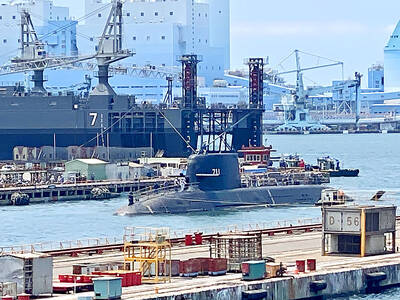
AGING: While Japan has 22 submarines, Taiwan only operates four, two of which were commissioned by the US in 1945 and 1946, and transferred to Taiwan in 1973 Taiwan would need at least 12 submarines to reach modern fleet capabilities, CSBC Corp, Taiwan chairman Chen Cheng-hung (陳政宏) said in an interview broadcast on Friday, citing a US assessment. CSBC is testing the nation’s first indigenous defense submarine, the Hai Kun (海鯤, Narwhal), which is scheduled to be delivered to the navy next month or in July. The Hai Kun has completed torpedo-firing tests and is scheduled to undergo overnight sea trials, Chen said on an SET TV military affairs program. Taiwan would require at least 12 submarines to establish a modern submarine force after assessing the nation’s operational environment and defense

A white king snake that frightened passengers and caused a stir on a Taipei MRT train on Friday evening has been claimed by its owner, who would be fined, Taipei Rapid Transit Corp (TRTC) said yesterday. A person on Threads posted that he thought he was lucky to find an empty row of seats on Friday after boarding a train on the Bannan (Blue) Line, only to spot a white snake with black stripes after sitting down. Startled, he jumped up, he wrote, describing the encounter as “terrifying.” “Taipei’s rat control plan: Release snakes on the metro,” one person wrote in reply, referring
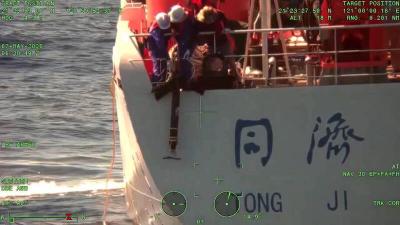
The coast guard today said that it had disrupted "illegal" operations by a Chinese research ship in waters close to the nation and driven it away, part of what Taipei sees a provocative pattern of China's stepped up maritime activities. The coast guard said that it on Thursday last week detected the Chinese ship Tongji (同濟號), which was commissioned only last year, 29 nautical miles (54km) southeast of the southern tip of Taiwan, although just outside restricted waters. The ship was observed lowering ropes into the water, suspected to be the deployment of scientific instruments for "illegal" survey operations, and the coast

An inauguration ceremony was held yesterday for the Danjiang Bridge, the world’s longest single-mast asymmetric cable-stayed bridge, ahead of its official opening to traffic on Tuesday, marking a major milestone after nearly three decades of planning and construction. At the ceremony in New Taipei City attended by President William Lai (賴清德), Premier Cho Jung-tai (卓榮泰), Minister of Transportation and Communications Chen Shih-kai (陳世凱) and New Taipei City Mayor Hou Yu-ih (侯友宜), the bridge was hailed as both an engineering landmark and a long-awaited regional transport link connecting Tamsui (淡水) and Bali (八里)


 RSS
RSS