


The governments of Greater Tainan, Greater Kaohsiung and Pingtung County jointly announced a household ethnic identity registration drive for the thus far unrecognized groups of Pingpu Aborigines.
“The lowland-dwelling Pingpu Aborigines have fought for many years for recognition of their ethnic group identity and to have their ‘Aborigine’ status affirmed. Their demands are justified and long overdue. We hope the central government can deal with this issue in a positive way and respect the authentic history of Pingpu Aborigines in Taiwan,” said Chen Tsung-yen (陳宗彥), head of the Greater Tainan Bureau of Civil Affairs.
This is the first move by a local government to register the ethnicity of Pingpu Aborigines — which include the Siraya, Makatao and Tavorlong people — who were the original inhabitants of southern Taiwan.
A number of current and past ethnolinguistic researchers consider the Makatao and Tavorlong to be sub-family branches of the Siraya, so the focus of the current drive is to register individuals as being Siraya people, one of the 10 Pingpu Aboriginal groups.
Under the direction of then-Tainan county commissioner Su Huan-chih (蘇煥智), local district offices launched the Digitization of Japanese-rule Era Household Registration Transcript program in 2008.
The work was based on detailed examination of all household registration documents in Greater Tainan dating back to the Japanese colonial era and in many instances involved case-by-case investigation, family visits and person-by-person verification.
Results from the digitization program indicated that there are 20,639 people in Greater Tainan who either have a Japanese-era ethnicity classification of “lowland-dwelling Pingpu Aborigine,” or who are descendants of such people. The project identified 14,047 Pingpu people in Greater Kaohsiung and 18,021 in Pingtung County.
Chen said that the basis of ethnic identity — the division between “mountain-dwelling” Aborigines and “lowland-dwelling” Pingpu Aborigines, and of the Hakka and Hoklo ethnic groups — was solidified by thorough household census surveys undertaken during the Japanese era.
After 1947 and the takeover by the Chinese Nationalist Party (KMT), the ethnicity statuses for individuals were upheld for legal use and governmental ethnicity classification.
Each person’s and family’s household registration transcript included a designation for “ethnic group.” The lowland-dwelling Pingpu were recorded as shou (熟, used to denote “civilized” at the time) or ping (平, “lowland-dwelling”) Aborigines, while the mountain-dwelling peoples were recorded as sheng (生, originally signifying “uncivilized”), or kao (高, “mountain-dwelling”) Aborigines.
For Hoklo people, the “ethnic group” classifications were recorded as fu (福, denoting their origin in China’s Fujian Province). The classification for Hakka and Cantonese inhabitants were recorded as yue (粵, a term denoting people from China’s Guangdong Province).
Chen said this was the basis for the electoral systems of “mountain-dwelling Aborigine” and “lowland-dwelling Aborigine” (平地原住民) districts and for electing representatives in the districts.
However, the KMT government now uses the term “lowland-dwelling Aborigines” to refer to any Aborigine who resides in lowland or urban areas and it does not recognize Pingpu Aborigines as an official group.
“Siraya people have the shou ethnicity classification in their household registration records. This shows there is a historical and legal basis for Siraya people to apply for their ethnicity to be recognized. They have the right to have their Aborigine status restored,” Chen said.
He urged the central government to stop ignoring the rights of the Pingpu Aborigines movement and said the government must respect the rights of self-identity and right of ethnic belonging for the Siraya people.
Chen said that Greater Tainan has opened up registration for Siraya people and their descendants in July, while Greater Kaohsiung and Pingtung County started to accept applications last month.
He said that as of Oct. 30, 40 eligible individuals had successfully registered as shou on their personal record of the household registration transcript.
Officials at the Greater Tainan bureau said the act of registration for shou classification as a Pingpu Aborigine is completely voluntary. Officials in the bureau and at all district offices will not force anyone to register if they do not wish to.
The process should be done in person, and for those physically unable to do so, a letter of authorization is needed for a family member or relative to apply for registration, officials said.
Those who are eligible can choose to register based on one of their parents or a direct family member who has the shou Pingpu Aborigine classification on their household registration transcript.

UPGRADE: The Kang Ding-class frigate is replacing its Chaparall missiles with Tien Chien II and Hua Yang VLS, which would provide it with long-range, 360° air defense Taiwan plans to produce 1,200 to 1,376 Hai Chien II missiles (海劍二, Sea Sword II) — also known as TC-2N — to serve as the standard air defense system of the navy’s surface combatant fleet, a source said yesterday. Last week, the Hai Chien II, the naval version of the Tien Kung II missile (天劍二, Sky Sword II), completed a live-fire test in waters off the National Chungshan Institute of Science and Technology’s Jiupeng facility (九鵬) in Pingtung County’s Manjhou Township (滿州). The MIM72 Chaparral and other dated air defense missiles that currently arm Taiwanese ships have inadequate range to combat Chinese

REASONS FOR TRAVEL: An assistant professor said that proposed amendments to penalize drivers if they used drugs overseas would not deter people from traveling People who operate a motor vehicle under the influence of marijuana would have their driver’s license revoked, even if they used the substance while overseas, the Ministry of Transportation and Communications said yesterday, citing proposed amendments to the Road Traffic Management and Penalty Act (道路交通管理處罰條例). The amendments would also authorize the government to revoke the licenses of people determined to have used Category 1 or Category 2 narcotics, even if they were not operating a vehicle while under the influence of drugs, as well as ban them from taking the license test for three years, the ministry said. People aged 18 or

Shih Hsin University President Chen Ching-he (陳清河) yesterday issued a public apology for comments made in his commencement speech last week, stating that he has asked the school to suspend his duties and halt his wages for two months as a show of contrition. At the commencement ceremony on May 30, Chen said, “If you don’t manage your time well, or your own emotions, or your health, then I am telling every one of you — put a quick end to ‘you,’ because the world has no need for ‘you.’” The comments have sparked significant controversy online, and Chen through an open
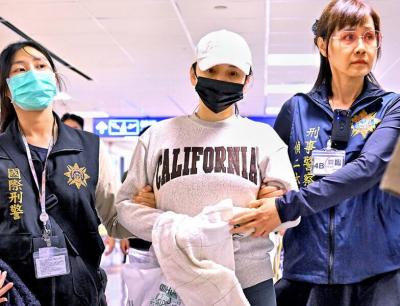
Johanne Liou (劉喬安), a Taiwanese woman who shot to unwanted fame during the Sunflower movement protests in 2014, returned to Taiwan last night after being deported from the US. She is to stand trial in Taiwan for charges involving embezzlement, fraud and drug crimes. The Criminal Investigation Bureau (CIB) said it took her into custody at Taiwan Taoyuan International Airport and would first question her before transferring her to the New Taipei District Prosecutors’ Office. She was arrested upon disembarking a flight from San Francisco that landed shortly before 7pm. Liou absconded to the US in 2019 after jumping bail


 RSS
RSS