


A woolly mammoth and a rhinoceros that are thought to have been frozen in permafrost 39,000 years ago were unboxed in Taipei on Wednesday ahead of an exhibition set to open Nov. 16 to showcase the creatures.
The creatures will be among more than 200 prehistoric animal specimens and objects used by ancient humans that will go on display at the National Chiang Kai-shek Memorial Hall until March 2.
The mammoth, nicknamed “Yuka,” was discovered in the Republic of Sakha in Siberia in 2010 and is considered one of the most well-preserved mammoth specimens to date. It was named “Yuka” because it was discovered in a place called Yukagir.
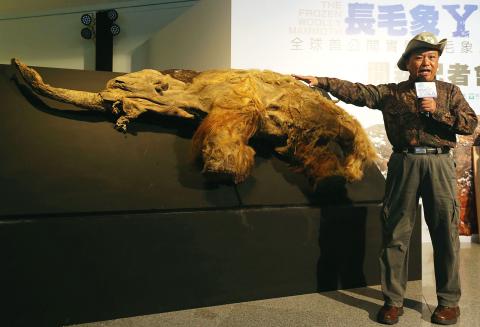
Photo: CNA
The female mammoth, about 3m long and 1.65m tall, is estimated to have died at the age of 10 and its skin, trunk, tail and four legs remain in good condition.
Scientists were also able to obtain liquid blood and muscle tissue from the mammoth and remove a well-preserved brain from its skull for further study.
The woolly rhinoceros, nicknamed “Kolyma,” was discovered in the lower Kolyma River in northeastern Siberia in 2007. The female rhino, 2.9m long and 1.2m tall, is estimated to have died at about the age of 20.
Before arriving in Taiwan, the extinct creatures were exhibited in Japan, where they attracted hundreds of thousands of people.
Yoshihiro Ota, chief executive officer of the Tokyo-based Nature’s Network Co, one of the organizers, said he hopes the exhibition will attract many children in Taiwan, as it did in Japan.
Former Taipei Zoo director Jason Yeh (葉傑生) also urged the public to attend the exhibition to learn more about the creatures that once roamed the Earth.
“Many precious animals are facing the threat of extinction today,” Yeh said, adding that he hopes the exhibition will also encourage people to cherish the Earth and do more to protect the environment.
Among other items that will be displayed are the skeletons of antelopes, bison and saber-tooth cats said to be from the Pleistocene epoch, which lasted from about 2.58 million years ago to 11,700 years ago.

Considering that most countries issue more than five denominations of banknotes, the central bank has decided to redesign all five denominations, the bank said as it prepares for the first major overhaul of the banknotes in more than 24 years. Central bank Governor Yang Chin-lung (楊金龍) is expected to report to the Legislative Yuan today on the bank’s operations and the redesign’s progress. The bank in a report sent to the legislature ahead of today’s meeting said it had commissioned a survey on the public’s preferences. Survey results showed that NT$100 and NT$1,000 banknotes are the most commonly used, while NT$200 and NT$2,000

The Centers for Disease Control (CDC) yesterday reported the first case of a new COVID-19 subvariant — BA.3.2 — in a 10-year-old Singaporean girl who had a fever upon arrival in Taiwan and tested positive for the disease. The girl left Taiwan on March 20 and the case did not have a direct impact on the local community, it said. The WHO added the BA.3.2 strain to its list of Variants Under Monitoring in December last year, but this was the first imported case of the COVID-19 variant in Taiwan, CDC Deputy Director-General Lin Ming-cheng (林明誠) said. The girl arrived in Taiwan on

South Korea is planning to revise its controversial electronic arrival card, a step Taiwanese officials said prompted them to hold off on planned retaliatory measures, a South Korean media report said yesterday. A Yonhap News Agency report said that the South Korean Ministry of Foreign Affairs is planning to remove the “previous departure place” and “next destination” fields from its e-arrival card system. The plan, reached after interagency consultations, is under review and aims to simplify entry procedures and align the electronic form with the paper version, a South Korean ministry official said. The fields — which appeared only on the electronic form

The Ministry of Foreign Affairs (MOFA) is suspending retaliation measures against South Korea that were set to take effect tomorrow, after Seoul said it is updating its e-arrival system, MOFA said today. The measures were to be a new round of retaliation after Taiwan on March 1 changed South Korea's designation on government-issued alien resident certificates held by South Korean nationals to "South Korea” from the "Republic of Korea," the country’s official name. The move came after months of protests to Seoul over its listing of Taiwan as "China (Taiwan)" in dropdown menus on its new online immigration entry system. MOFA last week


 RSS
RSS