


While night markets give people an impression of being crowded and unsanitary, they remain an irresistible drawcard for local and foreign tourists alike, according to the results of a survey released on Wednesday.
The poll, jointly conducted by the Global Views Survey Research Center and the Good Neighbor Foundation, showed that the majority — 51.1 percent — of respondents say night markets are unhygienic, compared with 28.5 percent who think otherwise.
About four out of five respondents have seen littering at night markets, a major hygiene problem that more than 90 percent of those polled say could be addressed by installing more recycling and waste bins.
Despite the negative impressions, the poll found that 24.7 percent of respondents visit a night market once a month, while 13.3 percent go there nearly once a week.
A vast majority — or 88 percent — of respondents say they visit night markets mostly with close acquaintances, the poll showed, with Greater Taichung’s Fongjia (逢甲) Night Market (25.6 percent), Taipei’s Shilin (士林) Night Market (15.4 percent) and Greater Tainan’s Huayuan (花園) Night Market (10.7 percent) the three favorites.
The survey was conducted from July 9 to July 11 through random telephone samplings of 1,080 residents, aged 20 or above.
Meanwhile, night markets appear to be one of the most visited places by foreign tourists, as nearly 77 percent of international tourists last year visited at least one night market during their stay, Tourism Bureau statistics showed.
A Malaysian exchange student at Tunghai University, who identified himself as Lin Tzu-min (林自民), said Fongjia Night Market deserves top position, adding that his favorite snacks are stinky tofu and papaya milk.
In a bid to give night markets nationwide a makeover, the foundation is to join hands with E.Sun Commercial Bank, Chunghwa Telecom Co and several universities to launch a “night markets cleanup campaign” on Sept. 29.
Those interested in signing up for the campaign can visit www.cleanuptheworld.org.tw for more information.

The brilliant blue waters, thick foliage and bucolic atmosphere on this seemingly idyllic archipelago deep in the Pacific Ocean belie the key role it now plays in a titanic geopolitical struggle. Palau is again on the front line as China, and the US and its allies prepare their forces in an intensifying contest for control over the Asia-Pacific region. The democratic nation of just 17,000 people hosts US-controlled airstrips and soon-to-be-completed radar installations that the US military describes as “critical” to monitoring vast swathes of water and airspace. It is also a key piece of the second island chain, a string of
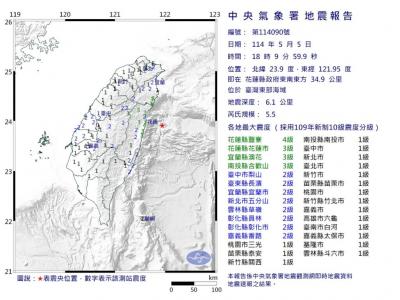
A magnitude 5.9 earthquake that struck about 33km off the coast of Hualien City was the "main shock" in a series of quakes in the area, with aftershocks expected over the next three days, the Central Weather Administration (CWA) said yesterday. Prior to the magnitude 5.9 quake shaking most of Taiwan at 6:53pm yesterday, six other earthquakes stronger than a magnitude of 4, starting with a magnitude 5.5 quake at 6:09pm, occurred in the area. CWA Seismological Center Director Wu Chien-fu (吳健富) confirmed that the quakes were all part of the same series and that the magnitude 5.5 temblor was

Taiwan will now have four additional national holidays after the Legislative Yuan passed an amendment today, which also made Labor Day a national holiday for all sectors. The Chinese Nationalist Party (KMT) and Taiwan People’s Party (TPP) used their majority in the Legislative Yuan to pass the amendment to the Act on Implementing Memorial Days and State Holidays (紀念日及節日實施辦法), which the parties jointly proposed, in its third and final reading today. The legislature passed the bill to amend the act, which is currently enforced administratively, raising it to the legal level. The new legislation recognizes Confucius’ birthday on Sept. 28, the
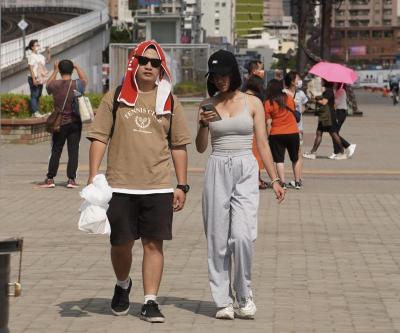
The Central Weather Administration has issued a heat alert for southeastern Taiwan, warning of temperatures as high as 36°C today, while alerting some coastal areas of strong winds later in the day. Kaohsiung’s Neimen District (內門) and Pingtung County’s Neipu Township (內埔) are under an orange heat alert, which warns of temperatures as high as 36°C for three consecutive days, the CWA said, citing southwest winds. The heat would also extend to Tainan’s Nansi (楠西) and Yujing (玉井) districts, as well as Pingtung’s Gaoshu (高樹), Yanpu (鹽埔) and Majia (瑪家) townships, it said, forecasting highs of up to 36°C in those areas


 RSS
RSS