


What is the owner of a king cobra — whose venom is so powerful a drop can theoretically kill up to 30 adult humans — supposed to do when their snake falls ill and has no appetite?
Huang Kuo-nan (黃國男), the manager of the World King Snake Education Plantation in Greater Tainan’s Gueiren District (歸仁), on Monday decided to take a risky approach to solving this problem by force-feeding his king cobra.
Huang said the king cobra, which is the longest venomous snake in the world, has been at the snake center for more than six years.
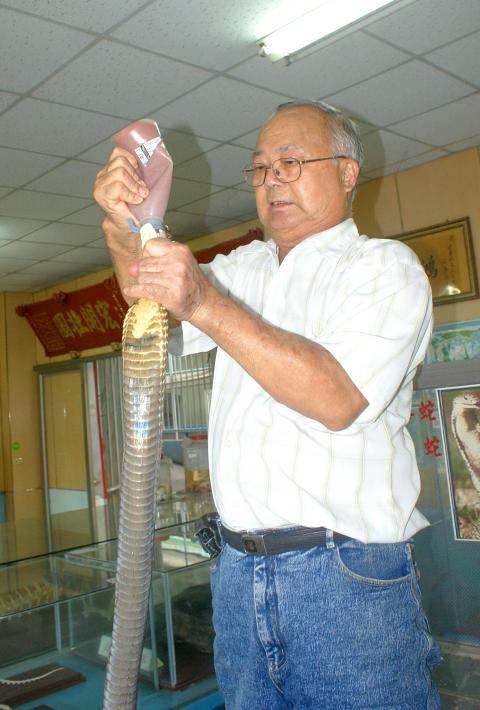
Photo: Wu Chun-feng, Taipei Times
The snake is longer than 3.5m, weighs 6kg and is very aggressive, Huang said, adding that even safely behind the glass in its tank, the cobra often rears up and flares its hood at the sight of people.
Despite making many children cry, Huang said the cobra is the star of the snake farm and draws many visitors.
Huang said that on average, the king cobra eats one oriental ratsnake every 10 days, but it seemed to have caught a cold over the Lunar New Year holiday in February and had become gradually more lazy and less inclined to eat since then.
Three months ago, the snake stopped eating altogether, Huang said, adding that it has lost nearly 1.2kg.
Unable to think of an alternative, Huang said he had to try the highly dangerous option of force-feeding the snake.
With the help of other employees, Haung held the snake down, put it in a chokehold and forced a bottle of raw beef paste with egg yolk down its throat.
Though the process only took three minutes, Huang said they felt like the longest minutes of his life.
“We’ve had it in captivity for a long time, but king cobras are not known for their kind hearts,” he said.
The snake was moved to another cage for observation, but while the workers all heaved sighs of relief after safely completing their dangerous task, Huang said that if the cobra does not regain its appetite, another force-feeding may have to be carried out soon.

NATIONAL SECURITY: Authorities are working to confirm the identities of the military personnel involved and investigating possible illegal conduct and regulatory violations Authorities are probing possible national security implications after Kinmen police and immigration officers on Sunday found a Chinese woman allegedly posing as a tourist while engaging in prostitution involving more than 10 military personnel. The woman, surnamed Chen (陳), has since been deported, authorities said, adding that investigators are still working to confirm the identities of those implicated, as the records only listed code names and aliases. The case stemmed from a report received by the Kinmen District Prosecutors’ Office on Friday last week from the Jinhu Precinct of the Kinmen County Police Bureau. On Sunday, police, along with the National Immigration

GLOBALGIVING: ‘ Caving to external pressure is not acceptable for an organization that has cultivated justice reform and human rights for 30 years,’ one NGO said A slew of non-government organizations (NGOs) have withdrawn from the GlobalGiving fundraising platform after it announced it would use “Chinese Taipei” instead of “Taiwan” from next month. The Taiwan Good Rice Association wrote on Facebook on Friday that it was informed on April 28 via a teleconference call of the change, which was made because the platform wanted to operate in China. Taiwan Good Rice is to terminate all cooperative relationships with GlobalGiving in response to the platform’s “unilateral and non-negotiable” decision to remove references to Taiwan, the NGO said. “Taiwan is in the official name of Taiwan Good Rice Association and the

HEAVY WEATHER: Typhoon Jangmi is due to crash straight into the Ryukyus as airlines look to shift flights to larger aircraft or cancel flights to Okinawa entirely Taiwan’s international air carriers announced flight adjustments over the weekend as Typhoon Jangmi is forecast to hit the Ryukyu Islands today and tomorrow. The Central Weather Administration (CWA) upgraded Jangmi from a tropical storm to a typhoon at 8am yesterday, with the eye located 580km south of Naha city. It was moving north at 19kph. Today, China Airlines’ CI-120, CI-121, CI-122 and CI-123 flights between Taoyuan and Naha, Okinawa, have been canceled as well as CI-132 and CI-133 between Kaohsiung and Naha. EVA Air’s BR-112, BR-113, BR-186 and BR-185 flights between Taoyuan and Naha are also canceled. Low-cost carrier Tigerair Taiwan canceled IT-230,

Chinese Nationalist Party (KMT) Chairwoman Cheng Li-wun (鄭麗文) yesterday briefed her party’s Central Standing Committee regarding her scheduled visit to the US between Monday next week and June 16, saying that her purpose would be to persuade the US that the Republic of China (ROC) Constitution was a “one China” constitution that would foster stable and peaceful cross-strait relations. The ROC Constitution is the most important defense for all Taiwanese citizens, as it upholds our democracy and has contributed to our robust economy, which aligns with international and US interests, she said. “We would not be troublemakers and drag the US under,”


 RSS
RSS