


A study conducted by National Chung Hsing University has revealed how jumping spiders use a silk dragline to stabilize themselves in mid-air and control their landings.
Slow-motion footage revealed the spiders use their silk draglines to stabilize their bodies and to brake, enabling them to land poised and ready to pounce on prey.
Scientists say that the discovery could inspire new robot design.
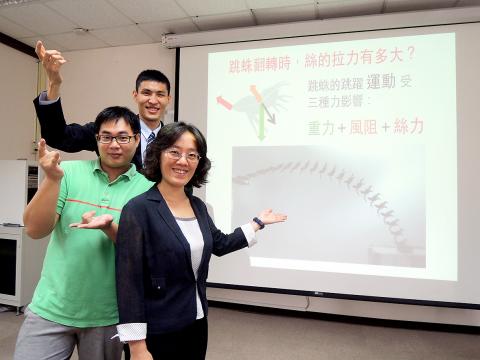
Photo: Tsai Shu-yuan, Taipei Times
The findings appeared on the Journal of the Royal Society Interface Web site on Aug. 7 and were also reported on by the BBC and Science News.
Interface is a peer-reviewed online scientific journal that started publication in 2004, and includes reviews, research articles and short reports from the interface between physical sciences and life sciences.
The study, conducted by physics professor Chi Kai-jung (紀凱容), used high-speed cameras — 1,000 frames per second — to shoot more than 10,000 photographs of the Adanson’s house jumper, Hasarius adansoni, a species of jumping spider.
Chi said academics had concluded that macrovertebrates, such as humans, kangaroos or lizards, maintained balance by using inertia from swinging limbs or tails, while other creatures utilized aerodynmaic forces by flapping wings.
“My study may have provided a third possibility of how life in nature keeps balance,” Chi said, pointing to how the Adanson’s house jumper is able to maintain balance — even after flipping in the air — by using one strand of silk.
Chi said the key lay in the fact that the spider places a silk dragline on the ground before it jumps, and continues to pump out the silk while still in the air, adding that the spider was able to change direction in the air through tightening or loosening an internal organ, which Chi describes in the article as a type of friction brake.
The study discovered that the spider, 6mm in length, was able to jump 80mm horizontally in 1.5 seconds and was able to quickly regain its footing or change direction if it used a silk dragline. Non-silk jumping spiders without the draglines would land badly more often and take five times as long to steady themselves.
Chi said that the study integrated research into the kinesiology of spiders and the mechanics of spider silk, adding that the results may be applied to rock climbing equipment as well and robots.

Left-Handed Girl (左撇子女孩), a film by Taiwanese director Tsou Shih-ching (鄒時擎) and cowritten by Oscar-winning director Sean Baker, won the Gan Foundation Award for Distribution at the Cannes Critics’ Week on Wednesday. The award, which includes a 20,000 euro (US$22,656) prize, is intended to support the French release of a first or second feature film by a new director. According to Critics’ Week, the prize would go to the film’s French distributor, Le Pacte. "A melodrama full of twists and turns, Left-Handed Girl retraces the daily life of a single mother and her two daughters in Taipei, combining the irresistible charm of

A Philippine official has denied allegations of mistreatment of crew members during Philippine authorities’ boarding of a Taiwanese fishing vessel on Monday. Philippine Bureau of Fisheries and Aquatic Resources (BFAR) spokesman Nazario Briguera on Friday said that BFAR law enforcement officers “observed the proper boarding protocols” when they boarded the Taiwanese vessel Sheng Yu Feng (昇漁豐號) and towed it to Basco Port in the Philippines. Briguera’s comments came a day after the Taiwanese captain of the Sheng Yu Feng, Chen Tsung-tun (陳宗頓), held a news conference in Pingtung County and accused the Philippine authorities of mistreatment during the boarding of

88.2 PERCENT INCREASE: The variants driving the current outbreak are not causing more severe symptoms, but are ‘more contagious’ than previous variants, an expert said Number of COVID-19 cases in the nation is surging, with the Centers for Disease Control (CDC) describing the ongoing wave of infections as “rapid and intense,” and projecting that the outbreak would continue through the end of July. A total of 19,097 outpatient and emergency visits related to COVID-19 were reported from May 11 to Saturday last week, an 88.2 percent increase from the previous week’s 10,149 visits, CDC data showed. The nearly 90 percent surge in case numbers also marks the sixth consecutive weekly increase, although the total remains below the 23,778 recorded during the same period last year,

The Chinese Communist Party (CCP) is pushing for residents of Kinmen and Lienchiang counties to acquire Chinese ID cards in a bid to “blur national identities,” a source said. The efforts are part of China’s promotion of a “Kinmen-Xiamen twin-city living sphere, including a cross-strait integration pilot zone in China’s Fujian Province,” the source said. “The CCP is already treating residents of these outlying islands as Chinese citizens. It has also intensified its ‘united front’ efforts and infiltration of those islands,” the source said. “There is increasing evidence of espionage in Kinmen, particularly of Taiwanese military personnel being recruited by the


 RSS
RSS